The Samsung 9100 PRO SSD is our top choice for the Best 2TB NVMe SSD, offering industry-leading PCIe 5.0 speeds that significantly reduce load times for demanding AI applications and high-end gaming. For those prioritizing established Gen4 reliability for heavy-duty workstations, the Samsung 990 PRO SSD serves as a robust alternative, while the Crucial P310 SSD provides a versatile and efficient option for portable gaming consoles and laptops.
Selecting a high-capacity drive requires balancing raw sequential throughput with sustained random read and write performance. While newer PCIe 5.0 drives push the boundaries of data transfer, many users find that high-performance Gen4 drives offer a more thermally manageable and cost-effective solution for everyday professional workflows.
When evaluating these drives, consider your system's interface compatibility and thermal management capabilities. High-speed NVMe storage generates significant heat during sustained operations, making it essential to ensure your motherboard or laptop has adequate cooling to maintain peak performance without throttling.
If you are exploring broader storage options, our guide to the Best 2TB Internal SSD provides additional context on choosing the right drive for your specific motherboard configuration. For a wider look at storage performance, you can also review our Best 2TB SSD analysis to see how different form factors compare.
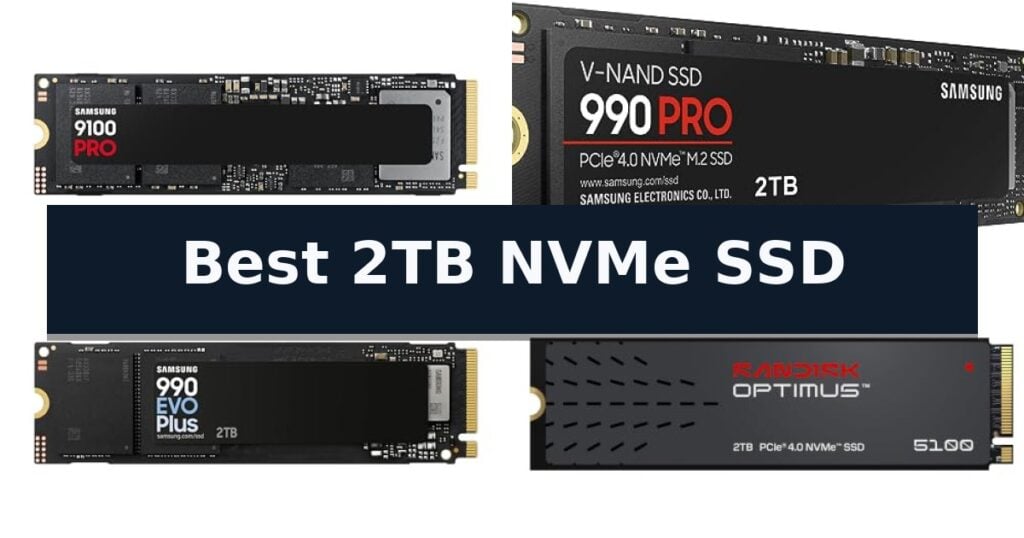
10 Best 2TB NVMe SSD in 2026 Reviews
Quick Comparison
| Product | Best For | Key Strength | Score |
|---|---|---|---|
| Samsung 9100 PRO SSD | Best Overall | PCIe 5.0 performance reaching up to 14,700 MB/s. | 4.9 |
| Samsung 990 PRO SSD | Elite performance for workstations | High-speed performance reaching up to 7,450 MB/s read speeds. | 4.3 |
| Samsung 990 EVO Plus SSD | Efficient Gen 4 upgrade | High-speed sequential performance reaching up to 7,250 MB/s read speeds. | 4.3 |
| SanDisk Optimus 5100 SSD | Reliable creator-focused storage | High-speed PCIe 4.0 performance for rapid application loading. | 4.3 |
| WD_Black SN7100 SSD | High-octane handheld gaming | High-octane performance with read speeds up to 7,250 MB/s. | 4.5 |
| Crucial P310 SSD | Versatile for portable consoles | High-speed PCIe 4.0 performance reaching up to 7,100 MB/s. | 4.4 |
| Crucial E100 SSD | Fast desktop and laptop upgrade | High-speed Gen4 performance reaching up to 5,000MB/s. | 4.5 |
| Kingston NV3 SSD | Balanced speed and power | High-speed Gen 4×4 performance with read speeds up to 6,000MB/s. | 4.5 |
| Western Digital Green SN350 SSD | Budget-friendly daily computing | Fast NVMe performance with transfer speeds up to 3,200MB/s. | 4.5 |
| Silicon Power P34A60 SSD | Affordable legacy system boost | High endurance rating with 1200 TBW. | 4.3 |
How We Chose
To identify the best 2TB NVMe SSD, we evaluate drives based on their real-world utility in high-performance computing environments. We prioritize consistent data throughput, thermal efficiency, and interface versatility, ensuring that each recommendation provides reliable storage for demanding tasks ranging from professional video editing to modern gaming.
- Sequential read and write throughput capabilities
- Random IOPS performance for multitasking and application responsiveness
- Thermal management and power efficiency under sustained load
- Interface compatibility with PCIe 4.0 and 5.0 standards
- Manufacturer-backed endurance and software support
1 Samsung 9100 PRO SSD — Blazing PCIe 5.0 speeds
The Samsung 9100 PRO SSD introduces a significant leap in storage technology by leveraging the PCIe 5.0 interface, enabling sequential read and write speeds of up to 14,700/13,400 MB/s. This drive is engineered to handle intensive data demands, making it a viable component for high-performance workstations, AI-driven applications, and modern gaming systems.
Beyond raw speed, the drive utilizes a 5nm controller designed to enhance power efficiency by up to 49% compared to previous generations. This architectural choice, paired with advanced thermal management, aims to maintain consistent performance levels during sustained heavy workloads. The unit is built in a standard M.2 2280 form factor, ensuring broad compatibility across desktop PCs, laptops, and consoles that support Gen5 storage.
For users managing large digital libraries, the Samsung 9100 PRO SSD supports capacities up to 8TB, providing substantial room for high-resolution media and game files. The integration with Samsung Magician Software allows for routine firmware updates, drive health monitoring, and additional encryption options, ensuring the hardware remains optimized throughout its lifecycle.
As a product from a brand that produces its own DRAM and NAND components in-house, this drive emphasizes vertical integration in its manufacturing process. The combination of high-speed throughput and thermal efficiency makes it a specialized choice for users requiring reliable, high-bandwidth storage solutions for demanding digital environments.
Best for: Users requiring extreme sequential read/write speeds for AI development, professional video editing, and high-end gaming workstations.
Skip if: Users with systems limited to PCIe 4.0 or 3.0 slots, as the drive's full performance potential requires a PCIe 5.0 compatible interface.
- PCIe 5.0 performance reaching up to 14,700 MB/s.
- 5nm controller for improved power efficiency.
- In-house production of DRAM and NAND components.
- Comprehensive drive management via Samsung Magician Software.
- Requires PCIe 5.0 compatibility to achieve advertised maximum speeds.
- High-performance thermal output necessitates adequate cooling solutions.
2 Samsung 990 PRO SSD — Elite performance for workstations
When your workflow demands rapid data access and high-performance bandwidth, the Samsung 990 PRO 2TB serves as a specialized solution designed for heavy-duty computing and high-end workstations. This NVMe internal solid state drive utilizes PCIe 4.0 technology to deliver substantial improvements in random performance, positioning it as a high-efficiency component for demanding tasks like video editing and complex data analysis.
Engineered for speed, the drive reaches read and write speeds up to 7,450 MB/s and 6,900 MB/s respectively. Beyond raw throughput, the architecture focuses on power efficiency, offering up to 50% improved performance per watt compared to its predecessor, the 980 PRO. This design choice allows for sustained high-intensity use while managing power consumption effectively.
The 2TB capacity provides significant space for large file libraries and extensive gaming installations. Its M.2 2280 form factor ensures compatibility with standard high-end computing slots, while the 5-year manufacturer warranty reflects the build intent for long-term reliability in professional environments.
Whether you are managing massive datasets or running resource-heavy applications, this drive prioritizes consistent performance. By balancing high-speed data transfer with refined power management, it provides a stable foundation for users who require consistent, high-bandwidth storage without compromising on efficiency.
Best for: High-end computing, professional video editing, and heavy-duty workstation tasks requiring rapid data throughput.
Skip if: Users with systems limited to PCIe 3.0 or those who do not require the high-bandwidth capabilities of a Gen4 NVMe drive.
- High-speed performance reaching up to 7,450 MB/s read speeds.
- Improved power efficiency with up to 50% better performance per watt.
- Significant random performance gains for heavy computing tasks.
- 5-year manufacturer warranty included.
- Requires PCIe 4.0 support to achieve advertised maximum speeds.
3 Samsung 990 EVO Plus SSD — Efficient Gen 4 upgrade
Upgrading your storage capacity to 2TB requires a drive that balances speed with thermal efficiency, and the Samsung SSD 990 EVO Plus 2TB is engineered to address these demands. By utilizing the latest NAND memory, this drive achieves sequential read and write speeds of up to 7,250 MB/s and 6,300 MB/s, respectively, making it a high-performance solution for handling massive file transfers.
The drive is designed for versatility, supporting both PCIe 4.0 x4 and PCIe 5.0 x2 interfaces. This compatibility ensures that users can leverage higher bandwidth for improved data processing. To maintain consistent performance during intensive tasks, the Samsung SSD 990 EVO Plus 2TB incorporates a nickel-coated controller that enhances thermal management, allowing the drive to operate efficiently while consuming less power.
Integration with the Samsung Magician Software provides users with essential tools for drive maintenance. This software facilitates firmware updates, enables extra encryption, and offers continual monitoring of drive health, ensuring the hardware remains reliable over its lifespan. The inclusion of Intelligent TurboWrite 2.0 technology further optimizes performance for large-file operations.
With a slim M.2 2280 form factor, this drive is suitable for a wide range of PC and laptop upgrades. The combination of advanced thermal control and high-speed throughput makes it a practical choice for users seeking to improve system responsiveness and storage capacity without compromising on power efficiency.
Best for: Users looking to upgrade their PC or laptop storage with a high-speed, power-efficient drive that supports both PCIe 4.0 and 5.0 interfaces.
Skip if: Users who require a dedicated heatsink for extreme thermal environments or those whose systems do not support the M.2 2280 form factor.
- High-speed sequential performance reaching up to 7,250 MB/s read speeds.
- Dual-interface compatibility supporting both PCIe 4.0 x4 and PCIe 5.0 x2.
- Nickel-coated controller for improved thermal management and power efficiency.
- Comprehensive drive management via the Samsung Magician Software.
- No integrated heatsink included in the base design for high-heat scenarios.
4 SanDisk Optimus 5100 SSD — Reliable creator-focused storage
The SanDisk Optimus 5100 2TB NVMe SSD is engineered for high-demand creative workflows, utilizing PCIe 4.0 architecture to achieve read speeds up to 7,100MB/s and write speeds reaching 6,700MB/s. This drive is built to accelerate the launch of resource-heavy creator applications, ensuring that large files and complex projects remain responsive during intensive use.
Designed with the M.2 2280 form factor, this SSD incorporates 8th generation SANDISK BiCS QLC 3D CBA NAND to balance high-capacity storage with efficient performance. The drive features an all-new power-efficient design, which helps maintain high performance while minimizing power consumption, a practical benefit for those working on portable systems.
Reliability is a core focus for this model, which offers an endurance rating of up to 1,200 TBW for the 4TB capacity, ensuring consistent performance for professional content creation. Users can manage the drive's health and maintain optimal operation through the downloadable SANDISK Dashboard application, which provides performance monitoring and firmware update capabilities.
The SanDisk Optimus 5100 2TB NVMe SSD represents a specialized solution for users who require high-speed data access for media-rich projects. Backed by a 5-year limited warranty, it provides a stable storage foundation for high-resolution images and 4K video editing workflows.
Best for: Content creators and professionals who require high-speed, high-capacity storage for 4K video editing and large-scale media projects.
Skip if: Users with older motherboards that do not support PCIe 4.0 technology will not be able to utilize the drive's maximum rated speeds.
- High-speed PCIe 4.0 performance for rapid application loading.
- Power-efficient design suitable for mobile computing environments.
- 5-year limited warranty providing long-term peace of mind.
- SANDISK Dashboard software for easy performance monitoring.
- QLC NAND technology may not match the sustained write endurance of TLC-based drives in extreme enterprise-level workloads.
5 WD_Black SN7100 SSD — High-octane handheld gaming
Optimizing storage for high-performance gaming requires hardware that balances raw throughput with modern efficiency. The WD_Black SN7100 2TB NVMe SSD is engineered to meet these demands, offering a PCIe Gen4 interface and next-generation TLC 3D NAND to support intensive data workloads. This drive is specifically built to enhance responsiveness in laptops and handheld gaming devices, where space and power management are critical.
Performance metrics for this 2TB model reach up to 7,250 MB/s read and 6,900 MB/s write speeds. These figures represent a significant jump in throughput, providing up to 35% faster performance compared to previous generations. Beyond raw speed, the drive emphasizes power efficiency, delivering up to 100% improvement over its predecessor to help extend battery life during extended gaming sessions.
Usability is supported by the WD_BLACK Dashboard software, which allows users to monitor drive health and optimize performance settings on Windows systems. The drive features a standard M.2 2280 form factor, ensuring compatibility with a wide range of modern computing hardware. With a 3-year limited manufacture warranty, it provides a reliable foundation for users looking to upgrade their storage capacity without sacrificing speed.
While this drive is a strong contender for high-octane gaming, users should note that the dashboard optimization software is exclusive to Windows environments. As a high-performance Gen4 component, it is best utilized in systems that can fully leverage its high-speed interface to minimize load times and improve system responsiveness.
Best for: Serious gamers using laptops or handheld devices who require high-speed storage and improved power efficiency.
Skip if: Users who require cross-platform optimization software or those using older systems without PCIe Gen4 support.
- High-octane performance with read speeds up to 7,250 MB/s.
- Improved power efficiency designed for mobile and handheld devices.
- Next-gen TLC 3D NAND for reliable, high-speed data handling.
- WD_BLACK Dashboard for performance monitoring and optimization.
- Windows-only software compatibility for the WD_BLACK Dashboard.
- Gen4 interface may be underutilized in older systems lacking PCIe Gen4 support.
6 Crucial P310 SSD — Versatile for portable consoles
Upgrading your storage capacity to a 2TB NVMe SSD provides a significant boost for modern computing, particularly when handling large game libraries or intensive media files. The Crucial P310 2TB SSD leverages PCIe 4.0 performance to achieve read speeds of up to 7,100 MB/s, effectively reducing wait times for system bootups and application launches.
Designed for versatility, this drive is compatible with a wide range of hardware, including desktop PCs, laptops, and specialized handheld gaming consoles like the ROG Ally X and Lenovo Legion Go. Its backward compatibility with PCIe Gen3 systems ensures that users can integrate this storage into older machines without sacrificing functionality, making it a flexible choice for various hardware configurations.
The drive utilizes advanced G8 NAND and integrated thermal control to maintain consistent operation under load. Beyond raw speed, it offers practical productivity gains, performing up to 2x faster than previous Gen3 models when executing tasks in software like Adobe Photoshop or Microsoft Excel. Each unit also includes Acronis Data Recovery Software to assist with file management and protection.
Measuring just 3.15 inches in length, the Crucial P310 2TB SSD fits easily into compact M.2 2280 slots. With a 5-year limited warranty, it provides a reliable path for users looking to expand their storage while benefiting from the efficiency of current-generation Gen4 technology.
Best for: Users seeking a high-capacity, versatile storage upgrade for gaming consoles, laptops, and desktops that supports both PCIe Gen4 and Gen3 interfaces.
Skip if: Users requiring specialized high-end workstation drives with dedicated DRAM caches for extreme, sustained write-heavy professional workloads.
- High-speed PCIe 4.0 performance reaching up to 7,100 MB/s.
- Broad compatibility with handheld consoles, laptops, and desktops.
- Backward compatible with PCIe Gen3 systems for flexible upgrades.
- Includes Acronis Data Recovery Software for added utility.
- Lacks a dedicated DRAM cache, relying on host-managed performance.
7 Crucial E100 SSD — Fast desktop and laptop upgrade
Upgrading your storage capacity to 2TB while significantly reducing load times is the primary advantage of the Crucial E100 2TB M.2 NVMe PCIe Gen4 Internal SSD. By leveraging Gen4 performance, this drive achieves speeds up to 5,000MB/s, offering a substantial leap in data transfer efficiency compared to traditional SATA-based storage or mechanical hard disk drives.
Designed for both laptop and desktop environments, the Crucial E100 2TB M.2 NVMe PCIe Gen4 Internal SSD provides a streamlined path to increased system responsiveness. The drive is built to be more durable and dependable than legacy hard drives, operating with less noise and heat, which contributes to a more stable computing environment.
Installation is simplified through the inclusion of step-by-step instructions, which also cover the cloning process to help users migrate their existing data without complex configuration. With a compact M.2 form factor, it integrates into modern systems while providing the high-capacity headroom needed for extensive photo and video libraries.
While this drive offers significant performance gains, users should verify that their motherboard or laptop supports the PCIe Gen4 interface to fully utilize the 5,000MB/s throughput. It is backed by a 3-year limited warranty, providing a standard level of support for your storage upgrade.
Best for: Users looking to upgrade their laptop or desktop storage to a high-capacity 2TB drive with faster Gen4 data transfer speeds.
Skip if: Users whose hardware is limited to older PCIe Gen3 or SATA interfaces, as they will not be able to achieve the maximum advertised 5,000MB/s speeds.
- High-speed Gen4 performance reaching up to 5,000MB/s.
- 2TB capacity suitable for large media collections.
- Simplified installation and data cloning process.
- Improved durability and quieter operation compared to HDDs.
- Interface dependency requires PCIe Gen4 compatibility for peak performance.
8 Kingston NV3 SSD — Balanced speed and power
Upgrading your storage capacity to a 2TB drive provides a significant boost for large media libraries and modern software installations. The Kingston NV3 2TB M.2 2280 NVMe SSD is engineered to handle these high-demand tasks by leveraging Gen 4×4 NVMe PCIe performance, which facilitates rapid data movement and system responsiveness.
This drive is built for efficiency, offering up to 6,000MB/s read and 5,000MB/s write speeds. These specifications make it a capable choice for users who require consistent throughput for file transfers or loading intensive applications. Its design focuses on high-speed, low-power operation, ensuring that it remains a practical component for various computing environments.
Beyond raw speed, the drive includes Acronis cloning software, which simplifies the process of migrating your existing operating system or data to the new storage. This utility is a helpful addition for users looking to upgrade their primary drive without the complexity of a manual system reinstall.
Durability and peace of mind are addressed through a 5-year limited warranty, reflecting the manufacturer's commitment to the longevity of the hardware. With its compact M.2 2280 form factor, the Kingston NV3 SSD integrates easily into most modern desktop and laptop motherboards that support PCIe 4.0, providing a streamlined path to expanded storage.
Best for: Users seeking a balance of high-speed PCIe 4.0 performance and reliable storage capacity for modern computing tasks.
Skip if: Users with older systems lacking PCIe 4.0 support or those requiring specialized enterprise-grade endurance features.
- High-speed Gen 4×4 performance with read speeds up to 6,000MB/s.
- Includes Acronis cloning software for easier data migration.
- 5-year limited warranty for long-term support.
- Low-power storage design suitable for various system builds.
- Performance limited to the capabilities of the host system's PCIe interface.
9 Western Digital Green SN350 SSD — Budget-friendly daily computing
The Western Digital 2TB WD Green SN350 NVMe Internal SSD leverages a slim M.2 2280 form factor, making it a straightforward upgrade for computers equipped with a compatible NVMe slot. This drive is engineered for daily computing tasks, offering data transfer rates up to 3,200MB/s to help improve system responsiveness.
Beyond its speed, this SSD is built with shock-resistance to protect data against accidental bumps and drops, a practical consideration for internal components. The drive utilizes QLC technology and includes access to the downloadable Western Digital SSD Dashboard, a utility designed to monitor drive health and usage patterns over time.
Installation is simplified by the compact design, which occupies minimal space within a chassis. To provide peace of mind, the product is backed by a 3-year limited warranty, ensuring support for the hardware throughout its intended service life in standard personal computing environments.
While this drive excels in general-purpose workloads, users should verify their system's compatibility with the Gen3 PCIe interface to ensure optimal performance. It serves as a reliable storage solution for those seeking to balance capacity and efficiency for everyday digital tasks.
Best for: Users looking to upgrade their personal computer storage with a reliable, high-capacity drive for daily computing tasks.
Skip if: Users requiring specialized high-end performance for professional video editing or intensive enterprise-grade workloads.
- Fast NVMe performance with transfer speeds up to 3,200MB/s.
- Shock-resistant design for improved durability against physical impacts.
- Compact M.2 2280 form factor fits easily into most modern NVMe-ready computers.
- Western Digital SSD Dashboard provides easy monitoring of drive health.
- Gen3 PCIe interface may limit maximum potential speeds compared to newer Gen4 or Gen5 standards.
- QLC technology is optimized for daily use rather than heavy, sustained write-intensive workloads.
10 Silicon Power P34A60 SSD — Affordable legacy system boost
Upgrading an older machine with a high-capacity drive is a practical way to extend its service life, and the Silicon Power 2TB NVMe M.2 PCIe Gen3x4 2280 SSD Solid State Drive (SP002TBP34A60M28) is built specifically for this purpose. This drive utilizes a PCIe Gen 3×4 interface, providing a reliable storage solution for users looking to move away from slower mechanical hard drives or smaller capacity flash storage.
Performance-wise, the Silicon Power P34A60 SSD is rated for read speeds up to 2,200MB/s and write speeds up to 1,600MB/s. These specifications offer a significant throughput improvement over legacy SATA-based drives, making it a suitable candidate for general computing tasks, file management, and system responsiveness.
Durability is a key consideration for high-capacity storage, and this model features a TBW (Total Bytes Written) rating of 1200, indicating its endurance for sustained write operations. The manufacturer backs this with a 5-year limited warranty, though it is important to note that the warranty terms are determined by whichever threshold—time or TBW limit—is reached first.
Before installation, verify your system's hardware configuration. The drive requires an M.2 connector with an M key. Because this specific model does not feature a B notch, it is physically incompatible with B-keyed slots. If you encounter issues with drive recognition or formatting, the manufacturer provides dedicated U.S.-based technical support to assist with troubleshooting common setup errors.
Best for: Users looking to upgrade legacy systems with a high-capacity, reliable PCIe Gen 3×4 storage solution.
Skip if: Users requiring high-speed PCIe Gen 4 or Gen 5 performance for intensive professional workloads or systems lacking an M-keyed M.2 slot.
- High endurance rating with 1200 TBW.
- 5-year limited warranty for long-term support.
- Significant speed upgrade over traditional mechanical drives.
- Dedicated U.S. technical support for troubleshooting.
- Specific M-key requirement limits compatibility with older B-keyed M.2 slots.
- PCIe Gen 3 interface is slower than modern Gen 4 or Gen 5 standards.
Best 2TB NVMe SSD Buying Guide
Interface Generations and Compatibility
Understanding the difference between PCIe 4.0 and 5.0 is critical for modern storage upgrades. While PCIe 5.0 drives offer significantly higher theoretical speeds, they require compatible hardware to reach their full potential and often demand more robust cooling solutions.
Most users will find that PCIe 4.0 remains the sweet spot for performance and compatibility. Before purchasing, verify whether your motherboard or laptop supports the specific PCIe generation to avoid limiting your drive's performance.
Thermal Management Requirements
High-performance NVMe SSDs generate heat during intensive data transfers, which can lead to thermal throttling if not properly managed. Drives with advanced controllers and efficient power management are less likely to slow down during long tasks.
If your system lacks an integrated M.2 heatsink, consider purchasing a drive that includes one or ensuring your chassis has sufficient airflow. Proper cooling is essential for maintaining the longevity and consistent speed of your storage.
Random Performance vs. Sequential Speed
While marketing often highlights sequential read and write speeds, random IOPS (Input/Output Operations Per Second) are frequently more important for day-to-day responsiveness. High random performance ensures that operating systems and applications load quickly.
For tasks like gaming and software development, a drive with high random performance will often feel faster than one that only excels in large file transfers. Look for drives that balance both metrics for a well-rounded experience.
Endurance and Reliability
Total Bytes Written (TBW) is a key metric for understanding how much data a drive can handle over its lifespan. For professional creators or users who frequently move massive files, a higher endurance rating provides long-term peace of mind.
Reliability also extends to the manufacturer's software suite, which allows for health monitoring and firmware updates. Keeping your drive's firmware current is one of the simplest ways to ensure continued stability and performance.
Capacity and Future-Proofing
A 2TB capacity is currently considered the standard for high-end gaming and creative work, offering enough space for large libraries without immediate storage anxiety. Choosing a drive that supports the latest standards ensures your investment remains relevant as software requirements grow.
Consider your future needs, as upgrading storage later can be disruptive. Investing in a high-quality 2TB drive now can prevent the need for additional drives or complex data migration in the near term.
Frequently Asked Questions
Do I need a heatsink for my 2TB NVMe SSD?
If you are using a high-performance PCIe 5.0 drive or working in a small, poorly ventilated case, a heatsink is highly recommended to prevent thermal throttling during heavy use.
Can I use a PCIe 5.0 SSD in a PCIe 4.0 slot?
Yes, NVMe SSDs are generally backward compatible, meaning a PCIe 5.0 drive will work in a PCIe 4.0 slot, though it will be limited to the maximum speed of the 4.0 interface.
What is the difference between TLC and QLC NAND?
TLC (Triple-Level Cell) NAND generally offers better performance and endurance compared to QLC (Quad-Level Cell) NAND, making it the preferred choice for primary drives used for gaming or professional work.
How do I monitor the health of my SSD?
Most major manufacturers provide proprietary software, such as Samsung Magician or Western Digital Dashboard, which allows you to check drive health, monitor temperatures, and perform firmware updates.
Is 2TB enough for modern gaming?
With many modern AAA games exceeding 100GB, a 2TB drive provides a comfortable buffer that allows you to keep a large library installed without needing to constantly uninstall and reinstall titles.
Conclusion: Our Top Pick
Our top pick is Samsung 9100 PRO SSD. Choosing the right 2TB NVMe SSD depends largely on your specific hardware and performance requirements. For users seeking the absolute fastest speeds available, the Samsung 9100 PRO stands out, while those on PCIe 4.0 systems will find excellent reliability in the Samsung 990 PRO or the versatile Crucial P310.
Regardless of your choice, ensure your system is prepared to handle the thermal output of high-performance storage. By focusing on your actual workload needs rather than just peak speed, you can select a drive that provides a stable and fast foundation for your computing tasks.