Shure SM58 Dynamic Vocal Microphone is our top choice for the Best Shure Microphones for Solo Vocals Live, offering legendary durability and a frequency response tailored to make vocals cut through any mix. For performers needing maximum gain before feedback, the Shure Beta 58A is a powerful alternative, while the Shure Beta 87A condenser microphone provides studio-grade detail for those who prioritize clarity over ruggedness.
Selecting a microphone for solo live performances requires balancing your vocal style with the acoustic environment of the venue. Dynamic microphones are generally preferred for their ability to handle high sound pressure levels and resist feedback in loud settings, whereas condenser options offer a more sensitive, nuanced capture that excels in controlled or acoustic-focused performances.
Understanding the polar pattern is essential, as it dictates how much stage noise is rejected. Supercardioid patterns provide tighter isolation than standard cardioid designs, which is beneficial when performing in front of loud monitors or alongside other musicians. Consider how your specific vocal range and the venue's typical volume levels influence your need for either a forgiving dynamic capsule or a precise condenser.
If you are looking for more options to refine your stage sound, our guide on the Best Shure Microphone for Vocals provides further insight into matching a mic to your specific voice type.
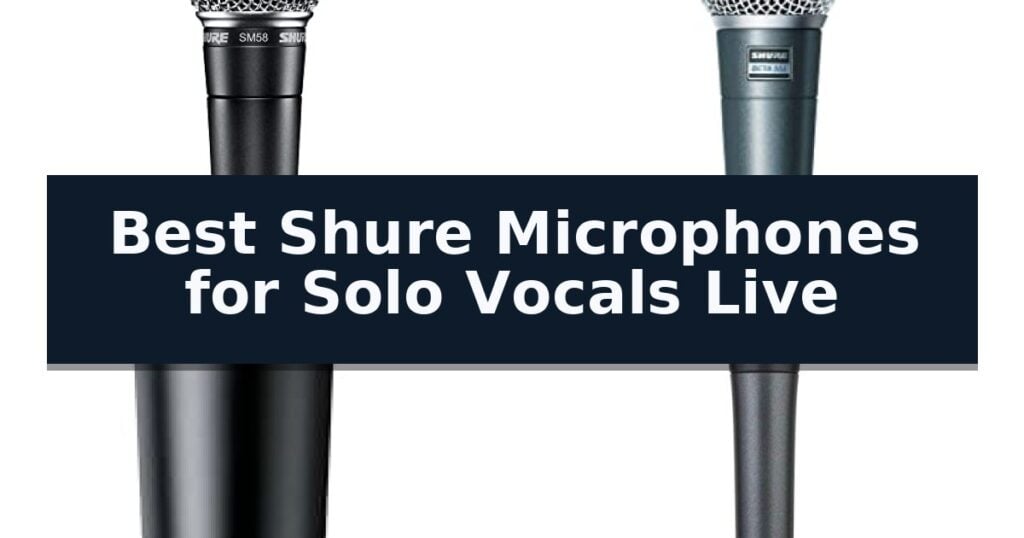
7 Best Shure Microphones for Solo Vocals Live in 2026 Reviews
Quick Comparison
| Product | Best For | Key Strength | Score |
|---|---|---|---|
| Shure SM58 Dynamic Vocal Microphone | Best Overall | Precision cardioid pickup pattern effectively minimizes feedback and background noise. | 4.9 |
| Shure Beta 58A Dynamic Vocal Microphone | Maximum gain before feedback | Supercardioid pattern maximizes gain before feedback on loud stages. | 4.7 |
| Shure Nexadyne 8/S Dynamic Vocal Microphone | Advanced dual-engine vocal clarity | Revonic Dual-Engine Technology provides consistent, natural vocal reproduction. | 4.9 |
| Shure Beta 87A Condenser Vocal Microphone | Studio-grade detail on stage | Supercardioid polar pattern for superior feedback rejection | 4.7 |
| Shure Super 55 Deluxe Vocal Microphone | Iconic vintage style and sound | Supercardioid polar pattern provides excellent off-axis sound rejection. | 4.4 |
| Shure SM58S Dynamic Vocal Microphone | Convenient integrated on/off switch | Integrated on/off switch for quick muting control. | 4.8 |
| Shure GLXD24+/SM58 Wireless Vocal System | Reliable freedom for performers | Dual Band Wireless Technology automatically avoids interference by scanning both 2.4GHz and 5.8GHz bands. | 4.6 |
How We Chose
Evaluating microphones for live solo vocals requires a focus on how each model handles the unique challenges of a stage environment. We assess these units based on their ability to isolate the singer's voice, resist feedback, and maintain sonic integrity under varying acoustic conditions, ensuring that each recommendation provides reliable performance for professional and amateur vocalists alike.
- Polar pattern consistency for feedback rejection
- Frequency response tailoring for vocal presence
- Handling noise and vibration isolation capabilities
- Durability and build quality for touring
- Power requirements and compatibility with standard mixers
1 Shure SM58 Dynamic Vocal Microphone — Industry standard for live vocals
Achieving consistent vocal presence in a live environment requires gear that can isolate the performer's voice while resisting the chaotic acoustics of a stage. The Shure SM58 Pro XLR Dynamic Vocal Microphone is engineered specifically for this purpose, utilizing a finely tuned frequency response with a subtle midrange lift to ensure vocals remain warm and articulate within a dense mix.
At the core of its design is a precision cardioid pickup pattern, which provides a uniform response that focuses exclusively on the sound source directly in front of the capsule. This directional sensitivity is essential for minimizing background noise and preventing feedback, allowing performers to maintain clarity even in high-volume settings.
Usability is enhanced by an integrated pop protection system, featuring a refined spherical grille and a built-in filter. This combination effectively manages plosives, breath, and wind noise without requiring external windscreens or accessories. The unit is built for longevity, utilizing rugged metal construction and a reinforced stand adapter to handle the physical demands of touring and frequent transport.
While this microphone is an industry standard for live performance, its versatility extends to podcasting and studio recording. Its XLR connectivity ensures compatibility with professional audio interfaces and mixing consoles, making it a reliable choice for those who prioritize consistent, professional-grade audio reproduction.
Best for: Performers and podcasters who require a durable, feedback-resistant microphone for consistent vocal clarity in live or studio environments.
Skip if: Users who require a condenser microphone's high-frequency sensitivity for delicate studio applications or those who prefer a USB-native connection without an audio interface.
- Precision cardioid pickup pattern effectively minimizes feedback and background noise.
- Integrated pop protection reduces plosives and wind noise without extra accessories.
- Rugged metal construction ensures durability for professional touring and frequent use.
- Finely tuned frequency response provides a warm, articulate midrange lift.
- XLR-only connection requires an external audio interface or mixer for operation.
2 Shure Beta 58A Dynamic Vocal Microphone — Maximum gain before feedback
Achieving professional-grade vocal presence on a crowded stage requires a microphone that can isolate the performer's voice while rejecting ambient noise. The Shure BETA 58A Supercardioid Dynamic Vocal Microphone is engineered specifically for this challenge, utilizing a supercardioid polar pattern to maximize gain before feedback, ensuring your vocals remain clear and prominent even in high-volume environments.
At the heart of its performance is a neodymium magnet that provides a high signal-to-noise ratio, delivering a clean, powerful output. The microphone features a tailored frequency response with a controlled bass rolloff, which effectively minimizes the proximity effect often encountered when singing close to the capsule. This consistency ensures that the sound you dial in during a soundcheck remains stable across varying load impedances.
Designed for the rigors of live performance, the Shure BETA 58A features a hardened steel mesh grille and a pneumatic shock mount system. These elements work together to absorb the physical vibrations and bumps common during stage use. The rugged construction is backed by Shure's long-standing manufacturing standards, providing the reliability required for frequent travel and demanding performance schedules.
The package includes essential accessories for immediate setup, such as the A25D adjustable stand adapter, a Euro thread adapter, and a zippered storage bag. Whether you are performing in a studio or on a loud stage, this microphone provides a dependable, high-output solution for solo vocalists.
Best for: Solo vocalists who need high gain-before-feedback and reliable noise rejection in loud live performance environments.
Skip if: Users who prefer the wider, more ambient pickup pattern of a cardioid microphone or those requiring a condenser microphone for high-frequency detail in controlled studio settings.
- Supercardioid pattern maximizes gain before feedback on loud stages.
- Neodymium magnet ensures a high signal-to-noise ratio for clean output.
- Pneumatic shock mount reduces handling noise and vibrations.
- Hardened steel mesh grille provides long-term durability.
- Supercardioid polar pattern requires more precise mic technique compared to standard cardioid models.
3 Shure Nexadyne 8/S Dynamic Vocal Microphone — Advanced dual-engine vocal clarity
Achieving vocal presence in a crowded live mix requires a microphone that can isolate the source while maintaining natural reproduction. The Shure Nexadyne 8/S Supercardioid Dynamic Vocal Microphone utilizes proprietary Revonic Dual-Engine Technology to address this challenge, employing two transducers to deliver consistent sound performance across a wide range of frequencies.
Engineered specifically for the demands of stage performance, this microphone features a supercardioid polar pattern. This design choice is critical for solo vocalists, as it helps reduce background noise and stage bleed, ensuring that the vocal signal remains focused and clear even when other instruments are present.
The Shure Nexadyne 8/S is built for the rigors of touring and frequent use, featuring a rugged all-metal construction and a dent-resistant hardened grille. Beyond its physical durability, the microphone is designed to minimize the need for corrective equalization, allowing the natural character of the voice to cut through dense live mixes effectively.
For professionals who require versatility, the microphone offers compatibility with interchangeable wireless microphone capsules. This allows users to maintain the same sonic signature whether they are using a wired XLR connection or transitioning to a wireless setup, providing a consistent workflow across different performance environments.
Best for: Solo vocalists performing in dense live mixes who require high vocal clarity and reduced stage bleed.
Skip if: Users who prefer a condenser microphone's sensitivity or those who do not require the specific noise-rejection benefits of a supercardioid dynamic capsule.
- Revonic Dual-Engine Technology provides consistent, natural vocal reproduction.
- Supercardioid polar pattern effectively reduces stage bleed and background noise.
- Durable all-metal construction and hardened grille withstand professional stage use.
- Interchangeable capsule compatibility allows for seamless transitions between wired and wireless setups.
- Supercardioid pattern requires disciplined mic technique to maintain consistent volume and tone.
4 Shure Beta 87A Condenser Vocal Microphone — Studio-grade detail on stage
Achieving studio-grade vocal clarity on a busy stage requires a microphone designed to isolate the performer's voice while rejecting ambient noise. The Shure Beta 87A Condenser Vocal Microphone addresses this by utilizing a highly consistent supercardioid polar pattern, which provides exceptional gain-before-feedback. This design ensures that vocals remain the focal point, even when performing in close proximity to loud stage monitors.
Engineered for the nuances of live performance, the Shure Beta 87A features a smooth frequency response with a gradual presence rise. This tuning captures bright, detailed vocal textures with the crisp definition necessary to cut through a dense live mix. To maintain tonal balance, the microphone includes an electronic low-frequency roll-off that compensates for the proximity effect, ensuring that vocals do not become muddy when the performer is singing close to the capsule.
Durability and handling are critical for live sound, and this model is built to withstand the rigors of the road. It incorporates an advanced cartridge shock-mount system that effectively absorbs mechanical shock and minimizes handling noise. Additionally, the built-in pop filter helps manage wind and breath sounds, keeping the output clean and professional throughout a set.
As a condenser microphone, the Shure Beta 87A requires phantom power to operate. Users must ensure their mixer, audio interface, or microphone input is capable of supplying the necessary power to drive the condenser element. With a wide 117 dB dynamic range and low distortion, it is a capable tool for vocalists seeking expressive, high-fidelity sound in live environments.
Best for: Solo vocalists performing in live environments who require studio-grade clarity and high gain-before-feedback.
Skip if: Users who do not have access to phantom power or those who prefer the rugged simplicity of a dynamic microphone that does not require external power.
- Supercardioid polar pattern for superior feedback rejection
- Advanced shock-mount system to reduce handling noise
- Electronic low-frequency roll-off to balance proximity effect
- Wide 117 dB dynamic range for expressive vocal capture
- Requires phantom power for operation
- Condenser element is more sensitive to environmental factors than standard dynamic mics
5 Shure Super 55 Deluxe Vocal Microphone — Iconic vintage style and sound
The Shure Super 55 Deluxe Vocal Microphone immediately commands attention with its classic satin chrome-plated housing and striking blue accents, offering a distinct retro aesthetic for live vocal performances. Beyond its vintage-style Unidyne appearance, this dynamic microphone is engineered to provide professional-grade audio clarity.
Equipped with a supercardioid pickup pattern, the microphone is designed to isolate the performer's voice while effectively rejecting background noise and feedback. This directional focus makes it a reliable choice for maintaining vocal presence in demanding live environments where stage noise is a constant factor.
Internal mechanics prioritize signal integrity through a shock-mounted internal cartridge, which serves to minimize handling noise and vibrations during use. This design ensures that the audio remains clean and uninterrupted, even when the microphone is handled frequently or mounted on a stand.
Durability and ease of use are central to its construction, featuring a rugged die-cast casing that withstands the rigors of frequent transport and stage setup. The inclusion of an integrated self-tensioning swivel mount allows for precise positioning without the need for an external mic clip, streamlining the setup process for solo vocalists.
Best for: Solo vocalists who require a combination of iconic vintage aesthetics and reliable, feedback-rejecting directional audio for live stage performances.
Skip if: Users who require a lightweight, compact microphone or those who prefer a modern, low-profile design over a traditional, heavy-duty vintage form factor.
- Supercardioid polar pattern provides excellent off-axis sound rejection.
- Rugged die-cast construction ensures long-term durability for live use.
- Integrated self-tensioning swivel mount allows for quick, tool-free positioning.
- Shock-mounted internal cartridge reduces unwanted handling noise.
- Heavier weight compared to modern, streamlined dynamic vocal microphones.
- Retro form factor may not suit all modern stage or studio setups.
6 Shure SM58S Dynamic Vocal Microphone — Convenient integrated on/off switch
Reliability in a live environment often comes down to the ability to manage audio signals directly from the stage, and the Shure SM58S Pro XLR Dynamic Vocal Microphone addresses this with an integrated on/off switch. This feature allows performers to mute their signal instantly between songs or during transitions without needing to signal a sound engineer or adjust settings on a mixer.
Engineered specifically for vocal applications, this microphone utilizes a tuned frequency response to deliver a clear, warm, and present sound. By emphasizing vocal clarity, it helps singers and speakers cut through the mix effectively, whether in a rehearsal space, a club, or a studio setting. The cardioid polar pattern is a critical design choice for live use, as it focuses on capturing sound from the front while rejecting off-axis noise from monitors, instruments, and the crowd.
Durability and control are central to its construction, featuring a hardened grille and internal filtering designed to mitigate plosives, breath noise, and handling sounds. These elements ensure that the audio remains clean even during energetic performances where the microphone is held close to the mouth. At 0.65625 pounds, it maintains a substantial feel while remaining manageable for extended use.
The Shure SM58S Pro XLR Dynamic Vocal Microphone serves as a standard for those who require consistent, professional-grade performance in demanding venues. Its combination of a rugged build and the convenience of an on/off switch makes it a practical tool for solo vocalists who need to maintain command over their audio output throughout a performance.
Best for: Solo vocalists and speakers who need direct control over their microphone signal via an integrated on/off switch during live performances.
Skip if: Users who require a condenser microphone for high-frequency detail in a controlled studio environment or those who prefer a switchless design to avoid accidental muting.
- Integrated on/off switch for quick muting control.
- Cardioid polar pattern effectively isolates vocals from background noise.
- Tuned frequency response optimized for vocal clarity.
- Hardened grille and internal filtering reduce plosives and handling noise.
- Manual switch may be prone to accidental activation if not handled carefully.
7 Shure GLXD24+/SM58 Wireless Vocal System — Reliable freedom for performers
Reliable wireless performance is essential for live vocalists who need to move freely across a stage without the constraints of a cable. The Shure GLXD24+/SM58 Wireless Vocal System addresses this by utilizing Dual Band Wireless Technology, which automatically scans and switches between 2.4GHz and 5.8GHz bands to maintain a consistent, interference-free signal.
This system centers on the iconic SM58 microphone capsule, known for its consistent performance in live environments. The GLXD4+ tabletop receiver manages the connection automatically, pairing with the transmitter without requiring manual frequency coordination. This plug-and-play approach minimizes setup time, allowing performers to focus on their set rather than technical adjustments.
Power management is handled by the included SB904 lithium-ion battery, which provides up to 12 hours of continuous runtime. Charging is flexible, as the battery can be replenished directly on the receiver or via the USB-C port on the handheld transmitter. A quick-charge feature is also available, delivering 1.5 hours of operation from a 15-minute charge.
Designed for versatility, the system supports up to 16 compatible half-rack systems when used with the optional Frequency Manager. While it offers robust performance for solo vocalists, users should note that this model is not backwards compatible with previous GLX-D or GLX-D Advanced generations, making it a dedicated solution for those building a new wireless setup.
Best for: Solo vocalists and performers who require a reliable, license-free wireless system with long battery life for live stage use.
Skip if: Users who already own older Shure GLX-D or GLX-D Advanced equipment, as this system is not backwards compatible with those legacy components.
- Dual Band Wireless Technology automatically avoids interference by scanning both 2.4GHz and 5.8GHz bands.
- Extended battery life provides up to 12 hours of runtime with convenient USB-C charging.
- Automatic frequency management ensures a simple, worry-free setup without needing manual coordination.
- Includes the industry-standard SM58 vocal microphone capsule for reliable live audio.
- Not backwards compatible with previous generation GLX-D or GLX-D Advanced wireless systems.
- Requires the separately sold Frequency Manager for large-scale installations of up to 16 systems.
Best Shure Microphones for Solo Vocals Live Buying Guide
Dynamic vs. Condenser Capsules
Dynamic microphones are the industry standard for live performance due to their robust construction and ability to handle high volumes without distortion. They are ideal for soloists who move around the stage or perform in venues with significant background noise.
Condenser microphones offer a wider frequency response and faster transient response, capturing more detail and air in the vocal performance. These are better suited for intimate settings where the singer requires a more natural, studio-like sound and can manage the requirement for phantom power.
Understanding Polar Patterns
The polar pattern determines the microphone's sensitivity to sound from different directions. A cardioid pattern is the most common, picking up sound primarily from the front and rejecting noise from the rear, which makes it versatile for most live stages.
Supercardioid patterns offer a narrower pickup angle, providing superior isolation and higher gain before feedback. This is particularly useful for soloists performing in loud environments where monitor bleed or stage noise is a constant concern.
Frequency Response and Vocal Presence
A microphone's frequency response curve dictates how it colors the sound. Many live vocal mics feature a presence peak in the upper-midrange frequencies, which helps the voice stand out against instruments without needing heavy equalization.
Consider your vocal timbre when choosing a mic. A microphone with a warm, bass-heavy response might complement a thin voice, while a brighter, more detailed mic can clarify a voice that tends to get lost in the mix.
Handling Noise and Durability
Live performance often involves handling the microphone or bumping into stands. Look for models with internal shock-mount systems, which are designed to absorb mechanical vibrations and prevent them from being transmitted as low-frequency thumps.
Durability is non-negotiable for touring musicians. Hardened steel grilles and rugged metal housings protect the sensitive internal capsule from drops and the general wear and tear of life on the road.
Connectivity and Power Requirements
Most live microphones use standard XLR connections, ensuring compatibility with virtually all professional mixing consoles and PA systems. Ensure your setup can provide the necessary phantom power if you choose a condenser microphone.
Wireless systems offer freedom of movement but require careful management of battery life and frequency bands. Always verify that your wireless system is set to a clear channel to avoid interference during your set.
Frequently Asked Questions
Do I need a condenser or dynamic microphone for live vocals?
Dynamic microphones are generally better for loud, high-energy stages due to their durability and feedback resistance. Condenser microphones are better for acoustic or intimate settings where you want to capture more detail.
What is the benefit of a supercardioid pattern?
A supercardioid pattern provides a tighter focus on the sound source and better rejection of off-axis noise, which helps prevent feedback when using stage monitors.
Do all Shure microphones require phantom power?
No, only condenser microphones like the Beta 87A require phantom power. Dynamic microphones like the SM58 and Beta 58A do not require any external power.
Can I use a handheld wireless mic for live solo performances?
Yes, wireless systems like the GLXD24+/SM58 provide the same capsule performance as their wired counterparts while offering the freedom to move around the stage.
How do I reduce plosives when singing live?
Most professional live microphones have integrated pop filters or grilles designed to minimize plosives. Proper mic technique, such as singing slightly off-axis, can also help.
Conclusion: Our Top Pick
Our top pick is Shure SM58 Dynamic Vocal Microphone. Choosing the right microphone for live solo vocals depends on your performance style and the specific acoustic demands of your venue. While the SM58 remains the reliable workhorse for most situations, specialized models like the Beta 87A or Nexadyne 8/S offer distinct advantages for those seeking higher detail or advanced feedback rejection.
Evaluate your need for durability, sound profile, and wireless freedom to narrow down your options. Investing in a high-quality microphone ensures your voice remains the focal point of every performance, regardless of the stage environment.