Synology DiskStation DS3622xs+ NAS is our top choice for the Best 12-Bay NAS, offering a robust 6-core Intel Xeon processor and high-speed networking capabilities that excel in demanding enterprise environments.
Selecting a high-capacity storage server requires balancing raw drive count with processing power and expansion potential. For professional environments, the ability to scale storage while maintaining consistent throughput is critical to supporting virtualization, backup consolidation, and large-scale media management.
Our evaluation focuses on hardware reliability, throughput performance, and the flexibility of the operating system to handle complex data management tasks. We prioritize units that offer clear upgrade paths, such as NVMe caching and high-speed network interface cards, to ensure the system remains relevant as data requirements grow.
When planning your storage array, choosing the right drives is as important as the chassis itself; for guidance on selecting high-capacity disks, see our Best 10TB NAS Drive guide to ensure your hardware is optimized for reliability.
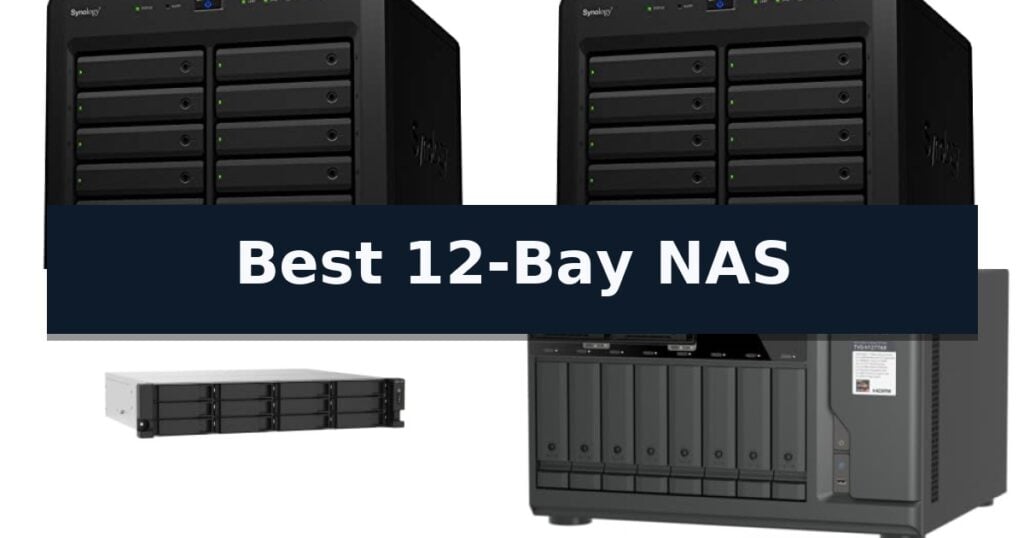
9 Best 12-Bay NAS in 2026 Reviews
Quick Comparison
| Product | Best For | Key Strength | Score |
|---|---|---|---|
| Synology DiskStation DS3622xs+ NAS | Best Overall | High-performance 6-core Intel Xeon processor for demanding workloads. | 4.9 |
| Synology DiskStation DS2422+ NAS | Scalable Business Data Hub | Scalable storage up to 24 bays using the DX1222 expansion unit. | 4.4 |
| QNAP TS-1273AU-RP Rackmount NAS | Reliable Redundant Rackmount | 12-bay capacity for massive storage expansion. | 4.5 |
| QNAP TVS-h1277AX Hybrid NAS | Fast Flash-Accelerated Desktop | Hybrid storage architecture combining high-capacity SATA bays with high-speed U.2 NVMe flash slots. | 4.8 |
| Asustor Flashstor 12 Pro NAS | Compact All-Flash Performance | 12 M.2 NVMe slots for high-performance all-flash storage. | 4.6 |
| BUFFALO TeraStation 51220RH Rackmount NAS | Enterprise-Ready Secure Storage | 96TB total capacity with enterprise-grade drives included. | 4.8 |
| Rosewill Hearth NAS PRO Chassis | Versatile DIY Server Foundation | Massive storage capacity with 12 hot-swap 3.5-inch bays and 6 additional 2.5-inch SSD mounts. | 4.8 |
| Oaknode Q670 12-Bay NAS Motherboard | Customizable Server Core | Supports up to 12 SATA drives via included SFF-8643 cables. | 4.6 |
| ZhenLoong 24-Bay Rackmount NAS Chassis | High-Density Custom Build | 24-bay hot-swap capacity for high-density storage requirements. | 4.6 |
How We Chose
When evaluating the best 12-bay NAS solutions, we focus on the hardware architecture and software versatility required for enterprise-level data management. An experienced reviewer looks beyond simple bay counts, prioritizing sustained throughput, expansion capabilities, and the reliability of the operating system to ensure these systems can handle intensive, multi-user workloads without bottlenecking.
- Processor architecture and core count for handling concurrent tasks and virtualization.
- Network interface options, specifically support for 10GbE or 25GbE connectivity.
- Scalability through expansion units to increase total drive bay count beyond the base chassis.
- Memory capacity and support for ECC RAM to ensure data integrity.
- Software ecosystem stability and ease of management for complex storage configurations.
1 Synology DiskStation DS3622xs+ NAS — High-Performance Enterprise Storage
Managing enterprise-grade data workloads requires hardware that balances raw processing power with high-density storage capacity. The Synology 12 Bay DiskStation DS3622xs+ (Diskless) addresses this demand by integrating a 6-core Intel Xeon processor capable of handling intensive tasks such as virtual machine hosting, video management systems, and centralized backup consolidation.
Engineered for high-throughput environments, this unit delivers over 260,000 4K random read IOPS and sequential performance reaching 4,700/2,400 MB/s. To support these speeds, the system offers flexible connectivity options, including 10/25GbE networking and Fibre Channel support, alongside NVMe SSD Cache slots to minimize latency during heavy read and write operations.
The chassis provides a native 12-bay configuration, but it is designed for significant growth. Users can scale the total storage capacity up to 36 drive bays by connecting two DX1222 expansion units. This modular approach allows businesses to start with a high-performance foundation and expand as their data requirements evolve over time.
Reliability is central to the design, backed by a 5-year warranty to ensure long-term operational stability. With up to 48 GB of memory support, the system maintains responsiveness even when managing complex workloads, making it a robust solution for professional storage environments.
Best for: Enterprises and data-intensive environments requiring high-speed storage, virtualization support, and scalable capacity.
Skip if: Small office or home users who do not require enterprise-grade processing, 10/25GbE networking, or the ability to scale to 36 bays.
- High-performance 6-core Intel Xeon processor for demanding workloads.
- Scalable architecture supports up to 36 total drive bays.
- Advanced connectivity with 10/25GbE and Fibre Channel support.
- Comprehensive 5-year warranty for enterprise peace of mind.
- Diskless configuration requires separate purchase of compatible storage drives.
- Requires DX1222 expansion units to reach maximum 36-bay capacity.
2 Synology DiskStation DS2422+ NAS — Scalable Business Data Hub
Managing high-density storage requires a robust foundation, and the Synology DiskStation 12 Bay DS2422+ provides a scalable architecture designed to handle intensive data workloads. This unit serves as a centralized hub for enterprise-grade file management, offering significant throughput capabilities for demanding environments.
Engineered for performance, the device delivers up to 2,201 MB/s read and 1,383 MB/s sequential write speeds. Out of the box, it includes 4GB of DDR4 memory, which can be expanded up to 32 GB to accommodate complex multitasking or heavy virtualization tasks. Users can further optimize data access by integrating NVMe SSD Cache to reduce latency during frequent read/write operations.
The chassis supports 12 internal drive bays, but the system is built for growth. By connecting one DX1222 expansion unit, you can effectively double your storage capacity to 24 bays without replacing the primary hardware. Connectivity is equally flexible, with options to upgrade to 10/25GbE networking to ensure the network interface does not become a bottleneck for high-speed data transfers.
This system is backed by a 3-year warranty, providing a level of support consistent with its role as a primary business data hub. Its physical footprint measures 16.5 inches in height and 18.5 inches in length, making it a substantial piece of equipment that requires dedicated rack or shelf space for proper airflow and maintenance.
Best for: Businesses and power users requiring a high-capacity, scalable storage solution that can grow from 12 to 24 drive bays.
Skip if: Home users or small offices with limited space and modest storage needs who would find the 12-bay footprint and enterprise-grade expansion capabilities excessive.
- Scalable storage up to 24 bays using the DX1222 expansion unit.
- High-speed performance with up to 2,201 MB/s read speeds.
- Flexible hardware upgrades including NVMe SSD Cache and 10/25GbE networking.
- Support for up to 32 GB of memory to handle intensive workloads.
- Large physical footprint requires significant dedicated space.
- Diskless design necessitates a separate investment in a high volume of hard drives.
3 QNAP TS-1273AU-RP Rackmount NAS — Reliable Redundant Rackmount
Managing massive datasets requires hardware that balances raw processing power with high-density storage capabilities. The QNAP TS-1273AU-RP Rackmount NAS serves as a centralized hub for enterprise-grade environments, utilizing an AMD Ryzen Embedded V1500B quad-core 2.2 GHz processor to handle intensive multitasking and data management tasks efficiently.
Designed for scalability, this unit features 12 x 3.5-inch drive bays, allowing for significant storage expansion in a rackmount form factor. The system comes equipped with 8GB of UDIMM DDR4 memory, which is expandable up to a maximum of 32GB, ensuring that the NAS can maintain performance levels even as your data requirements grow over time.
Connectivity and expansion are central to its utility. The device includes 2 x 2.5GbE ports for high-speed network throughput, alongside 2 x PCIe Gen3 x4 slots that provide flexibility for adding high-speed network cards or additional storage controllers. To ensure continuous uptime, the unit is built with a redundant PSU, a critical feature for maintaining operations during power supply failures.
Measuring 23.5 inches in length and weighing approximately 21.36 pounds, this unit is engineered for standard rack environments. With a 3-year warranty, it provides a stable foundation for businesses needing a reliable, high-performance storage solution that prioritizes data availability and hardware longevity.
Best for: Businesses and power users requiring high-density, rack-mountable storage with redundant power and high-speed networking.
Skip if: Home users or small offices without rack infrastructure who would find the dimensions and enterprise-focused power requirements excessive.
- 12-bay capacity for massive storage expansion.
- Redundant PSU ensures high availability and uptime.
- AMD Ryzen quad-core processor provides robust performance.
- Dual 2.5GbE ports for faster network data transfer.
- Rackmount form factor requires specific infrastructure.
- Diskless design necessitates additional investment in storage drives.
4 QNAP TVS-h1277AX Hybrid NAS — Fast Flash-Accelerated Desktop
The QNAP TVS-h1277AX-R5-16G 12-Bay Desktop Hybrid NAS is built for high-performance workflows, utilizing an AMD Ryzen 5 7000-series 6-core processor that reaches burst speeds of 5.1 GHz. This desktop unit provides a versatile storage architecture by combining eight 3.5-inch SATA bays for massive capacity with four dedicated 2.5-inch U.2 NVMe Gen4 flash bays for high-speed data access.
Designed for demanding environments, this NAS supports up to 192 GB of DDR5 memory, allowing for extensive virtualization, container hosting, and database management. The inclusion of dual 10GbE and 2.5GbE connectivity ensures that creative teams can stream or edit 4K and 8K footage directly from the device without needing to transfer files to local storage.
Flexibility is a core component of the hardware design, featuring three PCIe Gen4 slots that allow for future-proofing through the addition of 25GbE network cards or dedicated graphics cards for GPU pass-through. The system runs on the QuTS hero ZFS file system, which provides advanced data integrity features and snapshots to protect against accidental loss or ransomware.
Measuring 9 inches in height and 13 inches in width, the unit maintains a compact footprint despite its significant storage potential. It comes backed by a 5-year warranty, reflecting its focus on long-term reliability for professional and enterprise-grade applications.
Best for: Professional creative teams and IT labs requiring high-speed flash storage for 4K/8K video editing and intensive virtualization tasks.
Skip if: Home users or small offices with basic file backup needs, as the advanced ZFS features and high-performance hardware may exceed typical requirements.
- Hybrid storage architecture combining high-capacity SATA bays with high-speed U.2 NVMe flash slots.
- High-performance AMD Ryzen 5 processor capable of handling complex multitasking and virtualization.
- Advanced connectivity options including dual 10GbE ports and three PCIe Gen4 expansion slots.
- QuTS hero ZFS file system for robust data protection and snapshot capabilities.
- High hardware complexity may present a steeper learning curve for users unfamiliar with enterprise-grade NAS configurations.
5 Asustor Flashstor 12 Pro NAS — Compact All-Flash Performance
The Asustor Flashstor 12 Pro NAS redefines storage density by utilizing 12 dedicated M.2 NVMe slots in an ultra-compact chassis, making it a specialized solution for high-speed data workflows. By moving away from traditional mechanical hard drives, this all-flash system leverages the speed of modern solid-state storage to support intensive tasks like virtualization and high-resolution content creation.
At the heart of this unit is a Quad-Core 10nm Intel Celeron N5105 CPU paired with 4GB of DDR4-2933 RAM, providing a responsive foundation for data-heavy operations. The architecture is specifically tuned for throughput, featuring 10GbE connectivity to ensure that network bottlenecks do not limit the performance of the installed NVMe drives.
Designed with a focus on efficiency, the device measures just 1.89 inches in height, allowing it to fit into tight professional environments where rack space or desk real estate is at a premium. Despite its small footprint, it includes two USB 3.2 Gen 2×1 ports for external expansion and an HDMI output for direct display integration.
While the Asustor Flashstor 12 Pro NAS offers significant performance advantages, users should note that it requires M.2 NVMe storage media, which represents a different cost and capacity profile compared to traditional 3.5-inch drive arrays. This system is engineered for those who prioritize rapid access times and compact design over massive, low-cost bulk storage.
Best for: Content creators and IT enthusiasts who require high-speed, low-latency storage for virtualization and media workflows in a compact form factor.
Skip if: Users who need massive, cost-effective bulk storage capacity provided by traditional 3.5-inch mechanical hard drives.
- 12 M.2 NVMe slots for high-performance all-flash storage.
- 10GbE connectivity for rapid data transfer speeds.
- Compact, low-profile design that fits in space-constrained environments.
- Efficient DDR4-2933 RAM for responsive system performance.
- Exclusively supports M.2 NVMe drives, limiting options for traditional mechanical storage.
- Fixed 4GB RAM may be a limitation for extremely heavy multi-tasking or complex virtualization.
6 BUFFALO TeraStation 51220RH Rackmount NAS — Enterprise-Ready Secure Storage
Managing large-scale data environments requires hardware that prioritizes stability and security, and the BUFFALO TeraStation 51220RH Rackmount NAS is engineered specifically for these demanding professional use cases. This 12-bay unit arrives with enterprise-grade hard drives pre-installed, offering a massive 96TB raw capacity that can be configured in RAID 6 for 80TB of usable space or RAID 0 for full capacity.
Performance is driven by a focus on high-speed connectivity and data integrity. The device features a native 10GbE port for rapid file transfers, ensuring that heavy data loads do not bottleneck network performance. To protect against data loss and ransomware, the system utilizes snapshots for near-instantaneous recovery, alongside 256-bit drive encryption and two-factor authentication.
Designed for versatility, the system supports hybrid cloud integration, allowing users to sync data with services like Dropbox, Amazon S3, and Microsoft Azure. This setup provides an additional layer of security and cost-effective backup options. The unit is TAA compliant and manufactured in Japan, emphasizing a commitment to build quality and professional standards.
Maintenance and support are central to the product's value proposition. The system includes a 5-year manufacturer warranty with registration, supported by 24/7 US-based technical assistance and data recovery services. This comprehensive support structure is intended to provide long-term peace of mind for business environments that cannot afford extended downtime.
Best for: Business environments requiring high-capacity, secure, and rack-mountable network storage with enterprise-grade support.
Skip if: Home users or small offices without rack infrastructure who do not require high-density storage or enterprise-level security features.
- 96TB total capacity with enterprise-grade drives included.
- Native 10GbE connectivity for high-speed data transfers.
- Comprehensive 5-year warranty with 24/7 US-based support.
- Advanced data protection including snapshots and 256-bit encryption.
- Rackmount form factor requires specific infrastructure for installation.
- High initial investment due to the inclusion of 12 enterprise-grade drives.
7 Rosewill Hearth NAS PRO Chassis — Versatile DIY Server Foundation
Building a high-density storage array requires a chassis that balances massive drive capacity with robust thermal management. The Rosewill Hearth NAS PRO is engineered for these exact demands, offering a dedicated environment for up to 12 x 3.5-inch hot-swap HDDs alongside 6 x 2.5-inch SSD mounts. This configuration provides a substantial foundation for DIY NAS builders who require both high-capacity archival storage and high-speed flash caching in a single, cohesive unit.
Beyond its storage density, the chassis is designed for operational continuity. The tool-free hot-swap drive bays allow for drive replacement without requiring a system shutdown, which is a critical feature for maintaining uptime in home server environments. To handle the heat generated by such a dense drive array, the unit includes 5 x 120mm PWM fans and supports 240mm AIO coolers, ensuring that critical components remain within safe operating temperatures during heavy data transfers.
Versatility is a core component of this design, as the chassis is E-ATX compatible, allowing for a wide range of motherboard configurations. For power-hungry builds, the case supports a dual PSU setup, providing a dedicated bay for a second power supply to ensure stable power delivery and redundancy. Connectivity is modernized with a front-panel USB 3.2 Type-C port, facilitating fast data access for external peripherals.
When planning a build, it is important to note the physical constraints of the internal layout. The chassis supports a maximum PSU length of 180mm and a maximum GPU length of 360mm. While these dimensions accommodate most standard server components, builders should verify their hardware dimensions to ensure proper fitment within the 14.84-inch height and 15.75-inch width footprint.
Best for: DIY enthusiasts and home server builders who need a high-density, hot-swappable storage solution with support for dual power supplies and large-format motherboards.
Skip if: Users with limited desk or rack space who do not require more than a few drive bays and would prefer a more compact, pre-built NAS appliance.
- Massive storage capacity with 12 hot-swap 3.5-inch bays and 6 additional 2.5-inch SSD mounts.
- Dual PSU support for enhanced power delivery and system redundancy.
- Efficient thermal management via 5 included 120mm PWM fans and 240mm AIO cooler compatibility.
- Tool-free hot-swap functionality for simplified drive maintenance.
- Large physical footprint may be restrictive for users with limited workspace.
- Hardware compatibility requires careful verification of PSU and GPU length limits.
8 Oaknode Q670 12-Bay NAS Motherboard — Customizable Server Core
The Oaknode Q670 12-Bay NAS Motherboard provides a specialized foundation for high-capacity storage builds, utilizing a Micro ATX form factor that accommodates 12 SATA drives via three included SFF-8643 cables. Designed for users who prefer custom server configurations, this board supports 12th, 13th, and 14th Gen Intel Core processors, making it a versatile choice for those managing extensive data arrays.
Performance capabilities are centered around its 4* U-DIMM DDR5 RAM slots, which support up to 128GB of memory, and dual M.2 NVMe PCIe 4.0 slots for high-speed caching or boot drives. Connectivity is robust for network-heavy environments, featuring three 2.5GbE ports, including one i226-LM port that supports vPro for remote management and system recovery.
The board offers significant expansion potential through its PCIe x16 and PCIe x4 slots, allowing for the integration of dedicated graphics or additional network interface cards. For display output, it includes HDMI 2.0, DP 1.4, VGA, and eDP, supporting 4K resolution at 60Hz. It also provides a modern interface with a Type-C 20Gbps port for fast data transfers.
System builders should note that this motherboard requires both 24-pin and 8-pin power connections to operate. The initial boot process may take several minutes as the system initializes memory. With its focus on stability and high-speed data throughput, this board is a technical solution for DIY NAS projects requiring specific hardware compatibility.
Best for: Users building a custom, high-capacity 12-bay NAS server who require specific Intel processor compatibility and remote management features.
Skip if: Users seeking a pre-built, plug-and-play NAS appliance or those who do not have the technical experience to assemble and configure a custom motherboard-based system.
- Supports up to 12 SATA drives via included SFF-8643 cables.
- Equipped with three 2.5GbE ports for high-speed network connectivity.
- Features vPro support on the i226-LM port for remote troubleshooting.
- Compatible with a wide range of 12th, 13th, and 14th Gen Intel processors.
- Requires manual assembly and specific power configuration (24-pin + 8-pin).
- Initial boot time is extended due to memory initialization.
9 ZhenLoong 24-Bay Rackmount NAS Chassis — High-Density Custom Build
Building a high-density storage server requires a foundation that balances structural integrity with component flexibility. The ZhenLoong 24-Bay Rackmount NAS Chassis provides a robust 4U enclosure constructed from 1.0mm SGCC steel, designed to house up to 24 drives in a hot-swap configuration. This chassis is specifically engineered for users who need to manage large-scale data environments while maintaining standard rack compatibility.
The internal architecture centers on a 12Gb Mini SAS backplane, which supports both SATA and SAS hard drives. The inclusion of an integrated SFF8643 data interface ensures the system functions as a true 12G backplane, facilitating high-speed data throughput. For system cooling, the unit utilizes a combination of three 12025 silent PWM fans in the middle and two 8015 silent PWM fans at the rear, helping to manage thermal output during sustained operation.
Versatility in hardware selection is a primary focus, as the chassis accommodates ATX, MATX, and ITX motherboards up to 12" x 9.6". Power supply options are equally flexible, supporting standard ATX (PS2) units or redundant 1+1 CRPS configurations. The rear panel provides additional expansion capabilities, featuring two 2.5-inch SATA hot-swappable modules and eight full-height PCI slots for add-in cards.
Measuring 550mm x 430mm x 176mm, this chassis fits within standard rack environments using the included guide rails. The front interface is straightforward, offering essential controls including power, reset, and USB 3.0 connectivity, alongside status LEDs for power, HDD, and WAN activity. Please note that the manufacturer provides a one-year warranty specifically for the hard drive backplane and fans, while other components remain uncovered.
Best for: Users building a high-capacity, custom-configured 24-bay server who require support for both SAS and SATA drives in a standard 4U rackmount form factor.
Skip if: Users who require a pre-configured, plug-and-play NAS appliance with integrated software, or those who need a shorter chassis depth than 550mm.
- 24-bay hot-swap capacity for high-density storage requirements.
- 12Gb Mini SAS backplane with SFF8643 interface for high-speed connectivity.
- Flexible power supply support including standard ATX or redundant CRPS units.
- Robust 1.0mm SGCC steel construction for structural durability.
- Limited warranty coverage restricted only to the backplane and fans.
- Extended shipping lead time of approximately 30-40 days.
Best 12-Bay NAS Buying Guide
Performance and Throughput
High-capacity NAS units must maintain consistent read and write speeds when handling large files or multiple concurrent streams. The processor choice, such as an Intel Xeon or high-end Ryzen, dictates how effectively the system manages RAID parity calculations and data encryption without sacrificing speed.
For users editing 4K or 8K footage, the integration of NVMe SSD caching is a vital feature. This allows the NAS to store frequently accessed metadata or hot data on faster flash storage, significantly reducing latency compared to relying solely on mechanical hard drives.
Scalability and Expansion
A 12-bay chassis provides a substantial starting point, but business needs often evolve. Look for models that support dedicated expansion units, which allow you to add more drive bays to the existing volume without needing to migrate data to an entirely new server.
Beyond drive bays, check for PCIe expansion slots. These slots are essential for adding 25GbE network cards or additional M.2 NVMe adapters, ensuring the hardware can keep pace with future network infrastructure upgrades.
Data Protection and Reliability
Enterprise storage requires robust data protection features, including support for snapshots, off-site replication, and advanced RAID configurations. These tools are critical for recovering from accidental deletions or ransomware attacks, providing a safety net for sensitive business information.
Hardware-level reliability is equally important. Features like redundant power supplies and ECC memory support help prevent system downtime and data corruption, which are non-negotiable for servers running 24/7 in a professional setting.
Networking Requirements
The network connection is often the primary bottleneck in a 12-bay system. While standard 1GbE ports are sufficient for basic file sharing, they will severely limit the potential of a 12-drive array. Prioritize models with native 10GbE or higher connectivity.
Consider whether your existing network infrastructure supports these high-speed standards. If you are upgrading to 10GbE, ensure your switches and client workstations are also compatible to fully leverage the increased bandwidth provided by the NAS.
DIY Versus Pre-Built Systems
Pre-built NAS units offer a streamlined experience with proprietary software that simplifies management, backups, and cloud integration. These systems are ideal for businesses that need a reliable, "set-it-and-forget-it" solution with dedicated manufacturer support.
DIY builds using server-grade motherboards and chassis provide maximum flexibility and cost control for enthusiasts or IT departments with specific hardware requirements. However, this approach requires significant time for assembly, software configuration, and ongoing maintenance.
Frequently Asked Questions
Can I mix different hard drive capacities in a 12-bay NAS?
Most modern NAS operating systems support flexible RAID configurations that allow you to mix drives of different sizes, though the usable capacity will be limited by the smallest drive in the array.
Is 10GbE necessary for a 12-bay NAS?
Yes, for a 12-bay system, 10GbE is highly recommended. A standard 1GbE connection will limit your throughput to roughly 110 MB/s, which is significantly slower than what a modern 12-drive array can achieve.
What is the benefit of ECC memory in a NAS?
Error Correction Code (ECC) memory detects and fixes common data corruption issues in RAM, which is essential for maintaining data integrity in high-capacity storage environments.
How do expansion units work?
Expansion units connect to the main NAS via a dedicated high-speed cable, allowing the main unit to manage the additional drives as part of its existing storage pool or as a separate volume.
Are all 12-bay NAS units rackmount?
No, there are both desktop and rackmount 12-bay models. Desktop units are better for office environments without server racks, while rackmount units are designed for standard server cabinet installations.
Conclusion: Our Top Pick
Our top pick is Synology DiskStation DS3622xs+ NAS. Choosing the right 12-bay NAS depends on your specific performance needs and whether you prefer the ease of a pre-built ecosystem or the customization of a DIY build. Enterprise users should prioritize units with strong processor support and high-speed networking to ensure long-term scalability.
Always consider your current network infrastructure alongside your storage requirements. Investing in a system that allows for future expansion, such as PCIe slots for networking or NVMe caching, will provide the best return on investment as your data demands grow.