Rode NT1 Signature Series Microphone earns our recommendation for the Best XLR Condenser Microphone thanks to its industry-leading low self-noise and legendary studio-grade voicing. This microphone provides a reliable, high-fidelity foundation for vocalists and content creators who require a clean, professional signal path.
Selecting a studio microphone requires balancing technical specifications like self-noise and frequency response against the practical demands of your recording environment. While some models offer versatile hybrid connectivity, others focus on delivering a specific, time-tested sound signature that excels in controlled acoustic spaces.
Understanding the difference between raw performance and ease of integration is vital for any home studio setup. We evaluate these microphones based on their ability to isolate desired sound sources while maintaining the clarity and dynamic range necessary for high-quality music production and voiceover work.
Once you have selected your microphone, pairing it with a high-quality Best XLR Audio Interface for Streaming ensures that your signal is converted with maximum clarity and minimal latency.
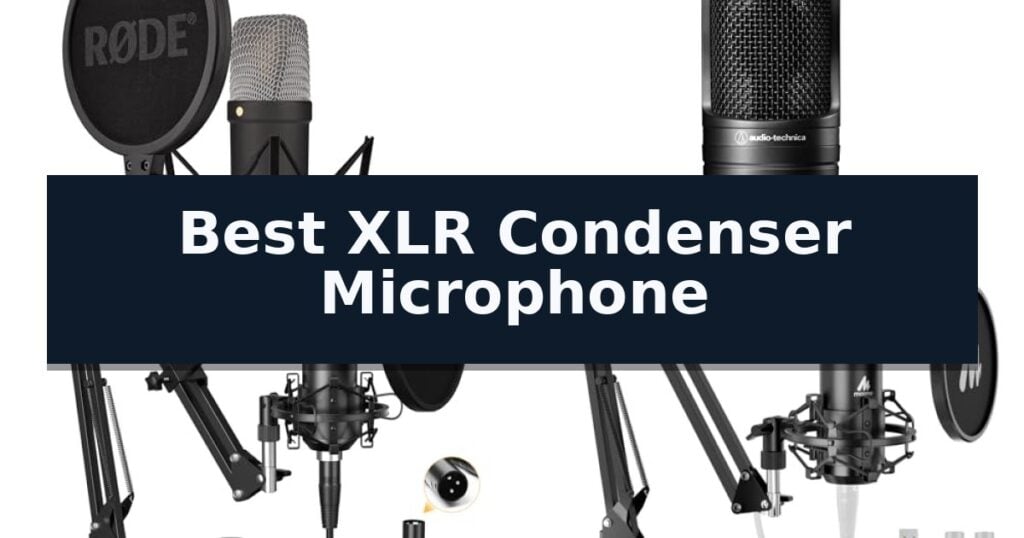
10 Best XLR Condenser Microphone in 2026 Reviews
Quick Comparison
| Product | Best For | Key Strength | Score |
|---|---|---|---|
| Rode NT1 Signature Series Microphone | Best Overall | Ultra-low 4.5dBA self-noise for pristine signal clarity. | 4.9 |
| Audio-Technica AT2020 Studio Microphone | Industry standard for home recording | Custom-engineered low-mass diaphragm for superior transient response | 4.3 |
| Maono PM320S Condenser Microphone | Complete starter kit for creators | Complete studio kit includes a boom arm, shock mount, and pop filter. | 4.5 |
| Maono A04 Gen2 Condenser Microphone | Flexible dual USB and XLR connectivity | Dual USB and XLR connectivity for maximum compatibility. | 4.8 |
| Mackie EM-91C Condenser Microphone | Budget-friendly professional studio sound | Cardioid polar pattern effectively isolates the primary sound source. | 4.4 |
| Audio-Technica AT2035 Condenser Microphone | Versatile with high-pass filtering | Large diaphragm for smooth and natural audio reproduction. | 4.5 |
| AKG P120 Condenser Microphone | High SPL handling for loud sources | High SPL handling up to 150 dB prevents distortion on loud sources. | 4.6 |
| Shure SM4 Studio Condenser Microphone | Interference shielding for clean audio | Patent-pending interference shielding blocks RF noise from nearby electronics. | 4.7 |
| Rode NT1 5th Gen Microphone | Hybrid analog and digital recording | Dual XLR and USB-C connectivity for flexible studio or mobile setups. | 4.7 |
| Fifine K669C Condenser Microphone | Sturdy build for entry-level studios | All-metal body provides superior durability and electromagnetic shielding. | 4.5 |
How We Chose
When evaluating the best XLR condenser microphone, we focus on technical transparency and build reliability. An experienced reviewer assesses how well a capsule captures detail without introducing unwanted electronic noise or coloration. We prioritize models that offer consistent performance across various vocal and instrumental applications, ensuring the hardware supports rather than hinders the recording process.
- Self-noise levels and circuit design
- Frequency response accuracy and character
- Maximum SPL handling for loud sources
- Included accessories and mounting versatility
- Build quality and long-term durability
1 Rode NT1 Signature Series Microphone — Ultra-low noise studio performance
Achieving professional-grade audio capture requires a signal chain that minimizes interference, and the RØDE NT1 Signature Series Studio Condenser Microphone addresses this with an exceptionally low 4.5dBA self-noise floor. This design choice ensures that the microphone remains whisper-quiet, allowing for clean, detailed recordings that capture the nuance of a performance without the distraction of electronic hiss.
The RØDE NT1 Signature Series Studio Condenser Microphone utilizes a large-diaphragm condenser capsule that carries the legacy of the original NT1 voicing, a standard in recording environments for two decades. Its tight cardioid polar pattern is specifically engineered to focus on the primary sound source while effectively rejecting off-axis room noise, making it a reliable choice for both vocal tracking and live streaming applications.
This model is positioned as a comprehensive solution, arriving with a complete vocal setup that includes an SM6 shock mount, an integrated pop filter, and an XLR cable. By providing these essential accessories, the package allows users to connect directly to an audio interface and begin recording immediately, streamlining the studio workflow.
Built for longevity and consistent performance, the microphone is backed by a 10-year warranty upon registration. While it requires an external audio interface with phantom power to operate, its robust construction and focus on acoustic clarity make it a versatile tool for those prioritizing a clean, studio-quality signal path.
Best for: Studio vocalists and content creators who require a low-noise, high-clarity microphone with all essential mounting accessories included.
Skip if: Users who do not own an audio interface with phantom power or those who require a USB-native connection for plug-and-play operation.
- Ultra-low 4.5dBA self-noise for pristine signal clarity.
- Complete studio bundle including shock mount, pop filter, and XLR cable.
- Legendary NT1 large-diaphragm voicing suitable for professional vocal recording.
- 10-year warranty provided by the manufacturer.
- Requires an external audio interface with phantom power to function.
- XLR-only connectivity lacks the convenience of USB digital output.
2 Audio-Technica AT2020 Studio Microphone — Industry standard for home recording
The Audio-Technica AT2020 Studio Microphone serves as a foundational tool for home and project studios, defined by its side-address condenser design. It is engineered to deliver reliable performance for vocal and instrument capture, establishing a consistent standard for those transitioning into professional-grade audio recording.
At the core of its performance is a custom-engineered low-mass diaphragm, which provides an extended frequency response and superior transient response. This design choice allows the microphone to handle high SPL (Sound Pressure Level) environments, offering the versatility required to record everything from delicate acoustic instruments to louder sound sources without compromising signal integrity.
The microphone utilizes a cardioid polar pattern, which is specifically tuned to reduce the pickup of unwanted noise from the sides and rear. This directional focus improves the isolation of the primary sound source, making it an effective choice for recording in spaces that may not be acoustically treated. It connects via an integral 3-pin XLRM output, ensuring compatibility with standard professional audio interfaces and mixing consoles.
Designed for durability and ease of use, the unit includes a stand mount for 5/8"-27 threaded stands, along with a 5/8"-27 to 3/8"-16 threaded adapter for broader compatibility. A soft protective pouch is also provided for storage. The Audio-Technica AT2020 Studio Microphone is backed by a two-year warranty on parts and labor, reflecting its status as a long-term investment for studio setups.
Best for: Home and project studio creators who require a reliable, versatile cardioid condenser microphone for vocals and instruments.
Skip if: Users who require a USB-native connection or built-in hardware monitoring controls, as this unit requires an external XLR interface.
- Custom-engineered low-mass diaphragm for superior transient response
- High SPL handling provides versatility for diverse sound sources
- Cardioid polar pattern improves isolation by reducing off-axis noise
- Robust build quality with included stand mount and protective pouch
- Requires external phantom power via an XLR interface
- No onboard controls for gain or pattern switching
3 Maono PM320S Condenser Microphone — Complete starter kit for creators
The Maono PM320S Condenser Microphone provides a comprehensive entry point for creators by bundling a professional-grade XLR condenser mic with a complete set of essential studio accessories. Built around a large 16mm condenser capsule, this microphone is engineered to capture superior transient detail and extended frequency response, making it a versatile tool for vocal tracking, podcasting, and music production.
Designed for reliable performance, the Maono PM320S Condenser Microphone requires a 48V phantom power supply, ensuring consistent signal quality when connected to an audio interface or mixer. Its cardioid polar pattern is specifically tuned to reject off-axis ambient noise, which helps maintain clean audio capture even in untreated home studio environments.
The hardware is constructed with rugged all-metal housing to withstand the rigors of daily use. The included adjustable metal boom arm offers stable positioning, while the integrated shock mount and pop filter work in tandem to minimize vibration rumble and tame plosives, ensuring your recordings remain professionally polished.
This all-in-one kit simplifies the setup process for streamers and vocalists by including all necessary components, such as an XLR-to-XLR cable and a foam windscreen. By combining high-SPL handling with a low-noise design, this microphone serves as a practical solution for those seeking broadcast-quality sound without the need for multiple separate purchases.
Best for: Content creators and vocalists looking for an all-in-one XLR microphone starter kit that includes mounting hardware and pop protection.
Skip if: Users who do not have an audio interface, mixer, or preamp capable of providing 48V phantom power will not be able to operate this microphone.
- Complete studio kit includes a boom arm, shock mount, and pop filter.
- Large 16mm condenser capsule captures high-quality transient detail.
- Rugged all-metal housing provides durability for daily studio use.
- Cardioid polar pattern effectively reduces unwanted ambient noise.
- Requires external 48V phantom power via an audio interface or mixer.
- XLR-only connectivity necessitates additional hardware for PC integration.
4 Maono A04 Gen2 Condenser Microphone — Flexible dual USB and XLR connectivity
The Maono A04 Gen2 Condenser Microphone distinguishes itself through its hybrid connectivity, offering both USB and XLR outputs in a single package. This design allows users to transition seamlessly between simple plug-and-play digital recording on a computer or mobile device and a more traditional analog studio setup using an audio interface or mixer.
At the heart of this microphone is a 16mm electret condenser transducer paired with a professional sound chipset that supports high-resolution 192kHz/24bit sampling rates. The device features a cardioid polar pattern, which is engineered to prioritize sound sources directly in front of the capsule while minimizing off-axis ambient noise. This makes it a practical choice for voiceovers, podcasting, and streaming where clarity is essential.
When utilized in USB mode, the microphone unlocks advanced functionality via the MAONO Link software. This interface provides users with granular control over their audio, including adjustable gain, a noise reduction switch with variable intensity, and various signal processing tools like a compressor, limiter, and EQ presets. These digital features allow for significant sound optimization directly within the recording chain.
The included all-in-one kit provides the necessary hardware for immediate setup, featuring an adjustable scissor arm stand, a shock mount to mitigate external vibrations, and both a pop filter and windscreen foam. The arm stand is designed for desks up to 2.1 inches thick, offering flexible positioning for various recording environments, though users should note that an XLR cable is not included in the package.
Best for: Content creators and podcasters who need a versatile microphone that can function as both a simple USB device and a professional XLR studio mic.
Skip if: Users who require a microphone compatible with XBOX consoles or those who do not have a phantom power-equipped audio interface for XLR operation.
- Dual USB and XLR connectivity for maximum compatibility.
- High-resolution 192kHz/24bit audio capture.
- Comprehensive MAONO Link software for real-time audio processing.
- Includes a complete accessory kit with a shock mount and boom arm.
- XLR cable not included in the box.
- Advanced software features are only available in USB mode.
5 Mackie EM-91C Condenser Microphone — Budget-friendly professional studio sound
Achieving clear, professional-grade audio for studio recordings often hinges on the reliability of your signal chain. The Mackie EM-91C is designed to provide a consistent, high-quality capture for both home and large-scale studio environments, utilizing a cardioid polar pattern that prioritizes sound sources directly in front of the capsule while minimizing background noise.
This large-diaphragm condenser microphone is built with a rugged, reliable construction intended to withstand the demands of frequent use. Its design focuses on delivering professional-quality sound without the complexity often found in higher-end studio gear, making it a straightforward choice for vocalists and instrumentalists alike.
The package includes essential accessories to help users get started immediately, specifically a shock mount and an XLR cable. These additions ensure that the microphone is ready for integration into an existing audio interface setup right out of the box, reducing the need for separate hardware purchases.
While the Mackie EM-91C excels in controlled studio settings, its performance is tied to the quality of the connected interface and the acoustic environment of the room. It serves as a dependable tool for those seeking a dedicated XLR connection for their recording projects.
Best for: Home or professional studio users who require a reliable, dedicated XLR condenser microphone for vocal and instrument recording.
Skip if: Users who prefer the convenience of USB connectivity or those who require specialized polar patterns beyond the standard cardioid configuration.
- Cardioid polar pattern effectively isolates the primary sound source.
- Rugged construction ensures long-term reliability in studio settings.
- Includes shock mount and XLR cable for immediate setup.
- Large-diaphragm design provides professional-quality audio capture.
- Requires an external audio interface with phantom power to operate.
- Fixed polar pattern limits versatility for complex multi-source recording scenarios.
6 Audio-Technica AT2035 Condenser Microphone — Versatile with high-pass filtering
Achieving professional-grade audio capture in a home studio environment often hinges on the quality of the transducer, and the Audio-Technica AT2035 Cardioid Condenser Microphone is engineered specifically for these demanding applications. By utilizing a large diaphragm design, this microphone delivers a smooth, natural sound profile while maintaining low self-noise, making it a reliable choice for critical recording tasks.
The microphone features a cardioid polar pattern, which is highly effective at reducing the pickup of unwanted sounds from the sides and rear. This design choice improves the isolation of the primary sound source, a vital requirement for podcasters and streamers working in less-than-ideal acoustic spaces. Furthermore, its high SPL handling and wide dynamic range provide the versatility needed to capture everything from delicate vocals to louder instruments without distortion.
Usability is enhanced through integrated hardware controls, including a switchable 80 Hertz high-pass filter and a 10 dB pad. These features allow users to manage low-frequency rumble and handle high-volume sources directly at the microphone level. The package also includes a custom shock mount, which provides superior isolation from mechanical vibrations and stand-borne noise.
Built for longevity and consistent performance, the unit is a standard XLR output device, requiring phantom power to operate. Its robust construction ensures it can withstand the rigors of both project studio use and live performance settings, serving as a foundational tool for any serious audio setup.
Best for: The Audio-Technica AT2035 is best for home and project studio users who require a versatile, low-noise microphone capable of handling a wide range of sound pressure levels.
Skip if: Skip this model if you require a USB-native microphone, as this unit strictly utilizes an XLR output and necessitates a separate audio interface or mixer with phantom power.
- Large diaphragm for smooth and natural audio reproduction.
- Switchable 80 Hz high-pass filter and 10 dB pad for flexible signal management.
- Cardioid polar pattern provides excellent isolation from ambient noise.
- Includes a custom shock mount for effective vibration reduction.
- Requires an external XLR interface and phantom power to function.
- Lacks the plug-and-play convenience of USB connectivity.
7 AKG P120 Condenser Microphone — High SPL handling for loud sources
Capturing clear audio for both studio and live environments requires a microphone capable of handling diverse sound sources without compromising detail. The AKG Pro Audio P120 features a 2/3-inch diaphragm designed to provide accurate sonic reproduction for vocals, speech, and instruments, making it a versatile addition to any recording setup.
Engineered for high-intensity recording, this microphone boasts High SPL Handling up to 150 dB, allowing it to record loud sources without introducing distortion. Its cardioid polar pattern focuses on the sound directly in front of the capsule, effectively minimizing background noise during tracking.
The AKG Pro Audio P120 includes integrated tools to refine your signal before it reaches your interface. Users can engage the -20 dB preattenuation pad to prevent clipping on extremely loud signals or utilize the 300 Hz bass cut filter to reduce low-frequency rumble, providing greater control over the recorded audio profile.
Built for consistent use, the microphone is constructed with high-quality materials to ensure long-lasting performance. It connects via a standard XLR connector, ensuring compatibility with most professional audio interfaces and recording hardware. Each unit includes a stand adapter to facilitate immediate setup in your studio space.
Best for: Home and project studio users who need a versatile, durable microphone capable of handling both quiet vocals and high-volume instrument sources.
Skip if: Users requiring a multi-pattern microphone or those who specifically need a USB-based connection for direct computer recording without an external audio interface.
- High SPL handling up to 150 dB prevents distortion on loud sources.
- Includes a switchable bass cut filter and -20 dB pad for signal management.
- Low-mass diaphragm ensures clear and accurate sonic detail.
- Durable construction suitable for both professional and home studios.
- Fixed cardioid polar pattern limits versatility compared to multi-pattern microphones.
- Requires an external audio interface and phantom power to operate.
8 Shure SM4 Studio Condenser Microphone — Interference shielding for clean audio
The Shure SM4 Studio Condenser Microphone distinguishes itself with a patent-pending interference shielding technology designed to block RF noise from common studio electronics like laptops and Wi-Fi routers. This focus on signal integrity ensures that your recordings remain clean and free from unwanted electromagnetic interference.
Engineered with a brass 1-inch dual-diaphragm capsule, this microphone provides natural audio reproduction by balancing controlled low-end frequencies with detailed highs. Its uniform cardioid polar pattern excels at off-axis noise rejection, while the large sweet spot effectively reduces the proximity effect, allowing for consistent audio quality during close-miking applications.
The kit includes a detachable magnetic pop filter and an integrated woven mesh Faraday cage, which work together to minimize plosive sounds and rumble. This combination results in a mix-ready sound that simplifies post-production workflows. With high-SPL handling up to 140dB, the microphone captures loud instruments without distortion, making it a versatile tool for both vocal and instrumental recording.
Built for longevity, the Shure SM4 Studio Condenser Microphone features a rugged, all-metal construction suitable for demanding studio environments. Its low-profile, camera-ready design ensures it remains unobtrusive during live-streaming or video recording sessions, while the included shock mount and brass mic stand adapter provide a complete, ready-to-use setup.
Best for: Home-studio creators and streamers who require a mix-ready, interference-shielded microphone for both vocals and loud instruments.
Skip if: Users who require a multi-pattern microphone for omnidirectional or figure-eight recording configurations will find this cardioid-only model limiting.
- Patent-pending interference shielding blocks RF noise from nearby electronics.
- High-SPL handling up to 140dB prevents distortion on loud sources.
- Integrated magnetic pop filter and Faraday cage reduce plosives and rumble.
- Rugged all-metal construction designed for long-term durability.
- Fixed cardioid polar pattern limits versatility compared to multi-pattern microphones.
9 Rode NT1 5th Gen Microphone — Hybrid analog and digital recording
The RØDE NT1 5th Gen Studio Condenser Microphone bridges the gap between traditional analog studio gear and modern digital workflows by offering both XLR and USB-C connectivity. This dual-interface design allows users to connect to professional audio mixers or plug directly into a computer for high-resolution recording without needing an external interface.
At its core, the microphone retains the classic warm sound signature of the original NT1, supported by a high-gain Revolution Preamp and 192kHz analog-to-digital conversion. This internal technology ensures that digital captures remain clean and detailed, while the 32-bit float over USB capability provides a clip-proof recording experience that prevents signal distortion during loud performances.
Built for longevity, the microphone features a body machined from high-grade aluminium finished with a military-grade ceramic coating. This robust construction is designed to withstand the daily demands of a studio environment, whether recording voiceovers, acoustic guitars, or percussion.
The package includes a shock mount and pop filter, providing a comprehensive solution for studio-grade audio. By integrating advanced digital processing with a proven condenser capsule, this microphone offers a versatile, all-in-one recording setup for home and professional studios alike.
Best for: Creators and musicians who require a versatile microphone that functions as both a professional XLR studio mic and a high-resolution USB digital interface.
Skip if: Users who exclusively require a simple, analog-only microphone and do not need the added cost or complexity of integrated USB-C digital conversion.
- Dual XLR and USB-C connectivity for flexible studio or mobile setups.
- 32-bit float recording over USB to prevent digital clipping.
- Ultra-low-noise Revolution Preamp for clean, high-gain signal capture.
- Military-grade ceramic coating for enhanced durability.
- Hybrid digital-analog design may be more complex than a standard, dedicated XLR-only microphone.
10 Fifine K669C Condenser Microphone — Sturdy build for entry-level studios
The Fifine K669C Condenser Microphone utilizes an XLR balanced output to effectively suppress signal loss and interference, ensuring a clean audio signal path for home studio recording. Its 16mm large diaphragm and low-noise circuitry are engineered to capture crisp vocals while rejecting unwanted ambient noise from the rear and sides via a cardioid pickup pattern.
Designed for accuracy, this microphone features a -43dB sensitivity rating and a 130dB Max SPL, allowing it to handle high-dynamic content like belted vocals or guitar amps without distortion. The 30Hz–20kHz frequency response provides a balanced sound profile with tight, clear audio reproduction across the spectrum.
The Fifine K669C Condenser Microphone features a rugged, all-metal body that provides physical shielding against electromagnetic interference and ensures long-term durability. The included metal tripod stand features non-slip feet to minimize desk vibrations, and the pre-installed 3/8"-to-5/8" threaded adapter allows for easy mounting on standard boom arms.
This microphone is a plug-and-play solution that simplifies the recording chain by offloading monitoring and volume controls to your external audio interface. It requires 48V phantom power to operate, making it a straightforward choice for podcasters, streamers, and musicians seeking a reliable, budget-friendly entry into XLR recording.
Best for: Home studio creators, podcasters, and musicians who require a reliable, budget-friendly XLR microphone with a sturdy metal build.
Skip if: Users who do not own an audio interface with 48V phantom power or those who prefer a USB-based microphone for direct computer connection.
- All-metal body provides superior durability and electromagnetic shielding.
- Cardioid pickup pattern effectively rejects background noise from the sides and rear.
- 130dB Max SPL allows for distortion-free recording of loud sound sources.
- Simple XLR interface integrates seamlessly into professional recording chains.
- Requires external 48V phantom power from an audio interface or mixer.
- XLR cable not included in the package.
Best XLR Condenser Microphone Buying Guide
Understanding Polar Patterns
Most studio condenser microphones utilize a cardioid polar pattern, which is designed to capture sound primarily from the front while rejecting noise from the rear and sides. This directional focus is essential for home studios where you may not have professional-grade acoustic treatment.
By minimizing the pickup of room reflections and ambient noise, a cardioid mic helps ensure your vocal tracks remain clean and focused. Always consider the placement of your computer fans or air conditioning units relative to the microphone's null point to maximize this isolation.
The Importance of Self-Noise
Self-noise, measured in dBA, represents the electronic hiss generated by the microphone's internal circuitry. For delicate recordings like whispered vocals or acoustic instruments, a lower self-noise figure is critical to prevent a distracting noise floor in your final mix.
High-quality condensers often feature advanced internal electronics to keep this floor as low as possible. If you frequently record quiet sources, prioritizing a microphone with a low self-noise specification will save you significant time during the post-production editing phase.
Handling Sound Pressure Levels
Maximum Sound Pressure Level (SPL) indicates how loud a sound source can be before the microphone begins to distort. While vocals are generally manageable, recording loud instruments like drums or guitar amplifiers requires a microphone with high SPL handling capabilities.
If your studio work involves diverse sources, look for a microphone that can handle high decibel levels without clipping. Some models also include a pad switch to further increase this headroom, providing extra flexibility for intense recording sessions.
Connectivity and Phantom Power
XLR condenser microphones require 48V phantom power, which must be supplied by an external audio interface or mixer. Ensure your existing hardware is capable of providing this voltage before integrating a new condenser into your signal chain.
While some modern microphones offer dual USB and XLR connectivity, the traditional XLR path remains the standard for professional audio quality. Using a dedicated interface allows for better gain staging and monitoring control compared to simplified USB-only setups.
Build Quality and Mounting
A robust, all-metal construction is not just about durability; it also provides better shielding against radio frequency interference. This is particularly important in modern home studios filled with Wi-Fi routers, smartphones, and other electronic devices.
Consider the included mounting hardware, such as shock mounts and pop filters. These accessories are vital for reducing mechanical vibrations and plosive sounds, which can otherwise ruin an otherwise perfect take.
Frequently Asked Questions
Do I need a special interface for an XLR condenser microphone?
Yes, you need an audio interface or mixer that provides 48V phantom power to operate an XLR condenser microphone.
What is the main benefit of a large-diaphragm condenser?
Large-diaphragm condensers are favored for their ability to capture a rich, detailed sound, making them ideal for vocals and acoustic instruments.
Can I use an XLR microphone with my computer directly?
You cannot connect an XLR microphone directly to a computer's 3.5mm jack; you must use an audio interface to convert the analog signal to digital.
How does a shock mount help my recordings?
A shock mount isolates the microphone from physical vibrations traveling through the stand, such as desk bumps or floor tremors.
Is a lower self-noise always better?
Generally, yes. Lower self-noise allows for cleaner recordings, especially when you need to apply compression or gain in post-production.
Conclusion: Our Top Pick
Our top pick is Rode NT1 Signature Series Microphone. Choosing the right XLR condenser microphone depends on your specific recording environment and the types of sources you intend to capture. By focusing on low self-noise, robust build quality, and appropriate SPL handling, you can ensure your signal chain remains professional and reliable.
Whether you are setting up a home studio for the first time or upgrading your current gear, prioritize models that offer the best balance of these technical traits. Investing in a quality microphone provides the most significant impact on the clarity and character of your audio recordings.