ASUS ROG Strix Z790-E Gaming WiFi II is our top choice for the Best 13th Gen Gaming Motherboard, offering a robust 18+1 power stage solution for high-end overclocking and extensive connectivity. For those prioritizing a balance of performance and cost, the MSI PRO Z790-A WiFi II provides reliable power delivery, while the ASRock Z790 PG Sonic serves as a unique alternative for enthusiasts seeking a distinct aesthetic without sacrificing essential features.
Selecting a motherboard for Intel's 13th Gen processors requires balancing your CPU's power demands with your specific connectivity needs. High-end Z790 boards are designed for users who plan to overclock or require maximum PCIe 5.0 lane availability for future-proofing. Conversely, B760-based options provide a more streamlined foundation for users who prioritize core gaming performance over advanced tweaking capabilities.
Experienced builders should focus on the VRM thermal design and memory support when comparing these options. While all these boards support the LGA 1700 socket, the differences in M.2 slot configurations, USB port density, and integrated cooling solutions will dictate the long-term flexibility of your gaming rig. Understanding these hardware trade-offs ensures your build remains stable and capable of handling modern high-speed storage and networking.
For those specifically looking to maximize memory performance, our guide to the Best 13th Gen DDR5 Motherboard provides detailed insights into compatibility and speed. If you are working with an existing memory kit, you may find our Best 13th Gen DDR4 Motherboard guide more relevant for your build.
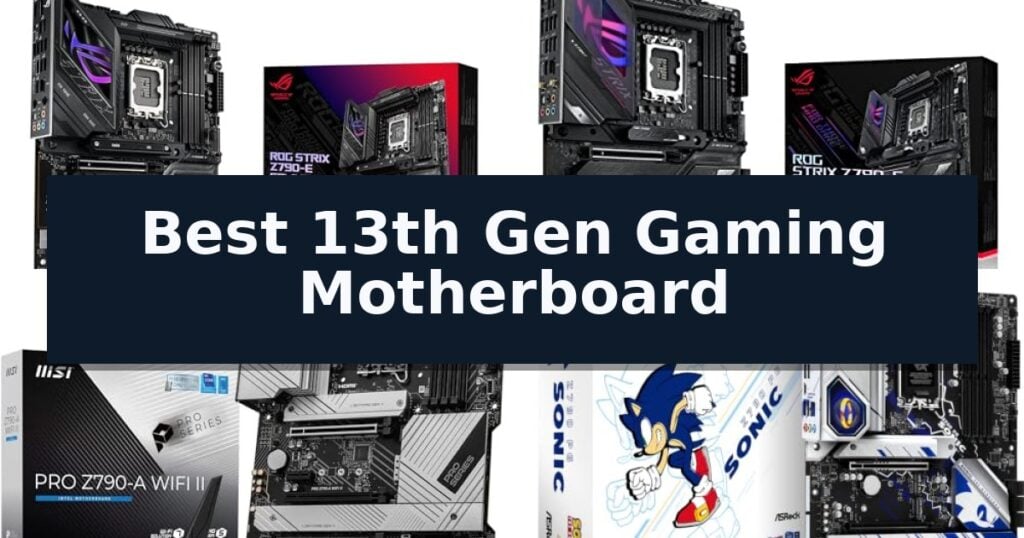
9 Best 13th Gen Gaming Motherboard in 2026 Reviews
Quick Comparison
| Product | Best For | Key Strength | Score |
|---|---|---|---|
| ASUS ROG Strix Z790-E Gaming WiFi II | Best Overall | Robust 18+1+2 power solution for stable voltage regulation. | 4.9 |
| ASUS ROG Strix Z790-E Gaming WiFi | High-End Overclocking and Cooling | 18+1 90A power stages for stable power delivery. | 4.4 |
| MSI PRO Z790-A WiFi II | Reliable Performance for High-End Builds | Robust 16 Duet Rail Power System with 80A SPS for stable CPU performance. | 4.5 |
| ASRock Z790 PG Sonic | Unique Aesthetic with Robust Power | PCIe 5.0 x16 slot for future-proof graphics card support. | 4.7 |
| MSI B760 Gaming Plus WiFi | Balanced Mid-Range DDR5 Gaming | 12 Duet Rail Power System for stable power delivery. | 4.6 |
| MSI PRO B760-P WiFi | Budget-Friendly ATX Foundation | 12+1 Duet Rail Power System for stable power delivery. | 4.5 |
| ASUS PRIME B760M-A AX D4 | Compact Build with DDR4 Support | DDR4 memory support for cost-effective system builds | 4.5 |
| MSI PRO B760M-P DDR4 | Essential Micro-ATX for Tight Spaces | Core Boost digital power design for enhanced CPU stability | 4.9 |
| ASRock B760M Pro-A D4 | Streamlined Micro-ATX Connectivity | 7+1+1 Dr.MOS power phase for stable CPU performance. | 4.4 |
How We Chose
To determine the best 13th Gen gaming motherboard, we evaluate boards based on their ability to sustain high-performance loads through robust power delivery and efficient thermal dissipation. We prioritize connectivity options that support modern peripherals and storage standards, ensuring each board provides a stable, long-term foundation for enthusiast gaming systems.
- Power delivery stability through VRM phase design and thermal management.
- Memory compatibility, specifically DDR5 overclocking headroom and signal integrity.
- PCIe 5.0 lane availability for current and future GPU or storage upgrades.
- Input/Output density including high-speed USB ports and networking standards.
- Form factor compatibility and physical clearance for large cooling solutions.
1 ASUS ROG Strix Z790-E Gaming WiFi II — Premium Power for Enthusiast Gaming
Building a high-performance system requires a foundation capable of handling the thermal and electrical demands of modern processors. The ASUS ROG Strix Z790-E Gaming WiFi II is engineered for this purpose, featuring a robust 18(110A)+1(110A)+2 power solution paired with dual ProCool II power connectors to ensure stable delivery for multi-core configurations.
Thermal management is addressed through a comprehensive cooling design. The motherboard utilizes massive heatsinks with an integrated I/O cover, connected by an L-shaped heatpipe to maintain efficiency under load. High-conductivity thermal pads further assist in dissipating heat from the VRM components, supporting sustained operation during intensive tasks.
For storage and expansion, the board offers extensive connectivity options. It includes a dedicated PCIe 5.0 M.2 slot equipped with a Combo-Sink U-shaped Direct Contact heatsink and backplate, alongside four additional PCIe 4.0 M.2 slots. The inclusion of a PCIe 5.0 x16 SafeSlot provides the necessary structural support for high-end graphics cards.
Connectivity is a primary focus of this model, highlighted by a front-panel connector supporting Power Delivery 3.0 up to 30W. The rear I/O panel is well-equipped with a 20Gbps USB port and eleven additional 10Gbps USB ports, ensuring ample bandwidth for peripherals and external devices.
Best for: Enthusiast gamers and power users who require extensive PCIe 5.0 storage support and high-wattage power delivery for multi-core processors.
Skip if: Users who do not require the advanced connectivity or the specific thermal overhead of the Z790 chipset may find more cost-effective options in lower-tier motherboard series.
- Robust 18+1+2 power solution for stable voltage regulation.
- Comprehensive PCIe 5.0 support for both M.2 storage and expansion slots.
- Advanced thermal management with integrated L-shaped heatpipe and high-conductivity pads.
- High-speed connectivity including USB 20Gbps and 30W front-panel power delivery.
- Premium feature set may exceed the requirements of standard gaming builds.
2 ASUS ROG Strix Z790-E Gaming WiFi — High-End Overclocking and Cooling
The ASUS ROG Strix Z790-E Gaming WiFi is engineered for high-performance computing, featuring an 18+1 90A power stage architecture designed to support the power demands of multi-core processors. This motherboard provides a robust foundation for building a system around Intel's 14th, 13th, and 12th Gen Core processors, utilizing the LGA 1700 socket for broad compatibility.
Thermal management is addressed through an optimized thermal design that includes dedicated VRM heatsinks, a PCH fanless heatsink, and double-sided M.2 heatsinks. These components work in tandem with hybrid fan headers and the Fan Xpert 4 utility to maintain stable operating temperatures during intensive tasks.
Connectivity and networking are prioritized with integrated WiFi 6E and Intel 2.5 Gb Ethernet, supported by ASUS LANGuard for reliable data throughput. The board also features extensive expansion options, including PCIe 5.0 support and five M.2 slots, one of which is PCIe 5.0 capable, ensuring high-speed storage and peripheral integration.
The board integrates several AI-driven features to streamline system maintenance and performance tuning. These include AI Overclocking, AI Cooling II, AI Networking via GameFirst VI, and AI noise cancellation, which collectively assist in optimizing the system's environment without requiring manual intervention for every variable.
Best for: Enthusiasts building a high-performance system who require extensive M.2 storage options and advanced AI-assisted thermal and power management.
Skip if: Users who do not require the advanced overclocking features or the high-density M.2 storage configuration and would prefer a more budget-oriented, standard ATX board.
- 18+1 90A power stages for stable power delivery.
- Comprehensive AI-driven optimization for cooling and networking.
- Extensive storage support with five M.2 slots.
- Future-ready with PCIe 5.0 support.
- Premium feature set may exceed the requirements of casual users.
3 MSI PRO Z790-A WiFi II — Reliable Performance for High-End Builds
Building a high-performance system requires a foundation capable of handling the thermal and electrical demands of modern processors. The MSI PRO Z790-A WiFi II is engineered for this exact purpose, utilizing a robust 16 Duet Rail Power System with 80A SPS stages to ensure stable power delivery for Intel 12th, 13th, and 14th Gen CPUs.
This ATX motherboard prioritizes thermal management through an extended heatsink design paired with 7W/mK MOSFET thermal pads. The integration of a 6-layer server-grade PCB with 2 oz. thickened copper further aids in heat dissipation, while dedicated pump-fan headers allow for precise control over liquid cooling loops.
For users focused on speed and storage, the board features four M.2 Gen4 x4 slots, each protected by M.2 Shield Frozr to mitigate thermal throttling during intensive data transfers. The primary PCIe 5.0 x16 slot is reinforced with Steel Armor to support heavy modern graphics cards, ensuring structural integrity under load.
Connectivity remains a highlight, with the board offering integrated Wi-Fi 6E and a 2.5G LAN controller for high-speed networking. Memory performance is supported by isolated circuitry designed for DDR5 modules, enabling overclocking speeds of 7800+ MT/s to maximize system throughput.
Best for: Builders seeking a reliable, feature-rich ATX platform for high-end Intel 13th Gen processors with a focus on thermal stability and fast storage.
Skip if: Users requiring a compact Mini-ITX form factor or those who do not intend to utilize DDR5 memory or PCIe 5.0 expansion cards.
- Robust 16 Duet Rail Power System with 80A SPS for stable CPU performance.
- Advanced thermal management including M.2 Shield Frozr and extended heatsinks.
- High-speed connectivity featuring Wi-Fi 6E and 2.5G LAN.
- DDR5 Memory Boost supporting overclocking up to 7800+ MT/s.
- ATX form factor may be too large for small-form-factor builds.
4 ASRock Z790 PG Sonic — Unique Aesthetic with Robust Power
The ASRock Z790 PG Sonic distinguishes itself with an officially licensed Sonic the Hedgehog aesthetic, integrating thematic elements directly into the heatsink and UEFI BIOS interface. Beyond its visual identity, this ATX motherboard is engineered to support 14th, 13th, and 12th Gen Intel Core processors, making it a specialized foundation for high-performance builds.
Performance-focused users will find the 14+1+1 phase power design with 50A Dr.MOS components capable of handling demanding workloads. The board supports DDR5 7200+ (OC) memory across four DIMM slots, allowing for up to 256 GB of RAM. For storage and expansion, it features a Blazing M.2 (PCIe Gen5x4) socket alongside four additional PCIe Gen4x4 M.2 slots, ensuring high-speed data throughput for modern NVMe drives.
Connectivity is robust, featuring a PCIe 5.0 x16 slot with SMT design to accommodate next-generation graphics cards. Networking is managed by the Killer E3100G 2.5 Gigabit LAN, which includes dedicated software for bandwidth prioritization. The rear I/O panel provides extensive options, including USB 3.2 Gen2x2 Type-C, HDMI 2.1, and DisplayPort 1.4 with DSC support for high-resolution output.
Installation is streamlined through features like the pre-installed I/O shield and the ASRock Auto Driver Installer. Users should verify chassis clearance for the ATX form factor (12.0" x 9.6") and ensure their CPU cooler is compatible with the LGA1700 socket before assembly.
Best for: Enthusiasts seeking a high-performance Z790 motherboard with a distinct, themed aesthetic and support for modern PCIe 5.0 and DDR5 standards.
Skip if: Users requiring a smaller form factor like Micro-ATX or Mini-ITX, or those who prefer a neutral, non-themed aesthetic for their build.
- PCIe 5.0 x16 slot for future-proof graphics card support.
- Extensive storage with one Gen5 and four Gen4 M.2 sockets.
- High-speed memory support up to 7200+ MHz via DDR5 overclocking.
- Intelligent networking via Killer 2.5G LAN software.
- ATX form factor requires a larger chassis for proper fitment.
- Themed aesthetic may not suit all minimalist or professional build styles.
5 MSI B760 Gaming Plus WiFi — Balanced Mid-Range DDR5 Gaming
Building a high-performance system for Intel's latest processors requires a foundation that balances power delivery with modern connectivity. The MSI B760 Gaming Plus WiFi provides a robust platform for 12th, 13th, and 14th Gen Intel Core processors, utilizing a 12 Duet Rail Power System with P-PAK VRMs to maintain stability under load.
Designed for enthusiasts who prioritize memory speed, this ATX motherboard features four DDR5 DIMM slots with isolated circuitry, supporting overclocking speeds of 6800+ MHz. The board is equipped with two PCIe 4.0 x16 slots, with the primary slot reinforced by Steel Armor to support heavy graphics cards, ensuring structural integrity for high-end builds.
Thermal management is addressed through an extended heatsink design paired with 7W/mK MOSFET thermal pads and a 6-layer PCB containing 2 oz. of thickened copper. Storage needs are met by dual M.2 Gen4 x4 slots, with the primary slot protected by M.2 Shield Frozr to mitigate thermal throttling during intensive data operations.
Connectivity is a highlight, featuring an integrated Intel Wi-Fi 6E module and Bluetooth 5.3 for wireless performance, alongside 2.5Gbps LAN for wired networking. The rear I/O panel includes USB 3.2 Gen 2 Type-C and Type-A ports, providing 10Gbps data transfer speeds for modern peripherals.
Best for: Builders seeking a reliable, mid-range ATX platform for DDR5-based 12th, 13th, or 14th Gen Intel systems.
Skip if: Users requiring legacy DDR4 memory support or those needing more than two M.2 storage slots.
- 12 Duet Rail Power System for stable power delivery.
- DDR5 memory support with overclocking capabilities up to 6800+ MHz.
- Integrated Wi-Fi 6E and 2.5Gbps LAN for high-speed networking.
- Steel Armor reinforcement on the primary PCIe slot.
- DDR5 memory only compatibility limits upgrade paths for existing DDR4 users.
- Limited to two M.2 slots for storage expansion.
6 MSI PRO B760-P WiFi — Budget-Friendly ATX Foundation
Building a high-performance system around Intel's latest processors requires a stable foundation that balances thermal management with power delivery. The MSI PRO B760-P WiFi DDR4 provides this through an enhanced 12+1 Duet Rail Power System, designed to maintain consistent voltage to the CPU even under demanding workloads.
The board is constructed with a 6-layer PCB using 2oz thickened copper, which aids in heat dissipation and signal integrity. To keep the system running cool during extended sessions, it features an extended heatsink and MOSFET thermal pads rated for 7W/mK, ensuring that critical components remain within safe operating temperatures.
Connectivity is a priority for modern builds, and this ATX motherboard includes integrated Wi-Fi 6E and Bluetooth 5.3 for high-speed wireless networking. For wired connections, the onboard 2.5Gbps LAN provides a fast data path, while the M.2 Shield Frozr protects your high-speed storage drives from thermal throttling.
This model supports DDR4 memory with speeds reaching 5333+MHz (OC), allowing users to leverage existing memory kits while benefiting from the performance gains of the 13th Gen architecture. With its combination of robust power delivery and comprehensive thermal solutions, it serves as a reliable base for a variety of system configurations.
Best for: Users looking for a reliable, feature-rich ATX motherboard that supports high-speed DDR4 memory and modern wireless connectivity for Intel 12th, 13th, and 14th Gen processors.
Skip if: Users who require DDR5 memory support or a smaller form factor like Micro-ATX or Mini-ITX will need to look at alternative motherboard options.
- 12+1 Duet Rail Power System for stable power delivery.
- Wi-Fi 6E and Bluetooth 5.3 integrated for advanced wireless connectivity.
- Premium thermal solutions including M.2 Shield Frozr and extended heatsinks.
- 6-layer PCB with 2oz thickened copper for enhanced durability and heat management.
- DDR4 memory limitation prevents the use of newer, faster DDR5 RAM modules.
7 ASUS PRIME B760M-A AX D4 — Compact Build with DDR4 Support
The ASUS PRIME B760M-A AX D4 provides a compact foundation for 13th Gen Intel Core processors, utilizing the LGA 1700 socket to support both 13th and 12th Gen Intel Core, Pentium Gold, and Celeron CPUs. This mATX motherboard is engineered for builders who prioritize a smaller footprint without sacrificing essential connectivity or thermal management.
Performance stability is supported by ASUS OptiMem II technology, which employs careful routing of traces and vias alongside ground layer optimizations to preserve signal integrity for improved memory overclocking. To maintain system health under load, the board features comprehensive cooling solutions, including dedicated VRM, M.2, and PCH heatsinks, complemented by hybrid fan headers and Fan Xpert 2+ software.
Connectivity options are robust for a board of this size, featuring PCIe 4.0 support and two M.2 slots for high-speed storage. Network and peripheral needs are met through integrated Wi-Fi 6, Realtek 2.5Gb Ethernet, rear USB 3.2 Gen 2 ports, and a front USB 3.2 Gen 1 Type-C header. The board is also CEC Tier II ready, reflecting modern power efficiency standards.
For aesthetic customization, the motherboard includes Aura Sync RGB Lighting, offering onboard Addressable Gen 2 headers and an Aura RGB header. This allows users to synchronize lighting effects across compatible hardware components, providing a cohesive look for the finished build.
Best for: Builders looking for a compact mATX motherboard that supports DDR4 memory and 13th Gen Intel processors with integrated Wi-Fi 6.
Skip if: Users who require DDR5 memory support or a full-size ATX form factor for additional PCIe expansion slots.
- DDR4 memory support for cost-effective system builds
- Integrated Wi-Fi 6 and 2.5Gb Ethernet for fast connectivity
- Comprehensive cooling with dedicated M.2 and VRM heatsinks
- Front USB 3.2 Gen 1 Type-C connectivity
- mATX form factor limits total expansion slot availability
- DDR4-only compatibility prevents use of newer DDR5 memory modules
8 MSI PRO B760M-P DDR4 — Essential Micro-ATX for Tight Spaces
Building a high-performance system requires a foundation that balances modern connectivity with efficient power delivery. The MSI PRO B760M-P DDR4 is engineered to support 12th, 13th, and 14th Gen Intel Core, Pentium Gold, and Celeron processors via the LGA 1700 socket, making it a versatile choice for users looking to leverage current Intel architecture within a compact form factor.
At the heart of this motherboard is a robust digital power design featuring Core Boost technology, which ensures stable power delivery to the CPU to maintain performance under load. For memory-intensive applications, the board utilizes Memory Boost to provide isolated, pure data signals, supporting dual-channel DDR4 memory at speeds of 4800+MHz through overclocking.
The board is designed for modern storage and expansion needs, incorporating PCIe 4.0 support and a Lightning Gen4 x4 M.2 slot. To manage thermal output during extended operation, the M.2 slot is equipped with an M.2 Shield Frozr, which helps maintain drive performance by dissipating heat effectively.
Measuring 9.6 inches by 9.6 inches, this mATX motherboard is well-suited for smaller chassis builds without sacrificing essential connectivity. It includes USB 3.2 Gen2 ports and multiple display outputs, including HDMI and DisplayPort, providing a straightforward interface for various system configurations.
Best for: Users building a compact 13th Gen Intel system who prioritize essential performance features and DDR4 memory compatibility.
Skip if: Users who require DDR5 memory support or a full-size ATX board for extensive multi-GPU or multi-drive expansion.
- Core Boost digital power design for enhanced CPU stability
- M.2 Shield Frozr thermal protection for high-speed storage
- PCIe 4.0 support for modern graphics and storage bandwidth
- Compact mATX form factor suitable for smaller PC cases
- DDR4 memory limitation prevents use of newer DDR5 standards
- mATX size offers fewer expansion slots than full ATX alternatives
9 ASRock B760M Pro-A D4 — Streamlined Micro-ATX Connectivity
Building a compact yet capable system requires a foundation that balances modern connectivity with efficient power delivery, and the ASRock B760M Pro-A D4 addresses this by integrating a 7+1+1 Power Phase with Dr.MOS design. This configuration ensures stable power for Intel's 14th, 13th, and 12th Gen processors, making it a reliable choice for users prioritizing a streamlined Micro-ATX footprint.
The board maximizes its small form factor by offering four DDR4 DIMM slots that support overclocking up to 5333+ MHz via XMP 2.0 profiles. Storage and expansion are handled through two Hyper M.2 (PCIe Gen4x4) slots and a pair of PCIe 4.0 x16 slots, providing sufficient bandwidth for modern gaming storage and peripheral configurations.
Connectivity is a highlight, featuring Dragon 2.5G LAN for high-speed networking and a comprehensive selection of I/O ports. Users benefit from both rear and front USB-C headers, alongside multiple USB-A and USB 2.0 ports. For systems utilizing integrated graphics, the board includes both HDMI 2.1 and DisplayPort 1.4 outputs.
Designed for versatility, the ASRock B760M Pro-A D4 is a practical solution for those who prefer to utilize existing DDR4 memory while upgrading to the latest Intel CPU architecture. Its layout is optimized for standard Micro-ATX cases, though builders should verify clearance for their specific cooling and GPU choices.
Best for: Builders seeking a compact Micro-ATX foundation that supports current Intel CPUs while leveraging existing DDR4 memory.
Skip if: Users who require DDR5 memory support or a full-sized ATX board for extensive multi-GPU or high-end expansion card setups.
- 7+1+1 Dr.MOS power phase for stable CPU performance.
- Supports high-speed DDR4 5333+ (OC) memory.
- Includes dual Hyper M.2 PCIe Gen4x4 slots for fast storage.
- Equipped with Dragon 2.5G LAN for optimized networking.
- DDR4 memory limitation prevents use of newer DDR5 standards.
- Micro-ATX form factor may limit expansion options compared to full ATX boards.
Best 13th Gen Gaming Motherboard Buying Guide
Power Delivery and Thermal Design
The power delivery system, or VRM, is critical for maintaining stability during intense gaming sessions. Boards with higher phase counts and high-amperage power stages are better equipped to handle the power spikes of top-tier processors without thermal throttling.
Effective cooling is equally important, as high-conductivity thermal pads and substantial heatsinks prevent the VRM components from overheating. Look for integrated heatpipes and extended coverage that connects the I/O shield to the main heatsink array for optimal heat distribution.
Memory Support and Overclocking
Modern gaming builds increasingly rely on high-frequency DDR5 memory to minimize latency. Motherboards with optimized trace routing and memory boost technology allow for higher stable clock speeds, which can provide a measurable improvement in frame rate consistency.
While some boards still support DDR4, moving to a DDR5-compatible motherboard is generally recommended for new 13th Gen builds. This ensures better compatibility with future memory modules and provides a clearer upgrade path as DDR5 prices continue to stabilize.
Connectivity and Expansion
The number of M.2 slots and PCIe lanes determines your system's ability to expand storage and add peripherals. A board with multiple Gen4 or Gen5 M.2 slots allows for high-speed NVMe storage arrays, which significantly reduce game load times.
Rear I/O connectivity, including USB 20Gbps ports and high-speed networking like 2.5Gb Ethernet or WiFi 7, is essential for modern setups. Ensure the board has enough internal headers to support your case's front-panel ports and any additional lighting or fan controllers.
Form Factor Considerations
ATX motherboards are the standard for most gaming builds, offering the most expansion slots and the easiest installation process. They provide ample space for large air coolers and multiple graphics cards if needed.
Micro-ATX boards are a practical choice for smaller, space-constrained builds. While they may have fewer expansion slots, they often retain the essential features of their larger counterparts, making them an efficient option for compact gaming systems.
BIOS and Software Features
A user-friendly BIOS interface is vital for adjusting fan curves, enabling XMP profiles, and managing system updates. Features like automated driver installers and AI-assisted overclocking can simplify the setup process for less experienced builders.
Software utilities that monitor system health and control RGB lighting add convenience. However, prioritize boards that offer stable, lightweight software that does not interfere with system performance or background processes.
Frequently Asked Questions
Can I use a 14th Gen processor with these 13th Gen motherboards?
Yes, most Z790 and B760 motherboards with the LGA 1700 socket support 14th Gen Intel processors, though a BIOS update may be required before installation.
Is DDR5 memory necessary for a 13th Gen gaming build?
While DDR4 is compatible with some B760 boards, DDR5 is recommended for 13th Gen systems to take full advantage of the platform's memory bandwidth and future-proofing capabilities.
What is the main difference between Z790 and B760 chipsets?
Z790 chipsets are designed for enthusiasts, offering more PCIe lanes, better overclocking support, and more robust power delivery, whereas B760 boards are more budget-friendly and lack advanced overclocking features.
Do I need a PCIe 5.0 slot for my graphics card?
Currently, most graphics cards utilize PCIe 4.0. A PCIe 5.0 slot is primarily a future-proofing feature that ensures compatibility with next-generation GPUs.
How do I know if my cooler will fit the motherboard?
Check the motherboard's CPU socket clearance and ensure your cooler includes an LGA 1700 mounting bracket, which is standard for most modern cooling solutions.
Conclusion: Our Top Pick
Choosing the right motherboard for your 13th Gen Intel processor depends on your specific performance goals and budget. For those seeking top-tier overclocking and connectivity, the ASUS ROG Strix Z790-E Gaming WiFi II is a standout choice that provides a comprehensive feature set for high-end gaming.
If you prefer a more balanced approach, options like the MSI PRO Z790-A WiFi II or the ASRock B760M Pro-A D4 offer excellent value and reliability. By focusing on your core needs—such as memory speed, storage expansion, and physical form factor—you can build a stable, high-performance system that meets your gaming requirements.