Patriot Viper Venom DDR5 Memory is our top choice for the Best 16GB DDR5 RAM for Gaming, offering a reliable 6000MT/s frequency that balances speed with broad platform support. The Corsair Vengeance DDR5 Memory serves as a strong alternative for users prioritizing tight latency, while the Patriot Viper Elite 5 DDR5 Memory provides a distinct aesthetic option for those seeking a single-module configuration.
Selecting high-performance memory requires balancing raw frequency against CAS latency to ensure your processor receives data without bottlenecks. While 16GB remains a standard capacity for modern gaming, the transition to DDR5 introduces new power management features and on-die error correction that improve stability during intensive sessions.
When building a system, compatibility with your motherboard's memory profiles is essential for achieving advertised speeds. Whether you are utilizing Intel XMP or AMD EXPO, verifying that your specific motherboard supports the kit's voltage and profile ensures you can reach peak performance without manual tuning.
If you are still weighing your options against older standards, our guide to Best 16GB DDR4 RAM provides a helpful comparison for those not yet ready to transition to the DDR5 platform.
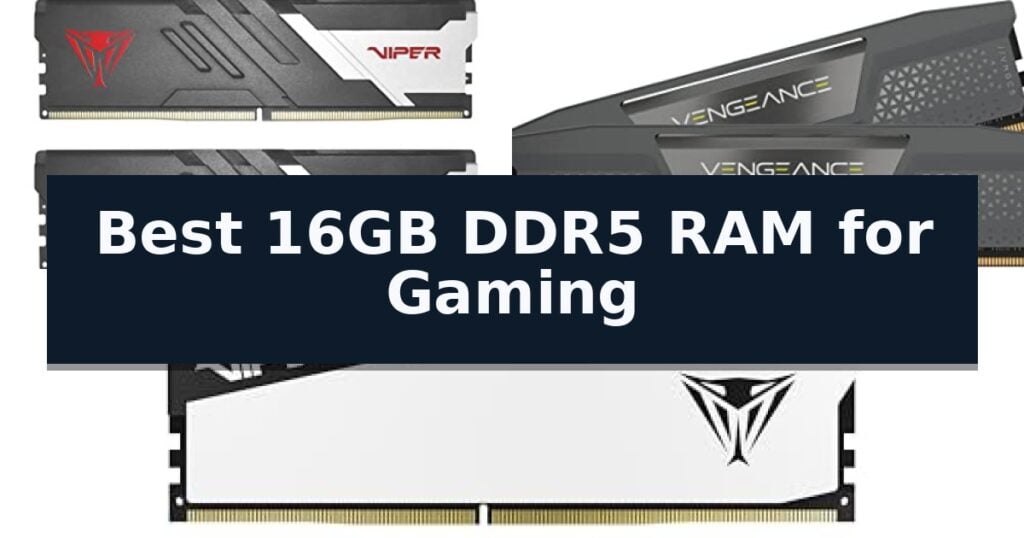
3 Best 16GB DDR5 RAM for Gaming in 2026 Reviews
Quick Comparison
| Product | Best For | Key Strength | Score |
|---|---|---|---|
| Patriot Viper Venom DDR5 Memory | Best Overall | High-speed 6000MT/s performance for improved gaming responsiveness. | 4.9 |
| Corsair Vengeance DDR5 Memory | Optimized for Tight Latency | AMD EXPO and Intel XMP 3.0 compatibility for platform flexibility. | 4.8 |
| Patriot Viper Elite 5 DDR5 Memory | Sleek Heat Spreader Design | On-Die ECC for improved data integrity. | 4.7 |
How We Chose
Evaluating 16GB DDR5 RAM for gaming requires a focus on how memory speed and latency interact with modern CPU architectures. We analyze technical specifications like MT/s and timing profiles to determine which kits provide the most stable, high-speed performance for gaming workloads, ensuring that each recommendation meets the demands of current-generation motherboards.
- Frequency and bandwidth throughput
- CAS latency and timing efficiency
- Compatibility with Intel XMP and AMD EXPO profiles
- Heat spreader design and thermal management
- On-die ECC and voltage regulation stability
1 Patriot Viper Venom DDR5 Memory — High-Speed Dual-Channel Performance
Optimizing system responsiveness for demanding gaming sessions often starts with high-frequency memory, and the Patriot Viper Venom DDR5 RAM 16GB (2X8GB) 6000MT/s CL36 is engineered to deliver that performance boost. By utilizing a 6000MT/s tested frequency, this kit provides the bandwidth necessary to keep pace with modern processors, ensuring smoother frame rates and reduced latency during intensive gameplay.
Designed for versatility, this memory kit features Intel XMP 3.0 and AMD EXPO support, allowing users to easily enable high-performance profiles through their motherboard BIOS. The 16GB capacity is configured as a dual-channel 2x8GB kit, which is a standard requirement for maintaining stability and speed in contemporary gaming builds. Furthermore, the inclusion of On-Die ECC (Error Correction Code) helps maintain data integrity, a critical feature for system reliability during long gaming sessions.
The Patriot Viper Venom DDR5 Memory is built as a UDIMM module, ensuring compatibility with standard desktop motherboards that support DDR5 architecture. With a voltage rating of 1.35v, it balances power delivery with the thermal demands of high-speed operation. The physical design is compact, measuring approximately 1.69 inches in height, which helps in maintaining clearance for various CPU cooling solutions.
Choosing the right memory involves balancing speed with system stability. This kit is specifically tuned for enthusiasts who want to leverage the benefits of the DDR5 standard without complex manual configuration. By focusing on tested timings of 36-46-46-110, the module ensures that the advertised speed is achievable on supported platforms, providing a straightforward upgrade path for gamers looking to maximize their hardware potential.
Best for: Gamers looking for a high-frequency, stable 16GB DDR5 upgrade that supports both Intel and AMD overclocking profiles.
Skip if: Users requiring higher memory density for professional workstation tasks like 4K video editing or 3D rendering, where 32GB or more is typically recommended.
- High-speed 6000MT/s performance for improved gaming responsiveness.
- Dual-channel 16GB configuration optimized for modern desktop systems.
- Broad compatibility with both Intel XMP 3.0 and AMD EXPO profiles.
- On-Die ECC for enhanced data integrity and system stability.
- 16GB total capacity may be limiting for heavy multitasking or professional creative workloads.
- CL36 latency is slightly higher than ultra-low latency kits available in the DDR5 market.
2 Corsair Vengeance DDR5 Memory — Optimized for Tight Latency
Achieving stable, high-speed memory performance requires hardware that supports modern standards, and the Corsair Vengeance DDR5 16GB (2 x 8GB) Up to 6000MHz AMD Intel RAM is engineered to meet these demands. By utilizing onboard voltage regulation, this memory kit allows for more precise and stable overclocking through the CORSAIR iCUE software, moving beyond the limitations of previous generation motherboard controls.
This memory kit is designed for versatility, featuring AMD EXPO and Intel XMP 3.0 compatibility. These dual memory profiles enable users to select optimized settings for their specific platform with ease. The modules are built with tightly screened memory chips, ensuring consistent quality and extended potential for those looking to push their system performance beyond stock settings.
Optimized for the latest motherboards, the Corsair Vengeance DDR5 Memory provides the bandwidth and response times necessary for demanding gaming environments. The gray aesthetic offers a low-profile look, while the physical dimensions of 5.3 inches in length and 0.3 inches in height ensure compatibility with a variety of desktop builds.
While the kit is rated for high speeds, it is important to note that reaching the maximum advertised frequency requires manual PC BIOS adjustments and overclocking. Performance outcomes remain dependent on the specific combination of CPU and motherboard used in the build, making it a component best suited for users comfortable with system-level configuration.
Best for: Gamers and PC builders who require high-speed, stable DDR5 memory with flexible compatibility for both AMD and Intel platforms.
Skip if: Users who prefer a plug-and-play experience without the need for BIOS adjustments or manual overclocking to reach peak speeds.
- AMD EXPO and Intel XMP 3.0 compatibility for platform flexibility.
- Onboard voltage regulation for improved overclocking stability.
- Tightly screened memory chips for reliable performance.
- Limited Lifetime Warranty for long-term support.
- Requires manual BIOS adjustments to achieve maximum rated speeds.
- Performance is dependent on the specific motherboard and CPU combination.
3 Patriot Viper Elite 5 DDR5 Memory — Sleek Heat Spreader Design
Upgrading your system memory requires a balance of speed and thermal management, and the Patriot Viper Elite 5 DDR5 Memory addresses this with a specialized aluminum heat spreader. This 16GB module is engineered to provide a stable foundation for high-performance computing, utilizing a sleek, low-profile design that integrates seamlessly into modern desktop builds.
Performance is driven by a 5600MT/s data rate, ensuring efficient throughput for demanding applications. The module incorporates On-Die ECC to enhance data integrity, a critical feature for maintaining stability during intensive tasks. Users can easily optimize their memory settings through support for XMP 3.0 and EXPO overclocking profiles, allowing for straightforward performance tuning on compatible Intel and AMD platforms.
Reliability is a core focus of this design, as the hardware has been rigorously tested across the latest DDR5 platforms. The aluminum heat spreader not only provides a distinct aesthetic but also serves a functional role in managing thermal output during sustained operation. With its UDIMM form factor, this memory is designed for standard desktop motherboard compatibility.
This 16GB single-stick configuration offers a practical entry point for those looking to leverage DDR5 technology without the complexity of multi-channel kits. Backed by a Limited Lifetime Warranty, the module is built to provide long-term service in high-performance environments.
Best for: Users seeking a reliable, high-speed DDR5 memory upgrade with integrated thermal management for modern desktop platforms.
Skip if: Users requiring multi-channel memory kits for specific dual-channel motherboard configurations or those needing higher total capacity than 16GB.
- On-Die ECC for improved data integrity.
- Aluminum heat spreader for effective thermal management.
- XMP 3.0 and EXPO support for easy performance tuning.
- Limited Lifetime Warranty for long-term peace of mind.
- Single-stick configuration may not maximize bandwidth compared to dual-channel kits.
Best 16GB DDR5 RAM for Gaming Buying Guide
Understanding Memory Frequency
Memory frequency, measured in MT/s, dictates how quickly data moves between your RAM and CPU. Higher frequencies generally allow for faster frame delivery in games, provided your processor can handle the increased throughput.
It is important to check your motherboard's QVL list to ensure it supports the specific frequency of your chosen kit. Attempting to run memory at speeds beyond your board's rated capacity can lead to system instability.
The Role of CAS Latency
CAS latency represents the delay between a command being issued and the data being available. While high frequency is vital, lower latency timings can often provide a more responsive experience in gaming.
Finding the right balance between high frequency and low latency is the key to optimizing your system. A kit with slightly lower speed but tighter timings can sometimes outperform a faster kit with loose, inefficient timings.
Platform Compatibility
Modern DDR5 kits often feature Intel XMP or AMD EXPO profiles to simplify the overclocking process. These profiles allow you to enable optimized settings directly in your BIOS with a single click.
Always verify that your kit specifically supports the profile type used by your processor platform. Using a kit optimized for one platform on another may still work, but it might require manual configuration to reach advertised speeds.
Thermal Management
DDR5 memory modules include on-board power management integrated circuits that generate heat during operation. Effective heat spreaders are necessary to maintain stability during long gaming sessions.
Low-profile heat spreaders are particularly useful for builds using large air coolers. Ensure your chosen RAM height does not conflict with your CPU cooling solution to avoid clearance issues.
Capacity Considerations
While 16GB is currently sufficient for most gaming titles, it represents the baseline for modern systems. If you frequently run background applications or stream while gaming, you may eventually need to consider higher capacities.
Choosing a 2x8GB kit allows you to take advantage of dual-channel memory architecture, which effectively doubles the bandwidth compared to a single-module setup. This is a critical performance factor for gaming.
Frequently Asked Questions
Is 16GB of DDR5 RAM enough for modern gaming?
Yes, 16GB is currently the standard for most gaming titles. However, if you multitask with many background programs or engage in content creation, you might eventually find 32GB more beneficial.
What is the difference between XMP and EXPO?
Intel XMP is designed for Intel-based systems, while AMD EXPO is optimized for AMD Ryzen processors. Both serve the same purpose of applying pre-configured, high-performance settings to your RAM.
Do I need to manually overclock my RAM?
Most DDR5 kits require you to enable the XMP or EXPO profile in your BIOS to reach their advertised speeds. If you do not enable these, the RAM will run at a lower, standard JEDEC speed.
Does RAM speed affect gaming frame rates?
Yes, faster RAM can improve minimum frame rates and reduce stuttering in CPU-bound games. The impact varies depending on the specific game and your overall system configuration.
Can I mix different brands of DDR5 RAM?
Mixing different kits is not recommended, even if they share the same speed. Different modules may have different internal chips or timings, which can cause system crashes or boot failures.
Conclusion: Our Top Pick
Our top pick is Patriot Viper Venom DDR5 Memory. Choosing the right 16GB DDR5 memory kit involves matching your motherboard's capabilities with the speed and latency profiles that best suit your CPU. Prioritizing kits with verified XMP or EXPO support ensures a smoother setup process and reliable performance during gaming.
By focusing on the balance between frequency and timing, you can ensure your system remains responsive and efficient. Always verify physical clearance for your heat spreaders to guarantee a trouble-free installation in your gaming rig.