ASUS ProArt Display PA329CDV is our pick for the Best OLED Monitors for Design because it combines professional-grade color accuracy with a 4K QD-OLED panel that meets the rigorous demands of color-critical creative work.
Designers require displays that offer more than just high contrast; they need reliable color reproduction and consistent performance across the entire screen. The PA329CDV stands out by providing factory-calibrated color accuracy and specialized features like Auto KVM, which streamline complex multi-device workflows for professionals.
When selecting a monitor for design, professionals should prioritize color gamut coverage, factory calibration reports, and connectivity options that support high-resolution peripherals. While gaming-focused OLEDs often prioritize refresh rates, design-centric models like this one focus on color precision and long-term panel reliability.
For those exploring the wider market, our guide to the Best OLED Monitors provides a broader look at available options beyond professional-specific models. If you are specifically looking for high-resolution displays, the Best OLED 4K Monitors guide details the top choices for maximum clarity.
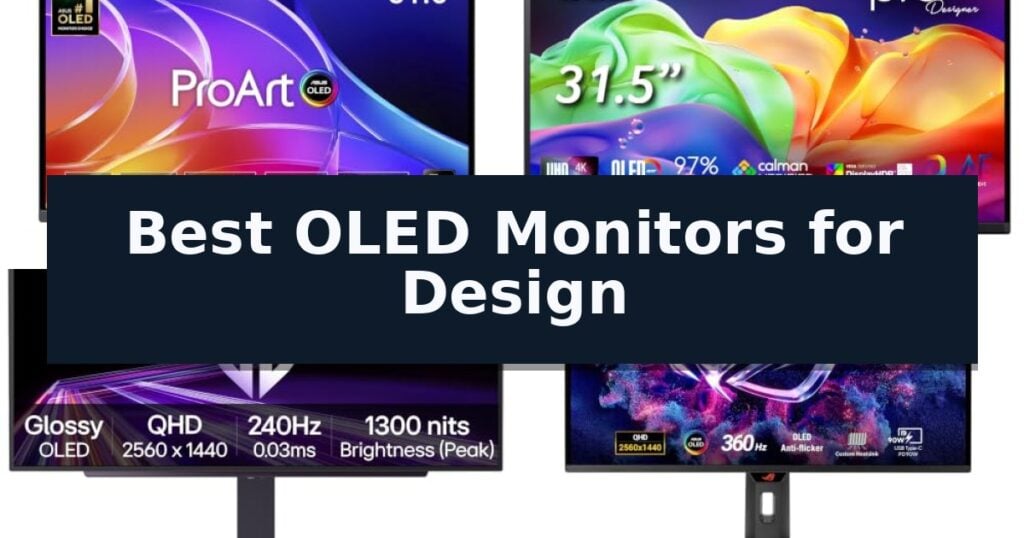
10 Best OLED Monitors for Design in 2026 Reviews
Quick Comparison
| Product | Best For | Key Strength | Score |
|---|---|---|---|
| ASUS ProArt Display PA329CDV | Best Overall | Factory-calibrated color accuracy with Delta E < 1.5. | 4.9 |
| Acer ProDesigner PE320QK | Pixel-Perfect Creator Precision | Exceptional color accuracy with Delta E | 4.5 |
| LG UltraGear 27GX704A-B | Vibrant Glossy OLED Clarity | Glossy OLED panel provides superior color vibrancy and clarity. | 4.7 |
| ASUS ROG Strix XG27ACDNG | High-Contrast Design Work | 99% DCI-P3 color gamut and Delta E < 2 for professional-grade color accuracy. | 4.4 |
| Samsung Odyssey OLED G6 | Pantone Validated Color Accuracy | Pantone Validated color reproduction for professional accuracy. | 4.6 |
| Alienware 34 QD-OLED AW3425DW | Expansive Ultrawide Workspace | High color accuracy with Delta E < 2. | 4.7 |
| Acer Predator X27U W1 | Stunning Cinematic Color | DCI-P3 99% color gamut for professional-grade color reproduction. | 4.6 |
| Deco Gear 27 OLED Monitor | Studio-Level Color Precision | 98% DCI-P3 color gamut for professional-grade color precision. | 4.6 |
| ASUS ROG XG27AQDMGR | TrueBlack Glossy Visuals | High-performance QHD WOLED panel with exceptional color accuracy and contrast. | 4.4 |
| Samsung Odyssey OLED G6 G60SD | Advanced Burn-In Protection | QD-OLED panel provides superior color spectrum and dynamic contrast. | 4.3 |
How We Chose
Selecting the right monitor for design requires a focus on technical precision rather than just visual impact. We evaluate these displays based on their ability to maintain color accuracy, handle high-resolution assets, and integrate into professional workflows, ensuring that the hardware supports the creative process without introducing color shifts or connectivity bottlenecks.
- Color Gamut Coverage: Assessing the percentage of DCI-P3 and AdobeRGB color spaces to ensure accurate color reproduction for print and digital media.
- Factory Calibration: Evaluating the presence of professional-grade calibration, specifically Delta E values, to ensure out-of-the-box color fidelity.
- Resolution and Clarity: Prioritizing 4K UHD resolution to provide the pixel density required for fine detail work and sharp text rendering.
- Connectivity and Workflow: Analyzing the inclusion of high-wattage USB-C power delivery and KVM functionality to support modern laptop-based design setups.
- Panel Protection and Warranty: Reviewing built-in burn-in mitigation technologies and the length of manufacturer support for professional usage.
1 ASUS ProArt Display PA329CDV — Professional Color Accuracy
Achieving professional-grade color fidelity requires hardware that bridges the gap between creative vision and technical output. The ASUS ProArt Display PA329CDV is engineered specifically for these high-stakes environments, utilizing a 31.5-inch 4K QD-OLED panel that delivers exceptional contrast and deep blacks. With a factory-calibrated Delta E < 1.5 and 99% DCI-P3 coverage, this monitor ensures that the colors you see on screen remain consistent throughout your entire post-production workflow.
Beyond its visual prowess, the display is built for high-performance tasks, featuring a 120Hz refresh rate and a 0.1ms response time. These specifications provide the fluid motion necessary for precise video editing and animation. To address the longevity concerns often associated with OLED technology, the unit includes a specialized anti-scratch film that provides 2.5x better panel protection than previous generations, making it a more viable candidate for busy, long-term studio use.
Workflow efficiency is central to the design, highlighted by a USB-C port that supports 96W Power Delivery. This allows users to power and charge a laptop while simultaneously handling data and video signals through a single cable. The integrated Auto KVM functionality further streamlines multi-device setups by enabling seamless switching between two connected computers, while dedicated Mac-optimized color temperature tuning ensures visual consistency when working across different operating systems.
The ergonomic stand provides comprehensive adjustment options, including tilt, swivel, pivot, and height settings, allowing for a customized workspace setup. While the large 31.5-inch footprint requires significant desk space, the inclusion of a 5-year warranty and a 3-month Adobe Creative Cloud subscription adds substantial value for professional users looking for a reliable, long-term display solution.
Best for: Professional designers and video editors who require high color accuracy, multi-device connectivity, and the deep contrast benefits of QD-OLED technology.
Skip if: Users who primarily perform static office work or text-heavy tasks may prefer an IPS panel to avoid the potential for image retention associated with OLED technology.
- Factory-calibrated color accuracy with Delta E < 1.5.
- Auto KVM and USB-C 96W PD support for efficient multi-device management.
- Enhanced panel protection via specialized anti-scratch film.
- Mac-optimized color temperature tuning for consistent cross-platform results.
- OLED panel technology requires careful management of static content to prevent burn-in.
- Large 31.5-inch footprint may be restrictive for smaller workspace environments.
2 Acer ProDesigner PE320QK — Pixel-Perfect Creator Precision
The Acer ProDesigner PE320QK distinguishes itself with a high-performance 31.5-inch 4K QD-OLED panel, designed to provide creators with exceptional color accuracy and depth. This monitor is Calman Verified and covers 97% of the AdobeRGB and 99% of the DCI-P3 color gamuts, ensuring that professional designers and photographers can rely on precise color representation for their workflows.
Engineered for fluid creative tasks, the display features a 120Hz refresh rate and a rapid 0.03ms (G to G) response time, which effectively eliminates ghosting during motion-heavy previews. The inclusion of AMD FreeSync Premium Pro technology further enhances visual consistency, while the VESA DisplayHDR True Black 500 certification ensures deep, accurate contrast levels for high-end editing.
Usability is a core focus, evidenced by the ErgoStand which offers extensive tilt, swivel, and height adjustment to accommodate various workspace setups. Additionally, the monitor includes Acer VisionCare Pro with TUV Eye Comfort Certification and BlueLightShield Pro, which are specifically integrated to reduce eye strain during extended design sessions.
Connectivity is robust, centered around a versatile USB 3.2 Type-C port that supports data transfer, DisplayPort, and 90W power delivery for single-cable laptop integration. Users can further customize their environment using the Creator Hub software, which allows for precise color space adjustments and multi-monitor configuration management.
Best for: Professional designers and video editors who require high-fidelity color accuracy and a seamless, high-refresh-rate workflow for their creative projects.
Skip if: Users who primarily need a budget-friendly monitor for general office tasks or those whose workspace cannot accommodate a large 31.5-inch display.
- Exceptional color accuracy with Delta E
- High-speed performance with 120Hz refresh rate and 0.03ms response time.
- Versatile connectivity featuring 90W power delivery via USB-C.
- Ergonomic design with extensive stand adjustability and eye-care features.
- Large footprint may not be suitable for smaller desk environments.
- Premium pricing reflects the specialized OLED and professional-grade feature set.
3 LG UltraGear 27GX704A-B — Vibrant Glossy OLED Clarity
The LG UltraGear 27GX704A-B distinguishes itself with a high-performance glossy OLED panel that prioritizes visual clarity and color depth, making it a compelling candidate for design-focused workflows that demand precise contrast and vibrant output. This 27-inch display utilizes a QHD resolution and supports up to 98.5% DCI-P3 color gamut, ensuring that creative projects are rendered with high intensity and accuracy.
Beyond its color capabilities, the monitor offers a 240Hz refresh rate and an exceptionally fast 0.03ms response time. These specifications, typically associated with gaming, also benefit designers by providing fluid motion and minimizing ghosting during high-speed interface navigation or video editing tasks. The inclusion of VESA DisplayHDR True Black 400 certification ensures deep black levels and high-contrast highlights, which are essential for color-critical work in dark environments.
Usability is enhanced through a suite of ergonomic adjustments, including height, tilt, swivel, and pivot controls, allowing for a flexible workspace setup. The monitor also features three UL certifications for anti-glare, flicker-free, and low blue light performance, which helps maintain visual comfort during long hours of design work. Connectivity is robust, featuring dual HDMI 2.1 ports and DisplayPort 1.4 for seamless integration with modern workstations.
To maintain the longevity of the OLED panel, the LG UltraGear 27GX704A-B includes integrated OLED Care features. These tools, accessible via on-screen controls, manage pixel care cycles and brightness settings to mitigate the risk of image retention. While the glossy finish provides a crisp, vivid image, users should consider their ambient lighting conditions to minimize potential reflections on the screen surface.
Best for: Designers who require high color accuracy, deep contrast, and a fast, responsive display for both creative work and high-refresh-rate applications.
Skip if: Users who work primarily in environments with intense, uncontrollable ambient light that may cause distracting reflections on the glossy screen surface.
- Glossy OLED panel provides superior color vibrancy and clarity.
- VESA DisplayHDR True Black 400 ensures deep, accurate black levels.
- Comprehensive ergonomic stand supports height, tilt, swivel, and pivot adjustments.
- Integrated OLED Care features help manage and mitigate image retention risks.
- Glossy screen finish may be prone to reflections in bright lighting environments.
- QHD resolution may be less sharp than 4K alternatives for fine-detail graphic design work.
4 ASUS ROG Strix XG27ACDNG — High-Contrast Design Work
Achieving precise color reproduction for professional design work requires hardware that balances deep contrast with accurate color output. The ASUS ROG Strix XG27ACDNG leverages a 26.5-inch QD-OLED panel to deliver vibrant visuals, making it a compelling choice for designers who prioritize color fidelity and high-speed performance.
This monitor is built for demanding workflows, featuring a 99% DCI-P3 color gamut and true 10-bit color depth. With a Delta E < 2 color difference rating, it provides the accuracy necessary for color-critical tasks. The display is VESA DisplayHDR 400 True Black compliant, ensuring that blacks are rendered with depth and contrast that standard LED panels cannot replicate.
To address the longevity concerns often associated with OLED technology, the monitor includes a custom heatsink and an advanced airflow design. These hardware solutions work alongside ASUS OLED Care+ functions to actively manage thermal output and mitigate the risk of burn-in. Users can manage these protective features and display settings directly through the DisplayWidget Center software, allowing for adjustments without navigating complex on-screen menus.
While optimized for gaming with a 360Hz refresh rate and 0.03ms response time, the monitor's technical specifications translate well to design environments where fluid motion and sharp clarity are required. The inclusion of ROG-exclusive OLED Anti-flicker technology further supports extended work sessions by minimizing visual fatigue caused by refresh-rate fluctuations.
Best for: Designers and creative professionals who require high color accuracy, deep contrast, and a responsive interface for both creative work and high-refresh-rate tasks.
Skip if: Users who require a 4K resolution display for ultra-high-density pixel work, as this model is limited to QHD (2560 x 1440) resolution.
- 99% DCI-P3 color gamut and Delta E < 2 for professional-grade color accuracy.
- QD-OLED panel provides superior contrast and VESA DisplayHDR 400 True Black performance.
- Custom heatsink and OLED Care+ software help manage thermal performance and panel longevity.
- 3-year warranty includes specific coverage for burn-in.
- QHD resolution may not provide the pixel density required for 4K-specific design workflows.
- OLED technology requires active management via provided software to maintain long-term panel health.
5 Samsung Odyssey OLED G6 — Pantone Validated Color Accuracy
The Samsung 27" Odyssey OLED G6 (G61SH) distinguishes itself with a high-performance QD-OLED display that brings QHD resolution to creative and gaming workflows. Designed for precision, this monitor is Pantone Validated, ensuring the accurate reproduction of over 2,100 colors and 110 skin tone shades, which is essential for color-critical design tasks.
Beyond color accuracy, the monitor features Glare-Free Technology to minimize external light interference, maintaining visual clarity in varied lighting environments. The inclusion of HDR10 support enhances the display's depth, providing nuanced shadows and brighter highlights that allow designers to see finer details in their work.
Performance is bolstered by a 240Hz refresh rate and an ultra-fast 0.03ms response time, which ensure smooth motion for video editing or high-motion design projects. To maintain the longevity of the panel, OLED Safeguard technology utilizes a thermal modulation system to actively manage heat and prevent burn-in during extended use.
The physical design prioritizes user comfort with a height-adjustable ergonomic stand that supports tilting, swiveling, and pivoting. This flexibility allows designers to orient the screen to their specific workspace requirements, while the overall build is backed by a 3-year manufacturer warranty for long-term support.
Best for: Designers and creative professionals who require high color accuracy, fast response times, and a versatile ergonomic workspace.
Skip if: Users who require 4K resolution for ultra-high-density detail or those who primarily work in static environments where a standard IPS panel might be more cost-effective.
- Pantone Validated color reproduction for professional accuracy.
- QD-OLED display technology providing high brightness and deep contrast.
- OLED Safeguard thermal modulation to protect against burn-in.
- 240Hz refresh rate and 0.03ms response time for fluid performance.
- QHD resolution may be insufficient for users needing 4K-level pixel density.
- OLED technology requires active management to ensure long-term screen health.
6 Alienware 34 QD-OLED AW3425DW — Expansive Ultrawide Workspace
Designers seeking a high-fidelity visual workspace often prioritize color precision and contrast, making the Alienware 34 240Hz QD-OLED Curved Gaming Monitor – AW3425DW – 34.2-inch WQHD (3440 x 1440) 0.03ms Display, 1800R Curve, AMD FreeSync Premium Pro, VESA AdaptiveSync, DisplayHDR TrueBlack 400 a compelling candidate for professional workflows. This monitor leverages advanced QD-OLED technology to deliver an infinite contrast ratio, ensuring that deep blacks and vibrant highlights remain distinct, which is essential for detailed photo editing and color grading tasks.
The display offers a wide color gamut with DCI-P3 99.3% color coverage and a Delta E < 2 accuracy rating, providing the color fidelity required for professional design environments. Its 34.2-inch WQHD resolution provides an expansive canvas, allowing designers to manage multiple application windows simultaneously without the need for a multi-monitor setup. The 1800R curve is specifically engineered to maintain consistent viewing angles across the entire ultrawide field of view, which helps minimize peripheral distortion and keeps the user focused on the center of their work.
For high-speed motion and fluid navigation, the monitor integrates NVIDIA G-SYNC Compatible, AMD FreeSync Premium Pro, and VESA AdaptiveSync technologies. While these features are often associated with gaming, they contribute to a smooth, tear-free visual experience during complex design software operations. The inclusion of VESA DisplayHDR TrueBlack 400 certification and 1000 nits peak HDR brightness further enhances the display's ability to render high-dynamic-range content with clarity.
Prospective buyers should note the physical footprint of this unit, as the 34-inch curved form factor demands significant desk depth and width. While the curved design excels at immersion and viewing consistency, it may present a trade-off for users involved in technical architectural or CAD drafting, where perfectly flat lines are a requirement. The monitor is backed by a 3-Years Warranty, providing long-term support for professional setups.
Best for: Designers who require a wide, color-accurate workspace with high contrast for professional visual editing and multitasking.
Skip if: Users who require a flat screen for technical drafting or those who do not have the desk depth to accommodate a 34-inch curved ultrawide display.
- High color accuracy with Delta E < 2.
- Infinite contrast ratio provided by QD-OLED technology.
- Expansive 34-inch ultrawide workspace for efficient multitasking.
- 1800R curve for improved viewing consistency across the display.
- Curved form factor may not be suitable for precision architectural or CAD drafting.
- Large footprint requires significant desk space.
7 Acer Predator X27U W1 — Stunning Cinematic Color
Achieving professional-grade color accuracy and fluid motion requires hardware that balances high-speed performance with precise visual output. The Acer Predator X27U W1 is built around a WQHD quantum dot OLED panel, a technology choice that provides deep, true blacks and high-contrast visuals essential for detailed graphic design and photo editing. By utilizing quantum dot technology, this monitor ensures that colors remain vibrant and consistent across the entire screen, which is vital when working with complex color-sensitive projects.
Beyond its static image quality, the monitor is engineered for responsiveness, featuring a 240Hz refresh rate and an ultra-fast 0.03ms (G to G) response time. While these specifications are often associated with gaming, they provide a distinct advantage for creative professionals by ensuring that scrubbing through high-resolution video timelines or navigating dense design software interfaces remains fluid and free of ghosting. This level of performance helps maintain focus during long sessions of intensive visual work.
The physical construction of the Acer Predator X27U W1 emphasizes workspace efficiency through its ZeroFrame aesthetic, which minimizes bezel thickness to maximize screen real estate. This design is particularly beneficial for multi-window workflows where space is at a premium. Furthermore, the included Ergo Stand offers flexible positioning, allowing users to adjust the monitor to their preferred ergonomic height and angle. Connectivity is handled by dual HDMI 2.1 and dual DisplayPort inputs, ensuring the display integrates seamlessly into modern workstations.
For color-critical tasks, the monitor supports a DCI-P3 99% color gamut and maintains a Delta E < 2 accuracy rating. These specifications mean the display is capable of reproducing a wide range of colors with high fidelity, reducing the need for constant recalibration. While the 26.5-inch size and WQHD resolution are optimized for a balance of pixel density and field-of-view, users who require 4K resolution for ultra-high-density pixel work may find the screen real estate limited compared to larger, higher-resolution alternatives.
Best for: Designers and creative professionals who require high color accuracy, deep contrast, and a responsive interface for detailed visual work.
Skip if: Users who require a 4K resolution display for ultra-high-density pixel work or those who prefer a larger screen size beyond 26.5 inches.
- DCI-P3 99% color gamut for professional-grade color reproduction.
- Quantum dot OLED technology providing deep contrast and true blacks.
- ZeroFrame design for a clean, expansive workspace.
- Ergo Stand allows for flexible monitor positioning.
- WQHD resolution may be less suitable for users needing 4K pixel density.
- 26.5-inch size is fixed and may not meet the needs of those requiring larger canvases.
8 Deco Gear 27 OLED Monitor — Studio-Level Color Precision
Achieving professional color accuracy requires hardware that prioritizes visual fidelity and responsiveness. The Deco Gear 27 OLED Monitor addresses this need by utilizing self-lit pixels to deliver infinite contrast and deep, true blacks, providing a high-performance foundation for design and content creation workflows.
Engineered for both speed and precision, this monitor features a 280Hz refresh rate and a 0.03ms response time, ensuring fluid motion during intensive tasks. The QHD resolution combined with a 98% DCI-P3 color gamut offers the clarity and color depth necessary for studio-level accuracy, while HDR400 support enhances brightness and contrast for a more immersive viewing experience.
Designers often face long hours at their desks, and this model includes a height-adjustable stand that allows for tilting, swiveling, and pivoting to maintain an ergonomic setup. The inclusion of a low blue light mode and a non-glare, borderless design helps reduce eye strain during extended editing or rendering sessions.
Connectivity is streamlined through dual HDMI 2.1 and DisplayPort 1.4 ports, supporting high-speed data transfer for various professional setups. By integrating Adaptive Sync technology, the monitor maintains consistent performance, effectively eliminating screen tearing and stuttering, which is essential for maintaining focus during complex creative projects.
Best for: Designers and content creators who require high color accuracy and fast response times for professional-grade creative workflows.
Skip if: Users who prioritize 4K resolution for ultra-high-density detail or those who require a larger screen format for complex multi-window layouts.
- 98% DCI-P3 color gamut for professional-grade color precision.
- 0.03ms response time and 280Hz refresh rate for fluid motion.
- Infinite contrast provided by self-lit OLED pixels.
- Highly adjustable stand supporting tilt, swivel, and pivot for ergonomic comfort.
- QHD resolution may not satisfy users requiring 4K pixel density for specific high-resolution design tasks.
9 ASUS ROG XG27AQDMGR — TrueBlack Glossy Visuals
Achieving precise color accuracy and fluid motion is essential for professional design workflows, and the ASUS ROG XG27AQDMGR addresses these needs with its high-performance 26.5-inch QHD (2560 x 1440) TrueBlack Glossy WOLED panel. This monitor is engineered to deliver deep contrast and vibrant visuals, making it a compelling candidate among the Best OLED Monitors for Design.
The display is built for demanding visual tasks, featuring 99% DCI-P3 color gamut coverage and true 10-bit color depth. With a Delta E < 2 color difference, it provides the high level of color fidelity required for color-critical work. Designers also benefit from the VESA DisplayHDR 400 True Black compliance, which ensures deep blacks and bright highlights for accurate HDR content evaluation.
Beyond static image quality, the monitor excels in responsiveness with a 0.03ms gray-to-gray response time and a 240 Hz refresh rate. These specifications minimize motion blur, which is particularly beneficial for those working with motion graphics or video editing. The inclusion of ELMB Sync further enhances motion clarity during fast-paced sequences.
ASUS has integrated several tools to maintain panel longevity, including OLED Care Pro and a Neo Proximity Sensor. The sensor detects user presence and automatically switches to a black screen when the user is away, helping to mitigate the risk of burn-in. Users can manage these protective features and calibrate display settings directly through the ASUS DisplayWidget Center software, streamlining the workflow without needing to navigate physical buttons.
The package includes a 3-year warranty with burn-in coverage, providing long-term peace of mind for professional use. Additionally, the purchase includes a free 3-month Adobe Creative Cloud subscription, offering immediate access to industry-standard design tools.
Best for: Professional designers and motion graphics artists who require high color accuracy, deep contrast, and fast response times for their creative workflows.
Skip if: Users who primarily perform static document-based work for extended hours may prefer a non-OLED display to avoid any concerns regarding burn-in maintenance.
- High-performance QHD WOLED panel with exceptional color accuracy and contrast.
- OLED Care Pro technology with proximity sensor to protect the screen.
- Ultra-fast 0.03ms response time and 240Hz refresh rate for smooth motion.
- 3-year warranty that explicitly includes burn-in coverage.
- Glossy screen surface may require careful lighting management to avoid unwanted reflections in bright environments.
10 Samsung Odyssey OLED G6 G60SD — Advanced Burn-In Protection
Precision and visual fidelity are the primary requirements for creative work, and the Samsung 27” Odyssey OLED G6 (G60SD) Series Gaming Monitor addresses these needs through its advanced QD-OLED panel technology. By utilizing self-emissive pixels, this display achieves near-infinite contrast ratios and pure black levels, ensuring that color-critical design tasks are rendered with high depth and accuracy.
To maintain consistent performance, the monitor integrates a Dynamic Cooling System that utilizes a pulsating heat pipe to diffuse thermal energy five times more effectively than traditional graphite methods. This is complemented by a Thermal Modulation System that uses predictive algorithms to adjust brightness based on surface temperature, protecting the panel during extended design sessions.
Usability is enhanced by specialized burn-in prevention features, including Logo and Taskbar Detection, which automatically reduces brightness on static elements common in professional software interfaces. The Glare Free technology further supports design workflows by minimizing external light reflections, allowing for clear visibility of fine details in both bright and dark environments.
The monitor features a slim 3.9mm profile and a high-speed 360Hz refresh rate with a 0.03ms response time, providing a fluid interface for high-resolution creative applications. Connectivity is supported via HDMI 2.1 and DisplayPort, ensuring compatibility with modern workstation hardware.
Best for: Designers who require perfect black levels, high color accuracy, and advanced thermal management for long-duration creative workflows.
Skip if: Users who primarily work with static, high-brightness UI elements for the vast majority of their day and prefer a non-OLED panel to avoid any risk of image retention.
- QD-OLED panel provides superior color spectrum and dynamic contrast.
- Dynamic Cooling System with pulsating heat pipe prevents thermal-related burn-in.
- Glare Free technology maintains image clarity in various lighting conditions.
- Logo and Taskbar Detection protects the panel from static image retention.
- OLED technology requires active management of static elements to ensure long-term panel health.
Best OLED Monitors for Design Buying Guide
Color Accuracy and Gamut
For design professionals, color accuracy is the most critical metric. A monitor must cover a wide color gamut, such as 99% DCI-P3 or AdobeRGB, to ensure that the colors seen on screen match the final output, whether for print or web.
Factory calibration is equally important. Look for monitors that provide a pre-calibration report with a Delta E value of less than 2. This ensures that the display is accurate right out of the box, saving time on manual adjustments.
Resolution and Pixel Density
Design work often involves intricate details that require high pixel density. A 32-inch 4K display offers a superior balance of screen real estate and sharpness, allowing for multiple tool palettes and high-resolution images to be viewed simultaneously.
While lower resolutions might suffice for some tasks, 4K is the industry standard for professional design. It prevents pixelation when zooming into fine lines or textures, providing a more accurate representation of the final project.
Connectivity for Creative Workflows
Modern designers often use laptops as their primary workstations. A monitor with high-wattage USB-C power delivery allows for a single-cable connection, charging the laptop while simultaneously carrying video and data signals.
Built-in USB hubs and KVM switches are also valuable for those using multiple computers. These features allow you to control two devices with a single set of peripherals, keeping your workspace clean and efficient.
Burn-in Mitigation and Longevity
OLED technology is susceptible to image retention, particularly with static elements like toolbars and menus. Professional monitors often include advanced cooling systems and software-based pixel-refresh cycles to mitigate this risk.
Always check the manufacturer's warranty regarding burn-in coverage. A longer warranty period, especially one that explicitly covers image retention, provides peace of mind for professionals who use their monitors for extended daily sessions.
Ergonomics and Viewing Comfort
Designers spend long hours at their desks, making ergonomics a non-negotiable factor. A fully adjustable stand that allows for height, tilt, swivel, and pivot adjustments is essential for maintaining a healthy posture.
Additionally, features like anti-glare coatings or blue light filters can significantly reduce eye strain. These additions ensure that the monitor remains comfortable to use during long design marathons, preventing fatigue.
Frequently Asked Questions
Why is OLED preferred for design over IPS?
OLED monitors offer infinite contrast ratios and perfect black levels, which are difficult for traditional IPS panels to replicate. This provides a more accurate representation of shadows and depth in visual content.
Do I need a 4K resolution for design work?
Yes, 4K resolution is highly recommended for design. It provides the necessary pixel density to view fine details without pixelation, which is crucial for precision work like photo editing or vector illustration.
How do I prevent burn-in on an OLED design monitor?
Most modern OLED monitors include built-in features like pixel shifting, screen savers, and automatic refresh cycles. Additionally, hiding taskbars and using dark mode can help reduce the risk of static image retention.
Is a 120Hz refresh rate necessary for design?
While 120Hz is primarily a gaming feature, it does make the user interface and cursor movement feel smoother, which can improve the overall experience of navigating design software.
What is the benefit of a KVM switch in a design monitor?
A KVM switch allows you to use one keyboard and mouse to control two different computers connected to the same monitor, making it easier to switch between a desktop and a laptop.
Conclusion: Our Top Pick
Choosing the right OLED monitor for design involves balancing color precision, resolution, and connectivity. The ASUS ProArt Display PA329CDV stands out by integrating these professional requirements into a reliable package designed for long-term creative use.
By prioritizing factory-calibrated color and robust build quality, designers can ensure their hardware enhances their workflow rather than hindering it. Investing in a monitor that specifically addresses the needs of creative professionals will yield better results and a more efficient workspace.