ASUS ROG Strix QD-OLED Gaming Monitor earns our recommendation for the Best OLED Monitors for PC Gaming because it combines a high-speed 360Hz refresh rate with robust burn-in protection features, making it a reliable choice for competitive play.
Selecting a display for high-end gaming requires balancing raw speed with visual fidelity. QD-OLED panels offer superior contrast and color depth compared to traditional LCDs, but they necessitate careful consideration of cooling and pixel-maintenance features to ensure longevity during long sessions.
When evaluating these monitors, we focus on how panel technology impacts motion clarity and color reproduction. Features like anti-flicker technology and specialized heatsinks are essential for maintaining performance, while connectivity options like HDMI 2.1 ensure compatibility with modern high-refresh-rate hardware.
For a broader look at the market, our guide to the Best OLED Gaming Monitors provides additional context on panel types and sizing. If you specifically prioritize competitive shooters, the Best OLED Monitors for FPS Gaming highlights models optimized for the lowest possible latency.
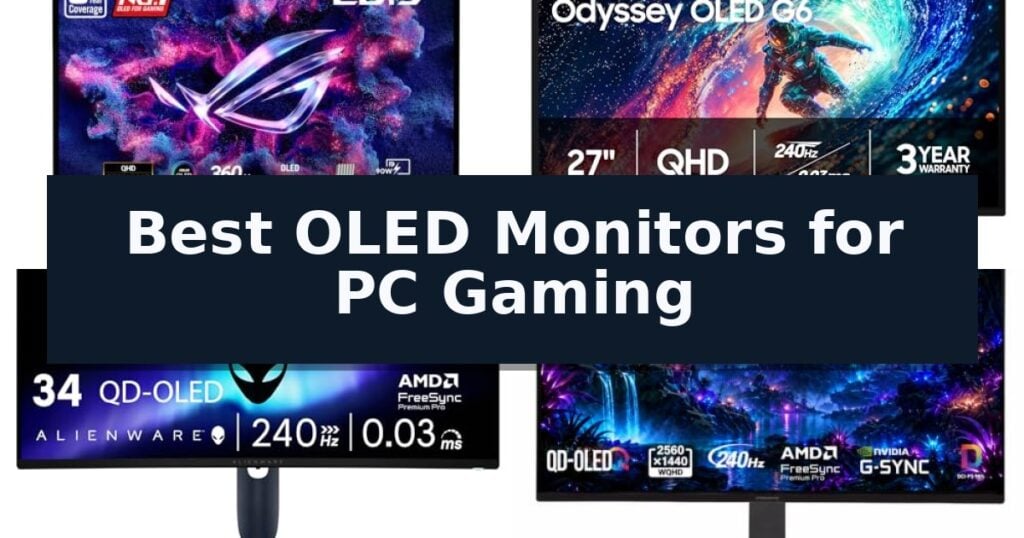
7 Best OLED Monitors for PC Gaming in 2026 Reviews
Quick Comparison
| Product | Best For | Key Strength | Score |
|---|---|---|---|
| ASUS ROG Strix QD-OLED Gaming Monitor | Best Overall | 360Hz refresh rate with 0.03ms response time for competitive motion clarity. | 4.9 |
| Samsung Odyssey OLED G6 Gaming Monitor | Glare-free display technology | Glare-Free Technology significantly reduces distracting reflections. | 4.4 |
| Alienware 34 QD-OLED Gaming Monitor | Immersive ultrawide curved screen | 240Hz refresh rate and 0.03ms response time for high-speed motion clarity. | 4.9 |
| Acer Predator QD-OLED Gaming Monitor | Color-accurate quantum dot visuals | 0.03ms response time for minimal motion blur | 4.8 |
| LG UltraGear OLED Gaming Monitor | Vibrant glossy panel finish | Ultra-fast 0.03ms response time for minimal ghosting. | 4.7 |
| ASUS ROG Glossy OLED Gaming Monitor | Proximity sensor burn-in protection | 0.03ms response time for minimal ghosting. | 4.8 |
| AOC Gaming QD-OLED Monitor | High-contrast true black performance | QD-OLED panel provides infinite contrast and vivid color reproduction. | 4.9 |
How We Chose
Evaluating the best OLED monitors for PC gaming requires a technical assessment of panel performance and long-term reliability. We prioritize displays that maintain high refresh rates without sacrificing color accuracy or HDR peak brightness. Our process involves analyzing cooling efficiency and pixel-care software to determine which models offer the most sustainable performance for dedicated enthusiasts.
- Refresh rate and response time capabilities for motion clarity
- Panel technology and color gamut coverage
- Integrated burn-in prevention and cooling systems
- Connectivity standards including HDMI 2.1 and DisplayPort
- Ergonomic adjustability and physical build quality
1 ASUS ROG Strix QD-OLED Gaming Monitor — Fastest 360Hz refresh rate
The ASUS ROG Strix 26.5” 1440P QD-OLED Gaming Monitor (XG27ACDNG) delivers a high-performance visual experience by combining a 360Hz refresh rate with an ultra-fast 0.03ms response time. This combination ensures fluid motion and minimal ghosting for competitive gaming, supported by the vibrant color reproduction of QD-OLED panel technology.
Engineered for longevity, the monitor incorporates a custom heatsink and advanced airflow design to manage thermal output effectively. These hardware protections are complemented by ASUS OLED Care+ functions, which work to mitigate the risk of burn-in during extended use. The inclusion of ROG-exclusive OLED Anti-flicker technology further stabilizes the image during fluctuating frame rates.
Visual fidelity is maintained through VESA DisplayHDR 400 True Black compliance and a 99% DCI-P3 color gamut, ensuring deep blacks and accurate color representation. The monitor also features G-SYNC Compatible technology to facilitate a tear-free gaming experience, while AI Gaming features provide intelligent performance enhancements to optimize settings on the fly.
Users can manage these advanced features through the DisplayWidget Center software, which allows for intuitive adjustments using a mouse rather than physical buttons. The package includes a 3-year warranty that explicitly covers burn-in, providing long-term assurance for the display's performance.
Best for: Competitive gamers seeking a high-refresh-rate display with advanced thermal management and burn-in protection.
Skip if: Users who require a 4K resolution display for professional creative work or those with limited desk space who prefer a smaller form factor.
- 360Hz refresh rate with 0.03ms response time for competitive motion clarity.
- Custom heatsink and advanced airflow for effective thermal management.
- 3-year warranty including specific coverage for burn-in.
- DisplayWidget Center software for convenient settings control.
- QHD resolution may not meet the needs of users prioritizing 4K pixel density.
- Premium feature set results in a larger physical footprint compared to standard monitors.
2 Samsung Odyssey OLED G6 Gaming Monitor — Glare-free display technology
The Samsung 27" Odyssey OLED G6 (G61SH) distinguishes itself with Glare-Free Technology, specifically engineered to maintain a clear, reflection-free display even in environments with challenging external light sources. This 27-inch monitor leverages a high-performance QD-OLED display to deliver vibrant color reproduction and deep contrast, making it a compelling choice for users prioritizing visual fidelity during intense gaming sessions.
Performance is driven by a rapid 240Hz refresh rate and a near-instant 0.03ms response time, which work in tandem to minimize motion blur and input lag. The integration of AMD FreeSync Premium further enhances the experience by reducing screen tearing and choppiness. For color accuracy, the monitor is Pantone Validated, ensuring it can reproduce over 2100 colors and 110 skin tone shades with precision.
To address the long-term maintenance of OLED panels, the unit includes OLED Safeguard technology, which utilizes a thermal modulation system to actively manage heat and mitigate the risk of burn-in. The monitor also supports HDR10, providing nuanced shadow detail and bright highlights to increase the perceived depth of in-game environments.
Ergonomics and versatility are addressed through the included height-adjustable stand, which supports pivoting, tilting, and swiveling to accommodate various desk setups. The Samsung 27" Odyssey OLED G6 (G61SH) is backed by a 3-year manufacturer warranty, providing long-term support for its advanced display components.
Best for: Gamers who require high-speed motion handling and color accuracy in a room with significant ambient light.
Skip if: Users who require a 4K resolution display for professional creative work or those who prefer a larger screen size beyond 27 inches.
- Glare-Free Technology significantly reduces distracting reflections.
- Ultra-fast 0.03ms response time and 240Hz refresh rate for smooth motion.
- OLED Safeguard thermal modulation system helps protect against burn-in.
- Pantone Validated color accuracy for lifelike visuals.
- QHD resolution may be less sharp than 4K alternatives for non-gaming tasks.
- 27-inch size may feel restrictive for users accustomed to ultrawide or larger displays.
3 Alienware 34 QD-OLED Gaming Monitor — Immersive ultrawide curved screen
The Alienware 34 240Hz QD-OLED Curved Gaming Monitor – AW3425DW – 34.2-inch WQHD (3440 x 1440) 0.03ms Display, 1800R Curve, AMD FreeSync Premium Pro, VESA AdaptiveSync, DisplayHDR TrueBlack 400 is engineered for users who prioritize high-fidelity visuals and rapid responsiveness in their desktop gaming environment. By utilizing a 34.2-inch QD-OLED panel, this monitor provides an expansive field of view that leverages an 1800R curvature to wrap the display around the user, which can help maintain consistent viewing distances across the entire screen surface during intensive gameplay.
Performance is defined by a 240Hz refresh rate and a 0.03ms response time, specifications intended to minimize motion blur and ghosting in fast-paced titles. The inclusion of NVIDIA G-SYNC Compatible, AMD FreeSync Premium Pro, and VESA AdaptiveSync ensures that the monitor synchronizes its output with the graphics hardware, which is a critical factor for achieving smooth, tear-free visuals. These technologies work in tandem to ensure that the hardware can keep pace with high-frame-rate gaming demands.
Visual fidelity is supported by 99.3% DCI-P3 color coverage and a Delta E
The physical design of the unit, measuring 31.71 inches in length and 21.84 inches in height, requires a dedicated desk footprint. While the ultrawide format provides significant immersion, the curved design is optimized for single-user gaming setups rather than professional tasks that require perfectly flat lines. Prospective buyers should ensure their workspace can accommodate the 20.04-pound weight and the specific dimensions of this curved display to fully utilize its immersive capabilities.
Best for: Gamers who prioritize high-refresh-rate, ultrawide immersion and color-accurate HDR performance in a dedicated desktop setup.
Skip if: Users with limited desk space or those who require a flat screen for professional graphic design and precision layout work.
- 240Hz refresh rate and 0.03ms response time for high-speed motion clarity.
- QD-OLED panel technology delivers infinite contrast and vibrant color reproduction.
- 1800R curvature enhances immersion for ultrawide gaming.
- Comprehensive adaptive sync support including G-SYNC and FreeSync Premium Pro.
- Large 34.2-inch footprint requires significant desk space.
- Curved display geometry may be less ideal for professional productivity tasks requiring flat surfaces.
4 Acer Predator QD-OLED Gaming Monitor — Color-accurate quantum dot visuals
The Acer Predator 26.5in QHD 2560×1440 QD-OLED 240Hz Gaming Monitor X27U W1 is engineered for users who demand high-speed visual clarity without compromising on color depth. By utilizing a quantum dot OLED panel, this monitor achieves deep contrast and cinematic color reproduction, supported by a 10-bit color depth. The 26.5-inch form factor is specifically chosen to align with the standard field of view preferred in competitive eSports, ensuring that the entire screen remains within your immediate focus during intense gameplay.
Performance is defined by the monitor's 240Hz refresh rate and a rapid 0.03ms (G to G) response time. These specifications work in tandem to minimize motion blur and ghosting, providing a fluid experience during fast-paced sequences. To maintain visual integrity, the inclusion of AMD FreeSync Premium and NVIDIA G-Sync compatibility synchronizes the panel with your graphics card, effectively eliminating stuttering and screen tearing that can disrupt competitive sessions.
Color accuracy is a core strength of this display, featuring a DCI-P3 99% color gamut and a Delta E < 2 rating. These metrics indicate professional-grade color precision, making the monitor suitable for both gaming and color-sensitive creative work. Furthermore, the ZeroFrame design reduces bezel thickness, which helps in maintaining an immersive, distraction-free environment.
Practicality is addressed through an ergonomic stand that allows for adjustments to suit various desk configurations. While the WQHD resolution provides a balance between high-speed performance and image detail, users should note that this size is optimized for speed and competitive utility rather than the ultra-high pixel density of 4K displays. This monitor effectively bridges the gap between advanced OLED technology and the connectivity requirements of modern PC gaming setups.
Best for: Competitive gamers who require ultra-fast response times and high color accuracy in a compact, tournament-standard screen size.
Skip if: Users who prioritize ultra-wide aspect ratios or 4K resolution for cinematic immersion over the high-refresh, eSports-focused 1440p format.
- 0.03ms response time for minimal motion blur
- 240Hz refresh rate for fluid gameplay
- DCI-P3 99% color gamut with Delta E < 2
- AMD FreeSync Premium and G-Sync compatibility
- 26.5-inch size may feel small for those seeking large-format immersion
- WQHD resolution is optimized for speed rather than 4K detail
5 LG UltraGear OLED Gaming Monitor — Vibrant glossy panel finish
The LG 27GX704A-B 27-inch Ultragear QHD OLED Gaming Monitor distinguishes itself with a high-performance glossy panel finish, designed to deliver superior clarity and vibrant color reproduction for competitive gaming. By combining a 240Hz refresh rate with an ultra-fast 0.03ms response time, this display minimizes ghosting and motion blur to ensure fluid visual output during fast-paced sequences.
Engineered for visual intensity, the monitor supports VESA DisplayHDR True Black 400 and provides a 1.5M:1 contrast ratio, which allows for deep blacks and bright highlights. The display reaches a standard brightness of 275 nits, with the capability to peak at 1300 nits, ensuring that details remain visible even in complex lighting environments. With 98.5% DCI-P3 color coverage, the screen offers a wide color gamut for immersive gaming experiences.
To support long-term usage, the unit features three UL certifications for anti-glare, flicker-free operation, and low blue light emission. The hardware includes integrated OLED care features, such as automatic pixel cleaning cycles that activate during standby or shutdown to help mitigate image retention. Users can manage these settings and display modes through an accessible on-screen control menu.
Connectivity is handled by dual HDMI 2.1 ports, a DisplayPort 1.4, and a USB 3.2 hub, making it compatible with both modern PCs and next-generation consoles. The stand provides ergonomic flexibility with height, tilt, swivel, and pivot adjustments, while the virtually borderless design helps maintain focus on the 27-inch screen.
Best for: Competitive gamers who prioritize motion clarity, deep contrast, and a glossy display finish for high-refresh-rate PC or console gaming.
Skip if: Users who require a larger screen size or a 4K resolution for professional creative work or media consumption.
- Ultra-fast 0.03ms response time for minimal ghosting.
- Glossy panel finish for enhanced visual clarity and color vibrancy.
- High 240Hz refresh rate supporting smooth motion in fast-paced games.
- Comprehensive OLED care features to assist in mitigating image retention.
- QHD resolution may not satisfy users seeking 4K pixel density.
- 27-inch screen size is fixed and may be too small for some desktop setups.
6 ASUS ROG Glossy OLED Gaming Monitor — Proximity sensor burn-in protection
The ASUS ROG XG27AQDMGR 27 Inch 1440p 240Hz Glossy OLED HDR Gaming Monitor distinguishes itself through its Neo Proximity Sensor, which actively detects user presence to trigger automatic screen dimming, a proactive measure designed to mitigate the risk of burn-in. This 26.5-inch TrueBlack Glossy WOLED display is engineered for high-speed performance, pairing a 240 Hz refresh rate with an ultra-fast 0.03ms gray-to-gray response time to ensure fluid motion clarity in competitive gaming environments.
Beyond its speed, the monitor prioritizes visual fidelity with VESA DisplayHDR 400 True Black compliance and a 99% DCI-P3 color gamut. The panel delivers true 10-bit color depth with a Delta E < 2 color accuracy rating, providing precise color reproduction for both gaming and creative tasks. Users can manage these advanced display settings and OLED Care Pro functions directly through the ASUS DisplayWidget Center application, eliminating the need for cumbersome physical OSD buttons.
The integration of ROG Gaming A.I technology offers additional enhancements to the gaming experience, while ELMB Sync works to minimize motion blur. The hardware is backed by a 3-year warranty that explicitly includes burn-in coverage, providing long-term support for the OLED panel. As a versatile display, it is optimized for both PC gaming and console use with PS5 and Xbox support, and includes a complimentary 3-month Adobe Creative Cloud subscription.
Best for: Competitive gamers and creative professionals who require high color accuracy and fast response times while prioritizing long-term OLED panel longevity.
Skip if: Users who prefer a matte display finish or those who do not require the specific burn-in protection features of the Neo Proximity Sensor.
- 0.03ms response time for minimal ghosting.
- Neo Proximity Sensor for automated burn-in prevention.
- TrueBlack Glossy WOLED panel for high contrast and color depth.
- 3-year warranty with specific burn-in coverage.
- Glossy screen finish may be prone to reflections in brightly lit rooms.
7 AOC Gaming QD-OLED Monitor — High-contrast true black performance
The AOC Gaming QD-OLED Monitor leverages advanced QD-OLED technology to achieve deep, true blacks and infinite contrast, creating a visual foundation that allows for highly vivid color reproduction. With a rated 147% sRGB and 110% DCI-P3 color coverage, this display is engineered to provide the color accuracy and saturation required for immersive gaming environments where visual fidelity is as critical as performance.
Built for high-frame-rate competitive play, the monitor features a 240Hz refresh rate paired with an ultra-fast 0.03ms response time. These specifications are specifically designed to minimize motion blur and ghosting, ensuring that fast-moving subjects remain sharp and distinct during intense, high-speed gameplay sessions. By reducing the time it takes for pixels to transition, the display helps maintain visual clarity during rapid camera movements.
Connectivity is handled through HDMI 2.1 and DisplayPort 1.4, providing the high-bandwidth support necessary for modern PC and console platforms. To maintain visual consistency and prevent artifacts, the monitor is G-SYNC Compatible, which synchronizes the display output with the graphics source to mitigate screen tearing and stuttering. This integration is essential for maintaining a smooth experience during fluctuating frame rates.
The physical design prioritizes user comfort and desk utility through an ergonomic height-adjustable stand that supports tilt, swivel, and pivot adjustments. Integrated Flicker-Free technology helps reduce eye strain during extended sessions, while the built-in USB 3.2 hub and VESA mount compatibility offer flexible installation options for various desk configurations. Users should note that while the QHD 1440p resolution is standard for high-refresh gaming, those prioritizing 4K density for professional productivity may find the pixel count limiting.
Best for: Competitive gamers seeking a high-refresh-rate display with the deep contrast and color accuracy of QD-OLED technology.
Skip if: Users who require a 4K resolution display for professional productivity or ultra-high-fidelity cinematic viewing may find the QHD resolution limiting.
- QD-OLED panel provides infinite contrast and vivid color reproduction.
- 240Hz refresh rate and 0.03ms response time for fluid motion.
- HDMI 2.1 connectivity supports high-performance gaming on PC and consoles.
- Ergonomic stand offers comprehensive height, tilt, and swivel adjustments.
- QHD 1440p resolution may not satisfy users prioritizing 4K pixel density.
- OLED technology requires awareness of static image management over long-term use.
Best OLED Monitors for PC Gaming Buying Guide
Refresh Rate and Motion Handling
High refresh rates are critical for competitive gaming, where every millisecond counts. Monitors offering 240Hz or 360Hz refresh rates provide a significant advantage in fast-paced titles by reducing motion blur and providing a smoother visual experience.
The near-instantaneous 0.03ms response time characteristic of OLED technology further minimizes ghosting. This ensures that fast-moving objects remain sharp, allowing players to track targets with greater precision during intense gameplay.
Color Accuracy and HDR Performance
QD-OLED panels are known for their ability to produce deep blacks and a wide color gamut, often exceeding 99% of the DCI-P3 color space. This results in vibrant, lifelike visuals that enhance immersion in graphically demanding games.
True Black HDR certification ensures that highlights and shadows are rendered with high contrast. This depth is essential for atmospheric titles where lighting and shadow details significantly impact the overall visual presentation.
Burn-in Protection and Longevity
OLED panels are susceptible to image retention, making integrated protection features essential. Advanced cooling systems, such as custom heatsinks and airflow designs, help manage thermal output to reduce the risk of permanent damage.
Software-based solutions like pixel-shifting and automatic refresh cycles are standard in modern monitors. These tools run during standby or shutdown to maintain panel health, ensuring the display remains vibrant over years of use.
Connectivity and Compatibility
Modern gaming monitors must support current connectivity standards to handle high resolutions at high refresh rates. HDMI 2.1 and DisplayPort 1.4 are necessary for full bandwidth support, particularly for users connecting both PCs and consoles.
G-SYNC Compatible and FreeSync Premium certifications are vital for eliminating screen tearing and stuttering. These adaptive sync technologies ensure that the monitor's refresh rate matches the frame output of the graphics card for a fluid experience.
Ergonomics and Physical Design
A monitor's stand should offer sufficient adjustability to ensure comfort during long gaming sessions. Features like height, tilt, swivel, and pivot adjustments allow users to position the screen for optimal viewing angles.
The physical footprint and bezel design also play a role in desk space management. Slim, borderless designs are preferred for multi-monitor setups, while integrated cable management helps maintain a clean and organized gaming environment.
Frequently Asked Questions
What is the primary benefit of QD-OLED over traditional OLED?
QD-OLED technology combines quantum dot layers with OLED to produce higher peak brightness and more vibrant color saturation compared to standard WOLED panels.
Do I need to worry about burn-in on modern gaming monitors?
While OLED panels are inherently susceptible to burn-in, modern monitors include advanced heatsinks and software-based pixel-care features that significantly mitigate this risk for typical gaming usage.
Is 1440p resolution sufficient for a 27-inch gaming monitor?
Yes, 1440p at 27 inches offers a high pixel density that results in sharp text and detailed imagery, making it a sweet spot for many gamers who want high performance without the extreme hardware demands of 4K.
What does G-SYNC Compatible mean for my gaming experience?
G-SYNC Compatible certification means the monitor has been validated to work with NVIDIA graphics cards to provide a tear-free and stutter-free experience by dynamically adjusting the refresh rate.
Can I use these gaming monitors for professional design work?
Many of these monitors feature high color accuracy, such as Delta E < 2 and wide DCI-P3 coverage, which makes them suitable for color-critical work in addition to gaming.
Conclusion: Our Top Pick
Our top pick is ASUS ROG Strix QD-OLED Gaming Monitor. Choosing the right OLED monitor depends on your specific gaming priorities, whether you value the absolute speed of a 360Hz panel or the immersive quality of an ultrawide display. The ASUS ROG Strix QD-OLED stands out for its balance of performance and protective features, providing a reliable foundation for any high-end setup.
Regardless of the model chosen, ensure your hardware supports the necessary connectivity to fully utilize the monitor's refresh rate. By prioritizing panels with robust cooling and adaptive sync support, you can enjoy a superior visual experience that remains consistent over time.