Synology RackStation RS422+ NAS is our top choice for the Best 1U NAS, offering a space-saving design that fits into tight rack environments without sacrificing essential data management features. For those requiring higher throughput, the Synology RackStation RS826+ NAS provides robust office-wide performance, while the QNAP TS-464eU NAS excels in versatile deployments with its short-depth chassis and integrated M.2 NVMe slots for caching.
Selecting a 1U rackmount storage server requires balancing physical constraints with your specific networking demands. While all these units fit standard 19-inch racks, the depth of the chassis varies significantly between models, which can be a deciding factor in smaller wall-mount cabinets or crowded server closets.
Beyond physical dimensions, buyers should prioritize the balance between storage expansion capabilities and network connectivity. Models featuring 10GbE ports or PCIe expansion slots offer a longer lifecycle for growing businesses, whereas units with fixed 1GbE or 2.5GbE ports are often more cost-effective for dedicated backup or smaller workgroup file-sharing tasks.
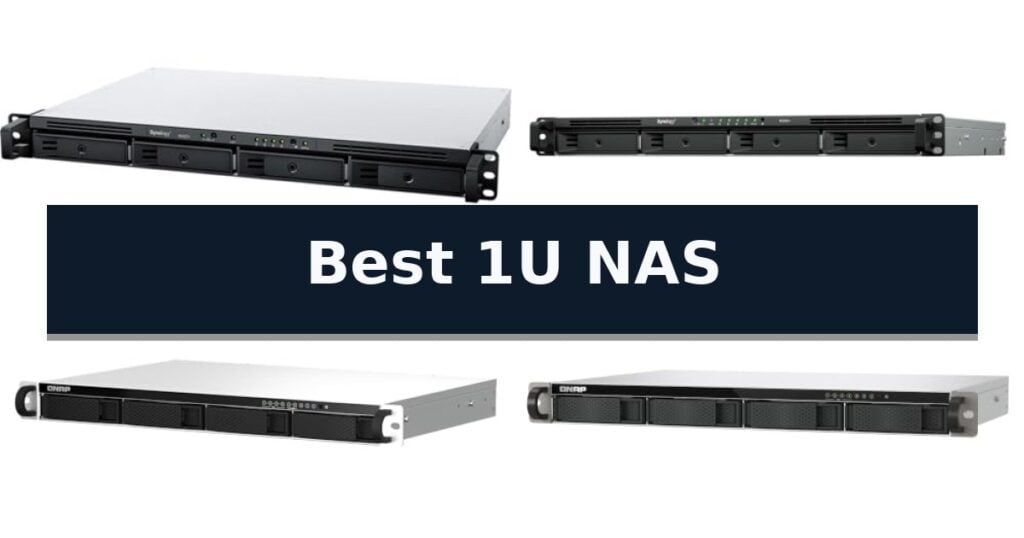
9 Best 1U NAS in 2026 Reviews
Quick Comparison
| Product | Best For | Key Strength | Score |
|---|---|---|---|
| Synology RackStation RS422+ NAS | Best Overall | Compact 1U design with a shallow 327.5 mm depth for tight rack spaces. | 4.9 |
| Synology RackStation RS826+ NAS | High-Performance Office File Sharing | High sequential throughput of over 2,000 MB/s read and 1,300 MB/s write. | 4.5 |
| QNAP TS-464eU NAS | Short-Depth for Versatile Deployment | Short-depth chassis design for versatile installation in shallow racks. | 4.8 |
| QNAP TS-432XeU NAS | Accelerated 10GbE Business Storage | Short-depth chassis allows for installation in compact or non-standard server racks. | 4.7 |
| Synology RackStation RS1626xs+ NAS | Intensive Workload Powerhouse | High-speed 10GbE connectivity via dual RJ-45 ports. | 4.6 |
| QNAP TS-433eU NAS | Space-Saving 2.5GbE Connectivity | Short-depth chassis of 11.51 inches fits in compact spaces. | 4.8 |
| TerraMaster U4-500 NAS | Ultra-Fast NVMe Accelerated Performance | Dual 10GbE ports for ultra-fast network throughput. | 4.9 |
| Buffalo TeraStation WS5420RN NAS | Native Windows Server IoT Integration | Native Windows Server IoT 2025 environment eliminates the need for additional CALs. | 4.4 |
| Ubiquiti UNAS Pro 4 | Enterprise-Grade High Availability | High-speed 10G SFP+ networking for rapid data transfer. | 4.3 |
How We Chose
Evaluating a 1U NAS requires a focus on physical footprint and hardware longevity. An experienced reviewer assesses how these compact servers handle thermal management and network throughput, ensuring the hardware can support specific business workloads. We prioritize units that offer clear paths for storage expansion and network upgrades, separating high-utility enterprise tools from basic storage appliances.
- Chassis depth compatibility for standard rack enclosures
- Network interface speed and expansion potential
- Processor performance and RAM capacity for multitasking
- Storage expansion and drive bay scalability
- Data management software features and backup integration
1 Synology RackStation RS422+ NAS — Compact Design for Small Racks
Optimizing server rack real estate requires hardware that balances performance with physical constraints, and the Synology RackStation RS422+ NAS is specifically engineered for these tight environments. With a chassis depth of just 327.5 mm when the server handles are installed, this unit fits into shallow racks where standard depth servers simply cannot go, making it a practical choice for small-scale server closets or edge computing deployments.
Despite its compact 1U form factor, the device does not compromise on data throughput. It is built to deliver over 601/516 MB/s sequential read/write throughput, providing the necessary speed for consistent file serving and data management tasks. This performance level ensures that the system can handle concurrent requests effectively without becoming a bottleneck in your network infrastructure.
Connectivity and future-proofing are addressed through a modular approach. The unit comes standard with dual 1GbE ports, which support essential network failover and load balancing to maintain uptime. For environments requiring higher bandwidth, the system features plug-and-play network upgrade modules, allowing users to integrate 10GbE RJ-45 connectivity as their data demands evolve. This flexibility allows the hardware to scale alongside growing business needs without requiring a complete system replacement.
The 4-bay configuration provides a stable foundation for RAID-protected storage, offering a balance between capacity and physical footprint. Backed by a 3-year warranty, the Synology RackStation RS422+ NAS is designed for professional reliability, ensuring that critical data remains accessible in space-constrained professional settings.
Best for: Small businesses or home offices requiring a space-efficient, 1U rackmount storage solution with upgradeable networking options.
Skip if: Users who require high-density storage beyond four bays or those who do not have a standard rackmount environment.
- Compact 1U design with a shallow 327.5 mm depth for tight rack spaces.
- Upgradeable networking via plug-and-play modules for 10GbE support.
- Stable throughput reaching over 601/516 MB/s for reliable data handling.
- Network redundancy provided by dual 1GbE ports with failover.
- Limited to 4 bays, which may restrict total storage capacity for larger data needs.
- Requires separate purchase of network upgrade modules for 10GbE connectivity.
2 Synology RackStation RS826+ NAS — High-Performance Office File Sharing
The Synology RackStation RS826+ 4-Bay 1U Rackmount NAS Server (Diskless) provides a high-density storage solution for office environments, delivering sequential throughput of over 2,000 MB/s read and 1,300 MB/s write. This performance profile is engineered to handle intensive file sharing, data syncing, and centralized backup operations across an entire office network.
Designed for scalability, the unit allows administrators to expand capacity up to 8 drive bays by integrating a single Synology RX426 Expansion Unit. The system includes intelligent storage optimization features, which automatically move infrequently accessed data to lower-cost cold storage tiers, ensuring that high-performance storage remains available for active, mission-critical workloads.
Connectivity is handled through four built-in 1GbE RJ-45 ports, while the integrated PCIe 3.0 expansion slot provides flexibility for future upgrades. Users can install optional 10GbE or 25GbE network interface cards, or utilize M.2 NVMe SSD adapter cards to further enhance I/O performance depending on specific infrastructure requirements.
This 1U rackmount server is backed by a 3-year manufacturer warranty, emphasizing its role as a reliable component for professional data management. Its compact form factor is optimized for standard rack environments, balancing high-speed data delivery with efficient space utilization.
Best for: Small to medium-sized offices requiring high-speed file sharing, scalable storage capacity, and flexible network expansion options.
Skip if: Users who do not have a standard rackmount infrastructure or those who require more than 8 total drive bays will need a different storage solution.
- High sequential throughput of over 2,000 MB/s read and 1,300 MB/s write.
- Scalable storage capacity up to 8 bays via expansion unit.
- Flexible expansion via PCIe 3.0 slot for 10GbE/25GbE or NVMe SSDs.
- Automated storage tiering for efficient data management.
- Diskless configuration requires separate purchase of compatible drives.
- Limited to one expansion unit for a maximum of 8 total bays.
3 QNAP TS-464eU NAS — Short-Depth for Versatile Deployment
Space-constrained server environments often require high-density storage without the footprint of a full-depth chassis. The QNAP TS-464eU NAS addresses this by utilizing a short-depth rackmount design, allowing it to fit into wall-mount racks or shallow cabinets where standard enterprise servers cannot go.
Driven by an Intel Quad-core CPU capable of bursting up to 2.9 GHz and supported by 8GB of RAM, this unit provides the necessary overhead for demanding file management tasks. The inclusion of dual 2.5GbE ports ensures that network bottlenecks are minimized, facilitating faster data transfers across connected teams or devices.
For users requiring high-speed storage tiers, the QNAP TS-464eU NAS features dual M.2 PCIe Gen 3 x1 NVMe SSD slots. These slots are engineered for cache acceleration or the creation of high-performance SSD storage pools, significantly improving responsiveness during intensive read/write operations.
Beyond its primary storage functions, the device offers versatile connectivity and multimedia capabilities. It includes multiple USB 3.2 Gen 2 ports for rapid external data transfers and an HDMI 1.4b output that supports 4K media playback and real-time transcoding, making it a functional solution for both office data management and local media display.
Best for: Small business or home office environments requiring high-performance storage in space-restricted rackmount settings.
Skip if: Users requiring high-capacity enterprise-grade drive bays or those who do not have a rackmount infrastructure.
- Short-depth chassis design for versatile installation in shallow racks.
- Dual 2.5GbE ports for high-speed network connectivity.
- Dual M.2 NVMe SSD slots for cache acceleration or high-speed storage pools.
- 4K real-time transcoding capabilities via HDMI output.
- Diskless configuration requires separate purchase of storage drives.
- Limited to 4 bays, which may restrict total storage capacity compared to larger units.
4 QNAP TS-432XeU NAS — Accelerated 10GbE Business Storage
Efficient storage management in space-constrained environments requires hardware that balances footprint with high-speed connectivity. The QNAP TS-432XeU-4G 4-Bay 1U Short-Depth Rackmount NAS addresses this by integrating a compact chassis with advanced networking capabilities, making it a viable solution for branch offices or edge computing deployments where standard-depth racks are unavailable.
At the core of this system is an Annapurna Labs Alpine Cortex-A57 Quad-core processor paired with 4 GB of DDR4 RAM. This hardware configuration is engineered to handle responsive storage services, including file sharing, team collaboration, and routine backup tasks. The inclusion of 10GbE/2.5GbE/SFP+ connectivity provides the necessary bandwidth to accelerate large file transfers and support multi-user access or virtualization workloads effectively.
The QTS software ecosystem serves as the management interface, offering tools for snapshots, comprehensive storage management, and remote access. These features are designed to enhance data protection and simplify the administrative overhead associated with managing business storage. By utilizing snapshots, users can maintain a versioned history of their data, which is critical for recovery in the event of accidental deletion or corruption.
Designed specifically for versatility, the short-depth rackmount design allows for installation in compact server racks. This physical profile does not sacrifice the core functionality of a 4-bay NAS, ensuring that businesses can maintain centralized file storage and backup operations even in environments with limited rack space. The unit is backed by a 3-year warranty, providing a baseline of support for its operational lifespan.
Best for: Small business or branch office environments requiring high-speed 10GbE connectivity within a compact, short-depth rackmount form factor.
Skip if: Users requiring high-performance virtualization or heavy multimedia transcoding that necessitates a more powerful x86-based processor.
- Short-depth chassis allows for installation in compact or non-standard server racks.
- Integrated 10GbE/2.5GbE/SFP+ connectivity for high-speed data transfers.
- QTS software provides robust tools for snapshots and data protection.
- Quad-core processor ensures responsive performance for standard business storage tasks.
- Limited RAM capacity may restrict performance in memory-intensive multi-tasking environments.
- ARM-based architecture may limit compatibility with certain third-party applications compared to x86-based NAS units.
5 Synology RackStation RS1626xs+ NAS — Intensive Workload Powerhouse
Efficient server-side data management requires hardware that balances density with high-speed connectivity, making the Synology 4 Bay Rackmount NAS – 1U (RS1626xs+) a primary candidate for space-constrained environments. This unit is engineered for intensive workloads, delivering sequential read and write performance exceeding 2,100 MB/s and 1,500 MB/s respectively, while supporting over 84,000 4K random write IOPS.
Designed for high-speed networking, the system features built-in dual 10GbE RJ-45 ports to facilitate rapid data transfer. The 1U chassis houses four drive bays, which can be scaled up to 16 bays total by utilizing a Synology RX1225RP expansion unit. Maintenance is streamlined through hot-swappable drive trays and fans, allowing for component replacement without requiring system downtime.
Data integrity is managed through a suite of license-free software tools, including Snapshot Replication, Hyper Backup, and the Active Backup Suite. These features provide comprehensive protection for critical files and system configurations. The hardware is backed by a 5-year limited warranty, reflecting its focus on long-term operational stability in professional settings.
The Synology 4 Bay Rackmount NAS – 1U (RS1626xs+) utilizes 16 GB of DDR4 ECC RDIMM memory to ensure data accuracy during complex processing tasks. Its compact 1U form factor is specifically intended for standard server rack installations, prioritizing a small physical footprint while maintaining robust performance capabilities.
Best for: IT administrators and small-to-medium businesses requiring high-speed 10GbE networking and scalable storage within a compact 1U rackmount footprint.
Skip if: Users who do not have a standard server rack environment or those who require more than 16 total drive bays should consider larger tower or multi-unit rack solutions.
- High-speed 10GbE connectivity via dual RJ-45 ports.
- Scalable storage capacity up to 16 bays with expansion units.
- Hot-swappable components for maintenance without downtime.
- 5-year limited warranty for long-term support.
- 1U form factor requires specific rack infrastructure.
- Limited to 4 internal bays without additional hardware investment.
6 QNAP TS-433eU NAS — Space-Saving 2.5GbE Connectivity
Managing high-speed data transfers within space-constrained server environments requires hardware that balances performance with physical footprint. The QNAP TS-433eU-US Compact 1U Short-Depth Rackmount 2.5GbE NAS addresses this by integrating a high-density storage architecture into a chassis depth of only 11.51 inches, allowing for deployment in cabinets or enclosures where standard rackmount units would be too cumbersome.
At the core of this system is an ARM 4-core Cortex-A55 2.0GHz processor paired with 4GB of DDR4 on-board RAM, providing the necessary compute resources for multi-user file management and background tasks. The inclusion of dual 2.5GbE ports serves to accelerate file sharing across local networks, effectively streamlining large file transfers for teams that require consistent throughput without the overhead of 10GbE infrastructure.
Beyond raw storage performance, the device emphasizes data protection and administrative utility. It supports integration with cloud environments, specifically enabling users to backup Google Workspace and Microsoft 365 accounts directly to the NAS using the Boxafe application. This feature allows for centralized management of cloud-based assets, ensuring that critical business data remains accessible even if cloud service availability fluctuates.
The QNAP TS-433eU NAS is built for reliability, backed by a 3-year warranty that underscores its role as a stable foundation for small-scale network storage. Its combination of a compact form factor and modern networking standards makes it a practical choice for environments where rack space is at a premium but network performance cannot be sacrificed.
Best for: Small offices or edge computing environments requiring high-speed 2.5GbE connectivity within shallow-depth rack enclosures.
Skip if: Users who require high-capacity 10GbE networking or those needing a full-depth chassis for enterprise-grade server racks.
- Short-depth chassis of 11.51 inches fits in compact spaces.
- Dual 2.5GbE ports provide accelerated network throughput.
- Boxafe integration simplifies cloud account backups.
- 4-core processor ensures efficient multi-tasking.
- Fixed 4GB RAM may limit performance for heavy virtualization tasks.
7 TerraMaster U4-500 NAS — Ultra-Fast NVMe Accelerated Performance
The TerraMaster U4-500 NAS is a compact 1U rackmount server engineered for performance-driven small and medium-sized businesses. It centers on a 12th Gen Intel Core i3-1215U processor, providing the computational power necessary for demanding virtualization and data-intensive tasks in a space-saving form factor.
Designed for speed, this unit features dual 10GbE network ports that offer 20Gbps aggregate bandwidth, supported by SMB multichannel for rapid data transfers. The inclusion of dual M.2 NVMe slots with Hyper Cache technology allows for significant performance gains in backup and access speeds, reaching up to 2090MB/s in sequential writes.
Flexibility is a core component of its architecture, supporting up to 96TB of raw storage across four bays. Users can choose between EXT4 for stability or Btrfs for advanced data protection features like snapshots and checksums. The system also integrates a comprehensive backup suite, including TerraSync and centralized backup tools to ensure data integrity.
While the TerraMaster U4-500 NAS provides robust hardware, such as 8GB of DDR5 memory and hardware-accelerated encryption via AES-NI, it remains a diskless solution. Buyers must account for the additional cost and installation of compatible HDDs or SSDs to complete the storage array.
Best for: Performance-driven SMBs requiring high-speed 10GbE connectivity and NVMe caching in a compact 1U rackmount footprint.
Skip if: Users who require a pre-populated storage solution or those with limited rack space who do not need enterprise-grade 10GbE networking.
- Dual 10GbE ports for ultra-fast network throughput.
- Dual M.2 NVMe slots with Hyper Cache technology for accelerated performance.
- 12th Gen Intel Core i3 processor and 8GB DDR5 RAM for efficient multitasking.
- Support for Btrfs file system providing advanced data protection and snapshots.
- Diskless design requires separate purchase and installation of storage drives.
- 1U rackmount form factor necessitates specific server rack infrastructure.
8 Buffalo TeraStation WS5420RN NAS — Native Windows Server IoT Integration
Managing data storage in a professional environment requires hardware that balances reliability with seamless software integration. The Buffalo TeraStation WS5420RN NAS distinguishes itself by running Native Windows Server IoT 2025 for Storage Workgroup edition, providing a familiar management interface for IT administrators without the complexity of third-party operating systems.
This 1U rackmount unit arrives ready for deployment with 16 TB of total capacity, utilizing four pre-tested, NAS-grade hard drives. The system ships pre-configured in RAID 5, offering 12 TB of usable space, though administrators can reconfigure the array to RAID 6 for enhanced redundancy or RAID 0 for maximum throughput depending on specific performance requirements.
A significant advantage of this model is its licensing structure, as it requires no Client-Access Licenses (CALs), which simplifies budgeting for small business networks. The inclusion of NovaBACKUP software provides an immediate solution for professional-level server and PC backups, while built-in cloud service integration with Azure and OneDrive facilitates a hybrid cloud architecture for improved data flexibility.
Built for durability and compliance, the unit is TAA compliant and manufactured in Japan. Buffalo supports the hardware with a 3-year warranty and 24/7 North America-based technical support, with the added benefit of qualification for their Simple Logical Data Recovery service upon product registration.
Best for: Small businesses requiring a rack-mounted storage solution with native Windows Server integration and simplified licensing.
Skip if: Users who require a non-rackmount form factor or those who prefer a Linux-based NAS operating system over Windows Server IoT.
- Native Windows Server IoT 2025 environment eliminates the need for additional CALs.
- Pre-tested NAS-grade hard drives included and pre-configured for immediate setup.
- Hybrid cloud integration supports seamless connectivity with Azure and OneDrive.
- TAA compliant construction with 24/7 North American support.
- 1U rackmount form factor requires dedicated server rack space for installation.
- Fixed hardware configuration limits internal expansion options compared to tower-based units.
9 Ubiquiti UNAS Pro 4 — Enterprise-Grade High Availability
Efficient data management in constrained server environments requires hardware that maximizes density without sacrificing connectivity. The Ubiquiti UNAS Pro 4 addresses this by providing a high-performance 1U rack-mount solution tailored for enterprise-grade file storage and data sharing. Its compact form factor is specifically designed for space-conscious server racks, making it an effective choice for businesses that need to maintain high availability within limited physical footprints.
Engineered for versatility, this unit features four drive bays compatible with both 2.5-inch and 3.5-inch drives. To minimize latency and improve throughput, the system includes two M.2 NVMe SSD slots dedicated to high-speed caching. This architecture ensures that demanding workloads benefit from faster access speeds and reliable data handling, allowing the system to manage intensive read/write operations more effectively than standard storage arrays.
Connectivity is a primary focus, highlighted by dual 10G SFP+ ports that provide high-bandwidth networking for intensive environments. The device also includes a standard GbE RJ45 port for flexible integration into existing network topologies. For businesses prioritizing uptime, the system supports power redundancy through a USP-RPS DC input, ensuring continuity during power fluctuations. This redundancy is a critical trade-off for organizations that cannot afford downtime, as it adds a layer of protection against localized power supply failures.
The Ubiquiti UNAS Pro 4 is built to support robust data integrity with integrated RAID 5, 6, and 10 configurations. Its NDAA compliance makes it a suitable choice for regulated professional environments requiring strict hardware standards. By combining enterprise-grade storage management with a 1U footprint, it offers a balanced approach for IT managers who need to scale storage capacity while adhering to strict rack space and compliance requirements.
Best for: Business environments requiring high-availability storage and 10 Gbps networking in a compact 1U rack-mount form factor.
Skip if: Users who do not have a 10G SFP+ network infrastructure or those requiring more than four primary drive bays for massive storage scaling.
- High-speed 10G SFP+ networking for rapid data transfer.
- Dual M.2 NVMe slots for performance-enhancing SSD caching.
- Power redundancy support via USP-RPS DC input.
- Flexible drive support for both 2.5" and 3.5" storage media.
- Limited to 10G networking without native support for slower SFP+ speeds.
- Fixed 1U form factor limits the number of internal drive bays to four.
Best 1U NAS Buying Guide
Understanding Chassis Depth
The 1U form factor is inherently space-efficient, but the actual depth of the unit is a critical installation constraint. Many short-depth models are specifically engineered for shallow wall-mount racks or telecommunications closets where standard enterprise servers would physically not fit.
Before purchasing, measure the available depth in your rack, including the space required for cable management and power connections. A unit that is too deep may prevent the rack door from closing or obstruct airflow, leading to potential thermal throttling.
Network Connectivity and Throughput
Network speed is the primary bottleneck for most NAS deployments. While 1GbE is sufficient for basic file storage, modern business environments often require 2.5GbE or 10GbE to handle concurrent user access, virtualization, and rapid backup cycles.
Look for models that include a PCIe expansion slot if you are unsure about your future bandwidth needs. This allows you to upgrade your network interface card later without replacing the entire NAS enclosure.
Scalability and Expansion
A 4-bay 1U NAS provides a solid starting point, but data needs often grow over time. Some models support external expansion units that allow you to add more drive bays to the existing storage pool, extending the life of your initial investment.
Check the manufacturer's compatibility list for expansion units, as these are typically proprietary. Ensure the NAS processor and RAM can handle the increased overhead of managing a larger storage array.
Storage Tiering and Caching
Performance-driven workloads benefit significantly from SSD caching. Many modern 1U units include dedicated M.2 NVMe slots, which allow you to use fast flash storage to accelerate read and write operations for frequently accessed files.
Automated storage tiering is another valuable feature that moves inactive data to slower, high-capacity HDDs while keeping active files on SSDs. This provides a balance between high performance and cost-effective storage capacity.
Operating System and Software Ecosystem
The software running on your NAS is just as important as the hardware. Look for platforms that offer robust snapshot capabilities, ransomware protection, and seamless integration with cloud backup services.
Consider whether you need a specialized OS, such as Windows Server IoT, or if a manufacturer-specific Linux-based OS meets your requirements for ease of use and application support.
Frequently Asked Questions
Can I install a 1U NAS in a standard home rack?
Yes, provided the rack is at least 19 inches wide and has sufficient depth to accommodate the specific model's chassis length and cable clearance.
Do all 1U NAS units support 10GbE networking?
No. While many enterprise-focused 1U units include 10GbE, others rely on 1GbE or 2.5GbE. Always check the specifications for built-in ports or available PCIe slots for upgrades.
What is the benefit of a short-depth 1U NAS?
Short-depth units are designed for smaller, wall-mounted racks or environments with limited space where full-depth enterprise servers are too large to fit.
Can I mix SSDs and HDDs in a 1U NAS?
Yes, many models support hybrid storage pools, allowing you to use SSDs for caching or high-speed tiers and HDDs for bulk storage.
Is a 1U NAS loud?
1U servers often use smaller, high-RPM fans to maintain airflow in a compact chassis, which can result in higher noise levels compared to tower-style NAS units.
Conclusion: Our Top Pick
Our top pick is Synology RackStation RS422+ NAS. Choosing the right 1U NAS depends on balancing your current storage capacity needs with the physical limitations of your rack environment. Prioritize units with expansion slots if you anticipate future network growth, as this provides the most flexibility for evolving business demands.
Ultimately, the best choice is one that fits your rack depth while providing the necessary throughput for your specific workload. Whether you need the high-performance capabilities of an enterprise-grade unit or the space-saving efficiency of a short-depth model, ensure your chosen NAS supports the data protection features required for your critical files.