SOYO GeForce RTX 3050 Graphics Card is our top choice for the Best 1-Slot Graphics Cards, offering a powerful balance of modern architecture and a true single-slot, low-profile footprint for space-constrained systems. The MAXSUN GeForce RTX 3050 Graphics Card provides a similar high-performance alternative for compact gaming builds, while the ASUS GeForce GT 730 Graphics Card serves as a specialized, silent solution for multi-monitor productivity setups.
Selecting a graphics card for a slim or small form factor (SFF) chassis requires balancing physical dimensions with thermal efficiency and power constraints. Because these systems often lack the space for bulky multi-slot coolers, identifying cards that maintain a strict single-slot width is essential for ensuring proper airflow and compatibility with existing internal components.
Beyond physical size, buyers must consider the power delivery requirements of their specific build. Many single-slot cards are designed to operate entirely on power drawn from the PCIe slot, which is ideal for standard power supplies found in slim workstations. We focus on cards that provide reliable display outputs and sufficient processing power for their intended use cases, whether that involves 1080p gaming or professional multi-display environments.
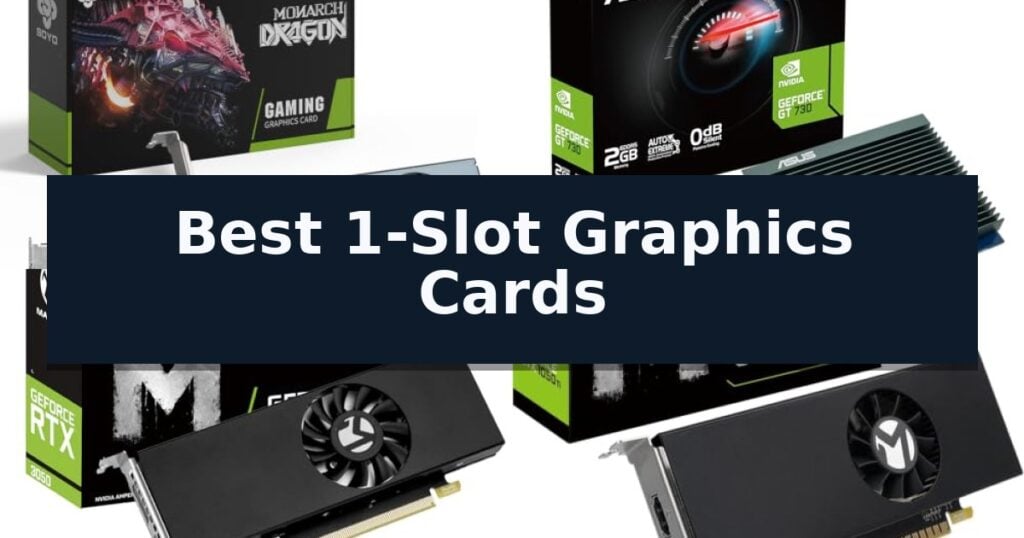
10 Best 1-Slot Graphics Cards in 2026 Reviews
Quick Comparison
| Product | Best For | Key Strength | Score |
|---|---|---|---|
| SOYO GeForce RTX 3050 Graphics Card | Best Overall | True 1-slot design for maximum compatibility in tight cases | 4.9 |
| ASUS GeForce GT 730 Graphics Card | Silent Passive Cooling Design | Silent passive cooling eliminates fan noise. | 4.4 |
| MAXSUN GeForce RTX 3050 Graphics Card | Slim Profile for Compact Builds | Slim low-profile design optimized for SFF and ITX cases. | 4.8 |
| MAXSUN GeForce GTX 1050 Ti Card | Efficient Low-Profile Gaming | Slim low-profile design fits into restricted SFF cases. | 4.6 |
| NVIDIA Quadro T1000 Graphics Card | Professional Multi-Display Precision | 8GB GDDR6 VRAM for handling large datasets. | 4.5 |
| MAXSUN AMD Radeon RX 550 Card | Ultra-Compact ITX Form Factor | Single slot design ensures compatibility with ultra-compact ITX and SFF cases. | 4.9 |
| MSI GeForce GT 1030 Graphics Card | Reliable Entry-Level Performance | Single-slot design fits into space-constrained PC cases. | 4.8 |
| MAXSUN GeForce GT 730 Graphics Card | Quad-Monitor Output Capability | Quad-monitor support via four integrated HDMI ports. | 4.8 |
| MSI GeForce 210 Graphics Card | Classic Slim System Upgrade | Low-profile, single-slot design fits into restricted chassis spaces. | 4.8 |
| PNY NVIDIA NVS 310 Card | Standard for Business Graphics | Single-slot design ideal for compact PC builds. | 4.8 |
How We Chose
Evaluating graphics cards for slim form factor systems requires a rigorous assessment of physical constraints and power efficiency. An experienced reviewer prioritizes cards that offer genuine single-slot dimensions without compromising on necessary display outputs or thermal stability, ensuring the hardware integrates seamlessly into restricted chassis environments while meeting specific performance requirements.
- Physical slot width and bracket compatibility
- Power consumption and PCIe bus-power limits
- Display output variety and resolution support
- Thermal management and cooling design
- Architecture generation and software compatibility
1 SOYO GeForce RTX 3050 Graphics Card — True Single-Slot Gaming Power
Space constraints in small form factor (SFF) builds often force compromises, but the SOYO GeForce RTX 3050 6GB GDDR6 Low Profile Gaming Graphics Card offers a distinct solution by providing a genuine 1-slot design. This allows users to upgrade their slim workstation or compact desktop without needing to sacrifice adjacent PCIe slots or modify the chassis to accommodate thicker cooling solutions.
Built on the NVIDIA Ampere architecture, this card features 6GB of GDDR6 memory and 2304 CUDA cores, providing a boost clock of 1470 MHz. It is engineered for efficiency, maintaining a low 70W TDP that allows it to operate entirely on power drawn from the PCIe slot. This bus-powered design eliminates the need for external power connectors, making it a straightforward upgrade for systems equipped with a standard 250W power supply.
The card is equipped with 18 dedicated RT Cores, enabling support for DirectX 12 Ultimate, Vulkan 1.3, and OpenGL 4.6. For display connectivity, it includes HDMI 2.1 and DisplayPort 1.4a outputs, supporting high-resolution setups including 4K and 8K. Thermal management is handled by an optimized single 4-pin PWM fan paired with a high-density heatsink that adjusts speed based on real-time workload demands.
Included in the package is a half-height bracket (71mm), ensuring compatibility with slim-profile cases. This card balances the need for modern graphical capabilities with the physical limitations of constrained PC builds, offering a focused tool for users who prioritize a compact footprint.
Best for: This card is ideal for users with space-constrained Small Form Factor (SFF) or slim workstation PCs who require a low-profile, bus-powered GPU upgrade.
Skip if: Skip this model if you require high-end performance for demanding 1440p or 4K gaming, as this card is optimized for 1080p efficiency and compact dimensions.
- True 1-slot design for maximum compatibility in tight cases
- Bus-powered operation requires no external power cables
- Low 70W TDP is compatible with standard 250W power supplies
- Includes half-height bracket for slim chassis installation
- Limited to 1080p gaming and entry-level rendering tasks
- Single-fan cooling may be louder under sustained heavy loads
2 ASUS GeForce GT 730 Graphics Card — Silent Passive Cooling Design
The ASUS NVIDIA GeForce GT 730 Graphics Card provides a specialized, space-efficient solution for users needing to expand display connectivity in compact computing environments. Its single-slot design is specifically engineered to fit into tight cases where internal real estate is at a premium, ensuring that adjacent motherboard slots remain accessible for other expansion needs.
Equipped with four HDMI ports, this card is highly effective for productivity-focused workstations or multimedia setups that require multiple high-definition displays. By supporting up to four screens simultaneously, it allows users to manage complex workflows or expansive digital workspaces without the need for multiple dedicated graphics cards.
Thermal management is achieved through passive cooling, a design choice that completely eliminates the need for active fans. This results in silent operation, making the card an ideal component for home theater PCs or quiet office environments where minimizing background noise is a priority.
Installation is simplified by its plug and play nature, as the card draws its power directly from the PCIe slot, requiring no additional cables from the power supply. Featuring 2GB of GDDR5 memory and a 64-bit interface, it offers a functional performance upgrade over standard integrated graphics, providing a reliable bridge for non-intensive visual tasks.
Best for: Users needing to drive multiple high-definition displays from a small-form-factor PC without adding noise.
Skip if: Gamers or professionals requiring high-performance rendering or intensive 3D processing power.
- Silent passive cooling eliminates fan noise.
- Four HDMI ports support multi-monitor configurations.
- Single-slot design saves valuable internal space.
- No external power cables required for installation.
- Limited performance compared to modern dedicated gaming GPUs.
3 MAXSUN GeForce RTX 3050 Graphics Card — Slim Profile for Compact Builds
Space constraints in compact PC builds often require specialized hardware, and the MAXSUN GeForce RTX 3050 Graphics Card addresses this with a slim, low-profile design measuring just 6.65 by 2.71 inches. This form factor is specifically engineered for Mini Small Form Factor (SFF) cases where standard-width cards cannot physically fit, allowing for a discrete GPU upgrade in restricted chassis environments.
Built on the NV Ampere architecture, this card integrates 6GB of GDDR6 memory across a 96-bit interface. It features a GPU core clock of 1042MHz with a boost clock speed reaching 1470MHz. The inclusion of AI-specialized Tensor Cores enables support for NV DLSS, which is intended to provide a performance boost in supported titles while maintaining image quality.
Connectivity is handled through a PCI-E X8 4.0 interface, offering a full digital I/O suite that includes HDMI 2.1 and DisplayPort 1.4a. These outputs support 8K resolution and multi-monitor configurations, providing flexibility for both entertainment and workstation setups in small ITX builds.
This card serves as a targeted solution for users prioritizing physical dimensions over raw, high-end throughput. By balancing the power of the RTX 3050 series with a reduced physical footprint, it enables the assembly of compact AI-capable PCs without requiring a full-tower case.
Best for: Users building or upgrading Mini Small Form Factor (SFF) PCs who require a dedicated GPU that fits within a 1-slot or low-profile space constraint.
Skip if: Users with standard ATX cases who prioritize maximum thermal headroom or high-end gaming performance, as larger cards offer more robust cooling solutions.
- Slim low-profile design optimized for SFF and ITX cases.
- NV DLSS support for performance scaling in compatible applications.
- Full digital I/O including HDMI 2.1 and DisplayPort 1.4a for multi-monitor setups.
- PCI-E 4.0 interface for modern connectivity standards.
- Limited physical size may restrict thermal dissipation capacity compared to larger, multi-fan cards.
4 MAXSUN GeForce GTX 1050 Ti Card — Efficient Low-Profile Gaming
Integrating a high-performance GPU into a space-constrained chassis requires a specialized form factor that does not compromise on connectivity or thermal management. The MAXSUN GeForce GTX 1050 Ti Card is engineered specifically for these tight environments, featuring a slim low-profile design measuring just 6.5 by 2.71 inches. This compact footprint allows it to slide into various Small Form Factor (SFF) systems, such as the Dell OptiPlex 7070 or Lenovo ThinkCentre M720Q, without requiring chassis modifications.
Beyond its physical dimensions, the card utilizes a silver-plated PCB paired with all-solid capacitors. This construction is intended to promote lower operating temperatures and increased electrical efficiency compared to standard designs. With a boost clock reaching up to 1392 MHz and 4GB of GDDR5 memory, it provides a dedicated graphics solution for users who need to upgrade the visual processing capabilities of their slim-line workstations.
Connectivity remains a priority despite the reduced size. The unit includes both HDMI and DisplayPort outputs, supporting resolutions up to 7680×4320. This allows for multi-monitor configurations, which can be useful for expanding screen real estate in professional or entertainment settings. The card operates on a PCIe 3.0 x16 interface, ensuring compatibility with the expansion slots found in most standard SFF business PCs.
When selecting a graphics card for a 1-slot or low-profile requirement, verifying the internal clearance of your specific PC case is essential. While the MAXSUN GeForce GTX 1050 Ti Card is designed to fit widely used SFF models, users should confirm that their power supply and internal cabling can accommodate the card's specific dimensions and power delivery needs to ensure a stable installation.
Best for: Users needing to upgrade graphics performance in space-constrained Small Form Factor (SFF) desktop PCs.
Skip if: Users with full-tower cases who require maximum cooling overhead or high-end multi-fan GPU performance.
- Slim low-profile design fits into restricted SFF cases.
- Silver-plated PCB and all-solid capacitors for efficiency.
- Supports multi-monitor setups via HDMI and DisplayPort.
- Includes 4GB GDDR5 memory for dedicated graphics tasks.
- Limited to low-profile cooling which may be less effective than full-sized GPU coolers.
- Restricted physical size may not be compatible with all non-standard or proprietary small-form-factor internal layouts.
5 NVIDIA Quadro T1000 Graphics Card — Professional Multi-Display Precision
The NVIDIA Quadro T1000 Graphics Card offers a specialized solution for users requiring high-density multi-display support within a restricted physical footprint. Built on the NVIDIA Turing architecture, this professional-grade GPU is engineered to fit into small form factor workstations while providing the necessary power to manage complex datasets and professional applications.
Designed for precision, the card features 8GB of GDDR6 memory and 896 CUDA cores, which facilitate efficient 2D drafting and mainstream 3D modeling. It includes four Mini-DisplayPort outputs with included adapters, enabling the configuration of up to four 4K displays at 60Hz or dual 8K displays. This capability makes it a functional choice for command centers, financial analysis, and multi-monitor creative workflows.
The unit maintains an energy-efficient 50W design, ensuring it operates within the power constraints of compact systems without requiring additional external power connectors. It is ISV certified for industry-leading CAD software, providing stability for engineering and architectural tasks. The card also assists in creative suites by offloading rendering tasks from the CPU, which can improve timeline scrubbing and export performance.
This specific offering is a Seller Refurbished unit, which includes a 1-Year Limited Hardware Warranty through Empowered PC. The package includes both half-height and full-height brackets, allowing for installation flexibility across various chassis sizes. As a refurbished component, it may show light signs of use but is verified through rigorous stress testing before shipment.
Best for: Professionals needing multi-monitor support and CAD acceleration in a compact, single-slot workstation environment.
Skip if: Users seeking high-end gaming performance or those requiring more than 50W of power for intensive real-time 3D rendering.
- 8GB GDDR6 VRAM for handling large datasets.
- Low-profile, single-slot design fits small form factor cases.
- Supports up to four 4K displays simultaneously.
- ISV certified for professional CAD software stability.
- Seller Refurbished condition may include minor cosmetic blemishes.
- Limited to PCIe 3.0 x16 interface speeds.
6 MAXSUN AMD Radeon RX 550 Card — Ultra-Compact ITX Form Factor
Integrating a high-performance GPU into a restricted chassis requires a specialized hardware footprint, and the MAXSUN AMD Radeon RX 550 4GB Low Profile Small Form Factor Video Graphics Card is engineered specifically for these tight constraints. Its single slot design allows it to occupy minimal space, making it a viable choice for users operating within SFF or Mini-ITX environments where standard dual-slot cards simply will not fit.
Beyond its physical dimensions, this card utilizes a silver plated PCB and all solid capacitors to manage thermal output and maintain operational stability. The inclusion of GDDR5 high-speed video memory provides a memory speed up to 6000 MHz, which supports smooth operation for various applications and gaming tasks. The card is built around the AMD Radeon RX 550 chipset, featuring 512 stream processors.
Connectivity is handled through dedicated DisplayPort and HDMI outputs, with the DisplayPort interface capable of supporting 8K resolution displays. This versatility makes the card suitable for HTPC platforms that require high-definition output in a compact form factor. The unit measures approximately 6.61 inches in length and 2.71 inches in width, ensuring it remains within the necessary parameters for ultra-compact ITX builds.
The MAXSUN AMD Radeon RX 550 Card is backed by a 3-year warranty, providing a long-term service commitment for the hardware. By focusing on efficiency and a streamlined physical profile, it addresses the specific needs of builders who prioritize space-saving design without sacrificing essential display capabilities.
Best for: Users building or upgrading Small Form Factor (SFF) or Mini-ITX PC systems that require a single-slot graphics solution.
Skip if: Users requiring high-end graphical performance for demanding modern AAA gaming or professional 3D rendering tasks.
- Single slot design ensures compatibility with ultra-compact ITX and SFF cases.
- 8K resolution support via DisplayPort for high-definition output.
- Silver plated PCB and all solid capacitors contribute to efficient thermal management.
- Low profile form factor specifically engineered for space-constrained builds.
- Limited performance ceiling compared to larger, multi-slot dedicated gaming GPUs.
- Single-slot cooling constraints may limit overclocking potential.
7 MSI GeForce GT 1030 Graphics Card — Reliable Entry-Level Performance
Space-constrained workstation builds often require a specialized approach to hardware, particularly when dealing with limited PCIe expansion. The msi Gaming GeForce GT 1030 4GB DDR4 64-bit HDCP Support DirectX 12 DP/HDMI Single Fan OC Graphics Card (GT 1030 4GD4 LP OC) offers a compact solution for systems needing discrete video output without occupying multiple expansion slots.
Engineered with a single-fan cooling design and a low-profile form factor, this card measures just 5.91 inches in length and 0.75 inches in width. These dimensions allow it to fit into slim-chassis desktop environments where standard-width cards would be physically incompatible. The unit utilizes a 64-bit memory interface and features 4GB of DDR4 video memory to handle display tasks.
Connectivity is streamlined through a single DisplayPort (v1.4a) and one HDMI 2.0b port, supporting dual-monitor setups. With a boost clock of 1430 MHz, the card is configured for entry-level graphical processing. The manufacturer includes a 3-year warranty to support the hardware, ensuring a level of coverage for the component's lifespan.
While this card provides a functional upgrade for systems lacking integrated graphics or requiring additional display outputs, users must ensure their motherboard has an available PCIe slot and that the chassis supports low-profile expansion brackets. It is a dedicated solution for users prioritizing a single-slot footprint over high-end gaming performance.
Best for: Users needing a compact, single-slot graphics solution for slim-chassis PCs or multi-monitor display support.
Skip if: Gamers or professionals requiring high-performance rendering, as the DDR4 memory and entry-level chipset are not intended for intensive graphical workloads.
- Single-slot design fits into space-constrained PC cases.
- Low-profile form factor allows for installation in slim-chassis systems.
- Includes both DisplayPort and HDMI outputs for flexible connectivity.
- Backed by a 3-year warranty.
- DDR4 memory is slower than GDDR5 variants of similar chipsets.
- Limited performance ceiling due to the entry-level GT 1030 architecture.
8 MAXSUN GeForce GT 730 Graphics Card — Quad-Monitor Output Capability
The MAXSUN GeForce GT 730 Graphics Card offers a specialized solution for users needing to drive multiple displays from a single, compact expansion slot. Designed with an ITX form factor, this GPU is engineered to fit into space-constrained PC builds while providing quad simultaneous display capability through its four dedicated HDMI ports.
Under the hood, the card features the GeForce GT 730 GPU paired with 4GB of GDDR3 memory on a 64-bit bus. It utilizes an engine clock of 902 MHz and a memory clock of 1333 MHz. To maintain thermal efficiency without the noise of a mechanical fan, the unit employs fanless passive heat dissipation, which relies on the card's physical design to manage temperatures during operation.
The construction emphasizes longevity and stability through the use of a silver-plated PCB and all solid capacitors. This choice of components supports consistent performance for multi-screen setups. The card requires a PCI Express 2.0 x16 slot and is compatible with systems utilizing a 200-watt or greater power supply, making it a viable option for basic desktop workstations or digital signage applications.
When integrating this card, users should ensure their motherboard has an available x16 or x8 lane slot. Because it occupies a single-slot footprint, it is well-suited for small-form-factor cases where internal space is at a premium. The maximum resolution supported is 3840 x 2160 at 30Hz across its four HDMI outputs.
Best for: Users requiring a compact, single-slot solution to drive up to four independent displays for workstation or digital signage tasks.
Skip if: Gamers or users performing intensive 3D rendering, as the GT 730 architecture is not intended for high-performance graphical workloads.
- Quad-monitor support via four integrated HDMI ports.
- Single-slot ITX form factor ideal for small PC cases.
- Fanless passive cooling ensures silent operation.
- Solid capacitors and silver-plated PCB for improved component stability.
- Limited 30Hz refresh rate at 4K resolution.
- Entry-level GPU performance not suitable for modern gaming.
9 MSI GeForce 210 Graphics Card — Classic Slim System Upgrade
When upgrading a slim workstation or a compact desktop build, space is often the primary constraint. The MSI GeForce 210 Graphics Card addresses this by utilizing a dedicated low-profile design that occupies only a single slot, ensuring compatibility with smaller system chassis where standard-sized cards would physically fail to fit.
Beyond its compact footprint, this card incorporates Military Class Concept Components, which are engineered for stability. The inclusion of the MSI Afterburner Overclocking Utility provides users with a software interface to manage and fine-tune the card's performance parameters, offering a level of control often missing in basic display adapters.
The card is built for efficiency, featuring a dual core center architecture that balances power consumption with output. Its physical dimensions are notably small, measuring approximately 5.7 inches in length and 3.3 inches in width, making it a practical solution for tight internal layouts where airflow and cable management are critical concerns.
While this model is an effective choice for basic display tasks and slim system integration, it is important to note its role as a specialized component. It is intended for systems where physical space is at a premium rather than for high-demand graphical processing or modern gaming workloads.
Best for: Users needing a single-slot, low-profile graphics solution for slim or compact computer builds.
Skip if: Users requiring high-performance graphical processing for modern gaming or professional 3D rendering.
- Low-profile, single-slot design fits into restricted chassis spaces.
- Includes MSI Afterburner Overclocking Utility for performance management.
- Built with Military Class Concept Components for structural stability.
- Compact dimensions ideal for slim or smaller systems.
- Limited performance capacity compared to modern multi-slot graphics cards.
10 PNY NVIDIA NVS 310 Card — Standard for Business Graphics
Space-constrained workstation setups often require specialized hardware that maintains a minimal physical footprint without sacrificing multi-display capabilities. The PNY NVIDIA NVS 310 1GB Graphic Card for DisplayPort VCNVS310DP-1GB-PB is engineered specifically for these environments, utilizing a single-slot design that integrates seamlessly into compact chassis configurations.
At the core of this card is the NVIDIA NVS architecture, which is optimized for business-oriented multi-display environments. It features 48 CUDA cores and 1GB of DDR3 GPU memory, providing the necessary resources for standard professional applications. The card utilizes a 64-bit memory interface capable of delivering 14 GB/s of bandwidth, ensuring stable data throughput for display output.
Connectivity is managed via integrated DisplayPort outputs, which support a maximum resolution of 2560 x 1600 at 60Hz. This allows for high-fidelity visual output in professional settings where screen real estate is a priority. The card's physical dimensions of 2.75 inches in height and 6.5 inches in width confirm its suitability for systems where internal space is limited.
Choosing this card involves balancing professional display requirements against the limitations of a single-slot form factor. While it excels in business-grade multi-monitor setups, it is not intended for high-performance gaming or intensive 3D rendering tasks. Users should verify that their system supports the DisplayPort interface and has the necessary clearance for a single-slot expansion card.
Best for: Professional business environments requiring multi-monitor setups within compact, single-slot computer chassis.
Skip if: Users requiring high-performance 3D rendering, gaming capabilities, or displays that do not support DisplayPort connectivity.
- Single-slot design ideal for compact PC builds.
- Supports high-resolution multi-display configurations up to 2560 x 1600.
- Optimized for business-grade stability and multi-monitor efficiency.
- Includes 1GB DDR3 memory for reliable professional application performance.
- Limited to DisplayPort output connectivity.
- Not designed for high-performance gaming or intensive graphical workloads.
Best 1-Slot Graphics Cards Buying Guide
Understanding Form Factor Constraints
The primary challenge with single-slot graphics cards is the physical limitation of the chassis. Many modern cases are designed for multi-slot cards, but slim workstations or proprietary SFF builds often require a strict single-slot profile to avoid blocking other PCIe lanes or hitting the case wall.
Always verify the bracket height included with the card. While most single-slot cards are low-profile, they may require a specific half-height bracket to fit into slim cases. Ensure your case supports the specific bracket type provided by the manufacturer before finalizing your purchase.
Power Delivery and Efficiency
Most single-slot graphics cards are engineered to be bus-powered, meaning they draw all necessary electricity directly from the motherboard's PCIe slot. This is a significant advantage for users with limited power supply units (PSUs) that lack dedicated 6-pin or 8-pin power connectors.
Check the total power draw of your system against the capacity of your PSU. While these cards are generally efficient, adding a GPU to a system designed for integrated graphics can push a low-wattage power supply to its limit, potentially affecting system stability.
Display Output Requirements
The number and type of display outputs are critical if you are building a workstation or a multi-monitor setup. Some cards prioritize a single high-resolution output like DisplayPort, while others offer multiple HDMI ports to support quad-monitor configurations.
Consider the resolution and refresh rate requirements of your monitors. Older cards may be limited to lower resolutions or refresh rates, whereas modern cards support 4K or 8K outputs, which is vital for high-density professional displays.
Thermal Management in Tight Spaces
Cooling is inherently difficult in a single-slot design because there is very little room for a large heatsink or multiple fans. Passive cooling solutions are silent but rely heavily on the internal airflow of the PC case to dissipate heat effectively.
Active cooling solutions, which use a small fan, are generally better for sustained workloads like gaming or video editing. These fans often use PWM control to adjust speed based on the GPU temperature, helping to keep noise levels manageable during lighter tasks.
Software and Driver Compatibility
Ensure the card you choose supports the software and APIs required for your specific tasks. Modern gaming requires support for DirectX 12 Ultimate and Vulkan, while professional creative software may require specific driver certifications for stability.
Older cards may reach the end of their driver support cycle, which can lead to compatibility issues with newer operating systems. Choosing a card with a more recent architecture generally provides better long-term support and access to modern features like AI-driven upscaling.
Frequently Asked Questions
Can I use a single-slot card in a standard tower case?
Yes, single-slot cards are compatible with standard PCIe slots found in most tower cases. However, they may look small and provide less cooling performance than larger, multi-slot cards.
Do I need extra power cables for these cards?
Most single-slot cards are designed to be bus-powered, drawing all necessary energy from the motherboard. Always check the specific model's technical specifications to confirm if it requires external power.
Are these cards suitable for modern gaming?
Models based on newer architectures like the RTX 3050 are capable of 1080p gaming. Older cards, such as the GT 730 or GT 1030, are better suited for multimedia, office work, or light, older titles.
What is the difference between low-profile and single-slot?
Low-profile refers to the height of the card (the bracket size), while single-slot refers to the thickness of the card. A card can be low-profile but still take up two slots in width, so always check both dimensions.
Can I run multiple monitors with these cards?
Many single-slot cards are specifically designed for multi-monitor setups and feature multiple HDMI or DisplayPort outputs. Check the I/O configuration of the specific card to ensure it meets your display needs.
Conclusion: Our Top Pick
Our top pick is SOYO GeForce RTX 3050 Graphics Card. Choosing the right single-slot graphics card depends on balancing your specific performance needs with the physical and power limitations of your system. For those requiring modern gaming capabilities in a compact form, the RTX 3050 variants offer the best combination of power and efficiency.
If your goal is professional multi-display productivity or a simple display upgrade for a slim workstation, older or specialized cards provide reliable, cost-effective solutions. Always verify your case's bracket requirements and power supply capacity to ensure a successful upgrade.