Western Digital Red SA500 NAS SSD is our top choice for the Best 2.5-Inch NAS Drives, offering specialized caching performance and endurance for 24/7 network-attached storage environments. For users prioritizing high-capacity media storage, the Gigastone High Endurance NAS SSD serves as a strong alternative, while the Samsung 870 EVO SATA SSD provides a reliable option for those seeking broad compatibility with various host systems.
Selecting the right drive for a NAS requires balancing sequential read/write speeds with the durability needed for constant operation. Unlike standard desktop drives, these models are engineered to handle the specific stressors of RAID configurations and multi-user access, which can significantly impact the longevity of your storage array.
When upgrading your network storage, consider how your specific workload—such as 4K video editing, database management, or simple file backups—dictates your requirements. Matching the drive's endurance rating to your daily data throughput ensures that your NAS remains responsive and reliable over its service life.
For users who need to compare these options against general storage needs, our Best 2.5-Inch SSD guide provides a broader look at available technology. If you are also considering mechanical options for your array, our Best 2.5-Inch HDD for NAS article covers the trade-offs between speed and capacity.
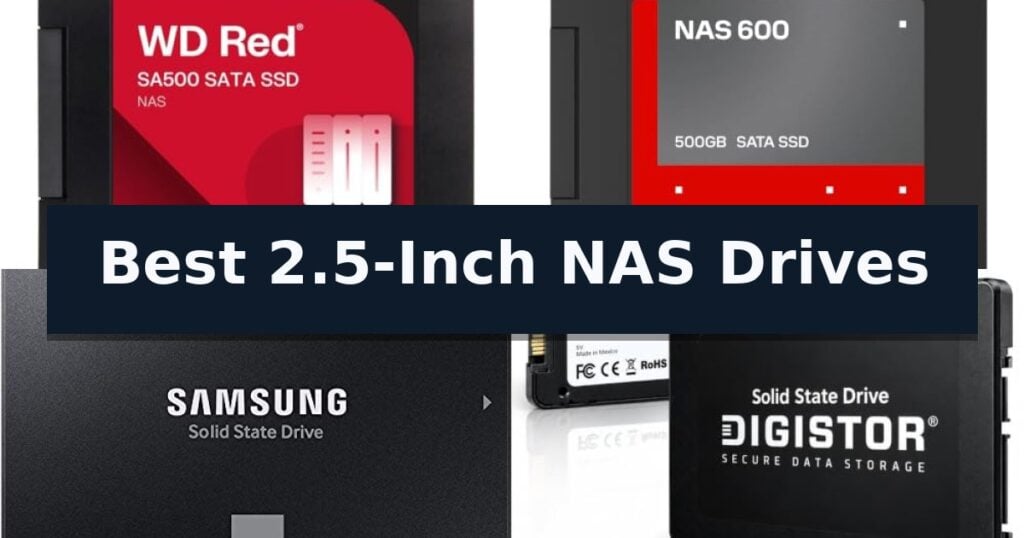
9 Best 2.5-Inch NAS Drives in 2026 Reviews
Quick Comparison
| Product | Best For | Key Strength | Score |
|---|---|---|---|
| Western Digital Red SA500 NAS SSD | Best Overall | Optimized for NAS caching to accelerate file access. | 4.9 |
| Sandisk NAS 600 SATA SSD | Engineered for Intense Workloads | High endurance rating up to 2,500 TBW for heavy 24/7 workloads. | 4.5 |
| Samsung 870 EVO SATA SSD | Industry-Leading Reliability | High endurance with up to 2,400 TBW for heavy workloads. | 4.6 |
| DiscTech Digistor Endurance Plus SSD | Enterprise-Grade Data Protection | Enterprise read-intensive design optimized for 24/7 operation. | 4.3 |
| Gigastone High Endurance NAS SSD | Superior Durability for Professionals | High endurance grade designed for 24/7 heavy workloads. | 4.5 |
| DIGIERA CAS100 SATA SSD | Reliable 24/7 Operation | High-speed performance with read speeds up to 550MB/s. | 4.3 |
| Ediloca ES580E SATA SSD | Shock-Resistant Storage | High-capacity 4TB storage density. | 4.8 |
| ORICO Y20 SATA SSD | Quiet and Noiseless Performance | 3D-NAND Technology for enhanced reliability and endurance. | 4.3 |
| Lufasnd Internal SATA SSD | Energy-Efficient System Upgrade | High-speed performance with read speeds up to 520MB/s. | 4.4 |
How We Chose
To identify the best 2.5-inch NAS drives, we analyze technical specifications focused on continuous operation and data integrity. An experienced reviewer evaluates these components by prioritizing endurance ratings and sustained throughput, ensuring the hardware can withstand the specific demands of network-attached storage environments without compromising system stability.
- Endurance and TBW ratings for 24/7 operation
- Sequential read and write performance for cache efficiency
- Compatibility with standard 2.5-inch NAS drive bays
- Warranty coverage and manufacturer reliability
- Form factor and physical installation requirements
1 Western Digital Red SA500 NAS SSD — Optimized for NAS Caching
Managing high-performance storage in a network-attached environment requires hardware that can handle constant read and write cycles without degradation. The Western Digital Red SA500 NAS SSD is specifically engineered to address this, utilizing 3D NAND technology to provide the endurance necessary for 24/7 operation in demanding NAS systems.
This drive is optimized for caching frequently accessed files, which significantly reduces latency and improves overall system responsiveness. Whether you are managing OLTP databases, performing photo rendering, or editing 4K and 8K video, the drive is designed to maintain consistent performance under the heavy workloads typical of multi-user environments.
Available in both 2.5-inch and M.2 form factors, the drive offers flexibility for integration into modern NAS hardware. With a SATA III 6 Gb/s interface and speeds reaching up to 560 MB/s, it provides a reliable upgrade path for users looking to maximize their SATA-based storage performance.
Built with a focus on reliability, the Western Digital Red SA500 NAS SSD is a purpose-built solution for those who require stable, high-speed storage for continuous business or home server use. Its architecture is explicitly tuned to handle the rigorous demands of NAS environments, ensuring that your data remains accessible and your system remains responsive.
Best for: Users seeking to improve NAS system responsiveness and reduce latency through high-endurance caching.
Skip if: Users requiring high-capacity archival storage, as SSDs are typically more expensive per gigabyte than mechanical hard drives.
- Optimized for NAS caching to accelerate file access.
- Superior endurance for 24/7 heavy read/write workloads.
- Versatile form factors including 2.5-inch and M.2 options.
- Reduced latency for demanding tasks like 8K video editing.
- SATA III interface limits maximum throughput compared to NVMe alternatives.
2 Sandisk NAS 600 SATA SSD — Engineered for Intense Workloads
Optimizing input/output responsiveness in demanding multi-user environments is the primary function of the Sandisk NAS 600 SATA SSD. Designed to serve as a high-performance cache or a dedicated storage tier, this drive is built to handle the continuous, 24/7 operational demands typical of modern network-attached storage systems.
The Sandisk NAS 600 SATA SSD utilizes a 2.5-inch, 7mm form factor, allowing it to integrate directly into existing 3.5-inch NAS drive bays. This design choice simplifies the transition from traditional mechanical hard drives to solid-state technology, providing a straightforward path to improved system speed for large media assets and complex application datasets.
Engineered for reliability in intense, multi-drive, and RAID configurations, the drive features an endurance rating of up to 2,500 TBW for the 4TB model. It is further supported by a 2.25 million hours mean time to failure (MTTF) rating and a 5-year limited warranty, ensuring long-term dependability for critical data environments.
By leveraging SATA III 6 Gb/s connectivity, the drive achieves read speeds of up to 560 MB/s. This performance profile is specifically tuned to energize NAS responsiveness, making it a practical choice for users looking to reduce latency during simultaneous file access or heavy read-intensive tasks.
Best for: Users seeking to improve NAS responsiveness and I/O performance through a dedicated SSD cache or high-endurance storage tier.
Skip if: Users requiring NVMe-based speeds or those with NAS hardware that lacks support for 2.5-inch SATA form factor drives.
- High endurance rating up to 2,500 TBW for heavy 24/7 workloads.
- 2.5-inch form factor ensures broad compatibility with standard NAS drive bays.
- 5-year limited warranty provides long-term support for critical storage.
- Optimized for RAID and multi-drive configurations.
- SATA III interface limits maximum transfer speeds compared to NVMe alternatives.
3 Samsung 870 EVO SATA SSD — Industry-Leading Reliability
Reliable storage is a cornerstone of any high-performance computing environment, and the Samsung SSD 870 EVO SATA SSD offers a robust solution for those requiring consistent data throughput. Built with Samsung's proprietary technology, this 2.5-inch drive is engineered to maximize the SATA interface limit, reaching sequential read and write speeds of up to 560/530 MB/s.
Beyond raw speed, this drive is designed for endurance, boasting an industry-defining rating of up to 2,400 TBW (Terabytes Written). This makes it a capable candidate for demanding workloads, ranging from everyday computing tasks to intensive 8K video processing. The inclusion of a larger variable buffer ensures that high performance is maintained consistently over long-term use.
Compatibility is a primary focus for this model, as it has been tested for integration with a wide variety of host systems, including NAS devices, motherboards, and video recording equipment. It supports AES 256-bit encryption (TCG/Opal v2.0, MS eDrive) to provide hardware-level security for sensitive data, while its shock-resistant design—rated for 1,500 G/0.5 ms—adds a layer of physical durability.
The drive maintains a standard 2.5-inch form factor with a height of just 0.27 inches, allowing for straightforward installation in most compatible enclosures. Whether you are upgrading an existing workstation or populating a storage array, the Samsung 870 EVO SATA SSD balances high-speed performance with the reliability needed for professional-grade applications.
Best for: Users seeking a high-endurance, reliable 2.5-inch SATA SSD for mixed workloads, including NAS storage and video editing.
Skip if: Users requiring the significantly higher bandwidth and lower latency provided by NVMe M.2 drives for specialized high-speed data tasks.
- High endurance with up to 2,400 TBW for heavy workloads.
- Maximizes the SATA interface with 560/530 MB/s sequential speeds.
- Includes AES 256-bit hardware encryption for data security.
- Validated for broad compatibility with NAS and video recording devices.
- Limited by the SATA 6Gb/s interface bottleneck compared to NVMe alternatives.
4 DiscTech Digistor Endurance Plus SSD — Enterprise-Grade Data Protection
Reliable data storage in professional environments requires hardware built for continuous uptime, a demand met by the DiscTech Digistor Endurance Plus 512GB Internal SATA SSD. This 2.5-inch drive is engineered specifically for 24/7 NAS, server, and workstation environments, ensuring that data remains accessible during constant operation.
Performance is optimized for active data workflows, delivering sequential read speeds up to 550 MB/s and sequential write speeds up to 520 MB/s over a SATA III 6Gb/s interface. These metrics help maintain responsiveness when managing large project files, media libraries, or shared storage applications.
Designed for longevity in intensive write scenarios, the drive is rated to support up to one full drive write per day (DWPD). This endurance makes it a practical choice for professionals who frequently update or move significant volumes of data across their systems.
Security and compatibility are central to its design. The drive utilizes TLC flash and features AES-256 hardware self-encryption with TCG Opal 2.0 support to protect sensitive information. Its standard 7mm 2.5-inch form factor ensures it integrates into a wide variety of existing multi-drive NAS deployments and workstations.
Best for: Professionals requiring a reliable, high-endurance 2.5-inch SSD for 24/7 NAS and workstation data storage.
Skip if: Users who require NVMe speeds or higher storage capacities than 512GB for their specific server configuration.
- Enterprise read-intensive design optimized for 24/7 operation.
- Supports up to one full drive write per day (DWPD) for high-endurance workflows.
- Includes AES-256 hardware self-encryption for professional-grade data security.
- Standard 7mm 2.5-inch form factor ensures broad compatibility with existing NAS hardware.
- Limited to 512GB capacity, which may not suit massive storage requirements.
- SATA III interface is slower than modern NVMe alternatives.
5 Gigastone High Endurance NAS SSD — Superior Durability for Professionals
The Gigastone High Endurance NAS SSD is engineered specifically for demanding, 24/7 storage environments where reliability is paramount. Featuring 3D NAND Flash and integrated SLC caching, this drive provides a consistent sequential transfer speed of up to 530 MB/s, ensuring that data-intensive tasks like 4K/8K video editing and photo rendering remain efficient.
Designed for heavy workloads, this 2.5-inch SATA III drive incorporates advanced features such as power loss protection and ECC (Error Correction Code) to safeguard data integrity during multi-user and multi-device access. Its silent operation and low-profile 7mm form factor allow for easy integration into various business and home office RAID configurations.
Compatibility is a primary focus, with the drive verified for use in popular systems from manufacturers like Synology, QNAP, and Asustor. While it excels in collaborative editing and database storage, it is not intended for high-demand server models or SAN environments, making it a specialized choice for professional-grade NAS setups.
Backed by a 5-year worldwide replacement warranty and lifetime technical support, this drive offers long-term peace of mind for users managing complex data consolidation. By balancing high-speed performance with endurance-grade durability, it serves as a robust solution for those requiring consistent uptime for intensive digital workflows.
Best for: Creative professionals and home office users requiring high-endurance, 24/7 reliable storage for intensive NAS workloads.
Skip if: Users operating enterprise-level server environments or SAN systems, as this drive is not optimized for those specific hardware architectures.
- High endurance grade designed for 24/7 heavy workloads.
- Includes power loss protection and ECC for enhanced data safety.
- 5-year worldwide replacement warranty provides long-term support.
- Verified compatibility with major NAS brands like Synology and QNAP.
- Not suggested for use in server models or SAN environments.
- Limited to SATA III interface speeds.
6 DIGIERA CAS100 SATA SSD — Reliable 24/7 Operation
The DIGIERA CAS100 SATA SSD is a 2.5-inch solid-state drive engineered to provide a performance upgrade for desktop PCs, laptops, and NAS devices. By utilizing the SATA 6Gb/s interface combined with SLC cache technology, this drive achieves sequential read speeds of up to 550MB/s and write speeds of 520MB/s, offering a significant speed increase over traditional mechanical hard drives.
Built for reliability, the drive features 3D NAND flash memory and an advanced controller equipped with an error correction algorithm. It is rated for an MTBF of over 1,000,000 hours and provides shock resistance up to 1500G, ensuring stable operation within a temperature range of 0°C to 70°C. The unit is designed to be energy-efficient, requiring only 5V power for operation.
The DIGIERA CAS100 SATA SSD arrives as a blank, unformatted disk, which provides users with full control over partitioning and formatting for specific NAS or RAID configurations. Its standard 2.5-inch form factor ensures compatibility with a wide range of systems, including those running Windows, macOS, and Linux. Each drive includes a user manual and is backed by a 5-year warranty.
Best for: Users seeking a reliable, high-speed 2.5-inch SATA storage upgrade for NAS, desktop, or laptop environments.
Skip if: Users requiring NVMe M.2 speeds or those whose hardware lacks a standard SATA interface.
- High-speed performance with read speeds up to 550MB/s.
- Durable construction featuring 1500G shock resistance.
- Broad compatibility across major operating systems and NAS devices.
- 5-year warranty for long-term peace of mind.
- SATA interface limitations compared to modern NVMe standards.
7 Ediloca ES580E SATA SSD — Shock-Resistant Storage
The Ediloca ES580E SATA SSD provides a high-capacity storage solution for users looking to modernize their computing environment. With a substantial 4TB capacity, this drive utilizes 3D QLC NAND technology to balance high-density storage with long-term data integrity, making it a viable candidate for those expanding their home server or desktop storage.
Performance is defined by its SATA III 6Gb/s interface, offering read speeds of up to 450MB/s and write speeds of 400MB/s. This hardware configuration is designed to accelerate system boot times and streamline file transfers compared to traditional mechanical hard drives. Because it contains no moving parts, the drive operates in complete silence, eliminating the mechanical noise associated with legacy storage.
Durability is a core design focus, featuring shock-resistant (1500G/0.5ms) and drop-proof (1.2m) construction. These physical protections help safeguard data during transport or accidental impacts. The unit is engineered for reliability, having undergone a 72-hour stress test to ensure consistent performance under demanding workloads.
Installation is straightforward due to its plug-and-play design, which requires no additional drivers for compatibility with Windows, macOS, or Linux systems. The drive is also backward compatible with SATA II interfaces, providing flexibility for older hardware upgrades. Every unit is supported by a 3-year limited warranty and dedicated technical support.
Best for: Users needing a high-capacity, shock-resistant storage upgrade for desktops, laptops, or NAS systems.
Skip if: Users requiring NVMe speeds or those with systems lacking a 2.5-inch SATA drive bay.
- High-capacity 4TB storage density.
- Shock-resistant and drop-proof physical design.
- Silent operation with no moving parts.
- Plug-and-play compatibility across major operating systems.
- Limited to SATA III interface speeds.
- Requires manual partitioning for initial setup.
8 ORICO Y20 SATA SSD — Quiet and Noiseless Performance
Upgrading your storage infrastructure often requires balancing speed with physical space constraints. The ORICO Y20 SATA SSD offers a streamlined solution for those looking to integrate high-speed flash storage into compact environments, such as small-form-factor desktop builds or DIY external drive enclosures.
Engineered with 3D-NAND Technology, this 2.5-inch drive is designed to provide consistent endurance for daily computing tasks. It delivers sequential read and write speeds of up to 500MB/s and 480MB/s respectively, offering a notable performance increase over traditional mechanical hard drives. These speeds facilitate faster system boot times and quicker program loading, which is essential for maintaining responsiveness in a modern computing environment.
The drive is built for versatility and durability, featuring a shockproof and anti-drop design that protects data during handling. Its operation is entirely quiet and noiseless, making it an ideal candidate for NAS systems or home media servers where acoustic noise is a concern. Furthermore, the unit is engineered for low power consumption and high-temperature resistance, ensuring stability during extended operation.
Installation is straightforward, though users should note that a newly installed drive must be properly formatted within the OS to appear in the file explorer. It maintains broad compatibility across Windows, macOS, and Linux systems. To provide peace of mind, the device is backed by a 3-year manufacturer warranty, supported by technical assistance for long-term reliability.
Best for: Users seeking a quiet, shock-resistant storage upgrade for compact desktop builds, laptops, or DIY external NAS enclosures.
Skip if: Users requiring NVMe speeds, as this drive is limited by the SATA III 6Gbps interface.
- 3D-NAND Technology for enhanced reliability and endurance.
- Quiet and noiseless operation suitable for home servers.
- Shockproof and anti-drop physical construction.
- 3-year manufacturer warranty for long-term support.
- SATA III interface limits maximum throughput compared to NVMe alternatives.
9 Lufasnd Internal SATA SSD — Energy-Efficient System Upgrade
Revitalizing an aging computer often begins with the storage drive, and the Lufasnd Internal SATA SSD provides a direct path to improved system responsiveness. By utilizing a standard 2.5-inch 7mm form factor and a SATA III 6Gb/s interface, this drive is engineered as a drop-in replacement for most desktop PCs and laptops, offering a straightforward upgrade for those looking to move away from traditional hard disk drives.
Performance is driven by 3D NAND TLC Flash technology, which supports sequential read speeds up to 520MB/s and write speeds up to 500MB/s. This architecture is designed to accelerate application loading and reduce boot-up times compared to mechanical drives. The drive is built without moving parts, contributing to a shock-resistant and vibration-resistant design that operates silently while consuming significantly less energy, which can help extend battery life in portable devices.
The Lufasnd Internal SATA SSD undergoes rigorous testing for up to 80 hours under various conditions, including vibration and repeated plug-in cycles, to ensure consistent performance. Available in capacities ranging from 128GB to 4TB, it offers flexible storage options for users managing everything from operating systems to high-resolution media libraries. The drive is compatible with a wide range of operating systems, including Windows 10, 8.1, 8, 7, and Linux 2.6.33 or later, making it a versatile choice for diverse hardware environments.
Best for: Users seeking an energy-efficient, shock-resistant storage upgrade for laptops or desktops that currently utilize a standard 2.5-inch SATA interface.
Skip if: Users requiring NVMe or M.2 form factors, as this drive is strictly limited to the 2.5-inch SATA III interface.
- High-speed performance with read speeds up to 520MB/s.
- Shock-resistant design due to the absence of moving parts.
- Energy-efficient operation that helps extend laptop battery life.
- Broad compatibility with various Windows and Linux operating systems.
- Interface limitation to SATA III, which may not match the speeds of newer NVMe-based systems.
Best 2.5-Inch NAS Drives Buying Guide
Understanding Endurance Ratings
NAS environments subject drives to constant read and write cycles that far exceed typical desktop usage. Look for drives that specify high Terabytes Written (TBW) ratings, as this metric indicates how much data the drive can handle before the flash memory reaches its end-of-life.
Drives designed for NAS often include features like power loss protection and advanced error correction. These additions are critical for maintaining data integrity when the drive is part of a RAID array where a single failure could jeopardize the entire volume.
Caching vs. Primary Storage
Many 2.5-inch SSDs are used as cache drives to accelerate access to frequently used files. In this role, the drive's latency and random I/O performance are more important than its total capacity, as it acts as a buffer between the network and slower mechanical hard drives.
If you are using the SSD as primary storage for a high-performance NAS, capacity becomes the priority. Ensure the drive you select supports the sustained write speeds necessary for your specific applications, such as video rendering or virtualization.
Form Factor and Compatibility
The 2.5-inch 7mm form factor is the industry standard for these drives, ensuring they fit into most modern NAS enclosures. However, always verify your NAS model's drive bay specifications, as some older units may require specific mounting brackets or adapters.
While SATA III is the most common interface, the performance is capped by the SATA 6Gb/s limit. Most modern SSDs reach this ceiling easily, so focus your decision on the drive's internal controller and NAND quality rather than advertised maximum speeds.
The Role of RAID Configurations
When installing multiple drives in a RAID setup, consistency is key. Using identical drives ensures that the array performs predictably and that all drives reach their wear-leveling milestones at approximately the same time, simplifying maintenance.
Some drives are specifically validated by NAS manufacturers for RAID compatibility. While most SATA SSDs will function, choosing a model with proven compatibility can prevent issues with drive recognition or array rebuild failures.
Warranty and Long-Term Support
A 5-year warranty is a strong indicator of a manufacturer's confidence in their drive's endurance for NAS use. Given that these devices operate continuously, a longer warranty period provides significant peace of mind and protection against premature hardware failure.
Check the manufacturer's support documentation for firmware update availability. Keeping your drive's firmware current is essential for maintaining compatibility with evolving NAS operating systems and optimizing performance over the life of the product.
Frequently Asked Questions
Can I use a standard desktop SSD in my NAS?
While a standard SSD will physically fit and function, it may lack the endurance and firmware optimizations required for 24/7 NAS workloads, potentially leading to earlier failure.
What is the benefit of using an SSD for NAS caching?
An SSD cache significantly reduces latency for frequently accessed files, allowing your NAS to respond faster to multi-user requests and intensive applications compared to using mechanical hard drives alone.
Do I need to format my new NAS SSD before use?
Yes, most new SSDs arrive unformatted. You will typically need to initialize and format the drive through your NAS management interface before it can be used for storage.
Does the SATA interface limit the speed of my NAS SSD?
Yes, the SATA III interface has a theoretical maximum speed of 6Gb/s. Most high-quality SSDs are designed to maximize this limit, so performance differences are often found in sustained write speeds and controller efficiency.
How do I know if a drive is compatible with my NAS?
Consult your NAS manufacturer's compatibility list on their official website. This list identifies drives that have been tested and verified to work reliably with your specific hardware model.
Conclusion: Our Top Pick
Our top pick is Western Digital Red SA500 NAS SSD. Choosing the right 2.5-inch NAS drive requires prioritizing endurance and reliability to ensure your data remains accessible in a 24/7 environment. By focusing on models designed for heavy read/write workloads, you can significantly improve the performance and longevity of your network storage system.
Always verify compatibility with your specific NAS enclosure and consider your primary use case—whether it is caching or high-speed storage—before making a final selection. A well-matched drive will provide a stable foundation for your data needs for years to come.