The Shure SM7B Dynamic Vocal Microphone earns our recommendation for the Best Professional Microphones because it delivers a balanced, warm vocal signature that has become a standard for broadcast and studio recording.
When selecting professional-grade audio equipment, the primary focus remains on the microphone's ability to reject unwanted room noise while maintaining a clean, high-fidelity signal. Dynamic models often excel in untreated environments by isolating the voice, whereas condenser options provide the sensitivity required for capturing nuanced acoustic details in controlled spaces.
Beyond the core sound profile, professional users must consider the physical interface and durability of the hardware. Reliable XLR connectivity, robust metal construction, and integrated features like pop filtering or shock mounting ensure that the equipment survives the rigors of daily use in demanding production environments.
For those looking to expand their setup, our guide to the Best Professional Microphone provides additional insights into matching hardware with specific recording needs.
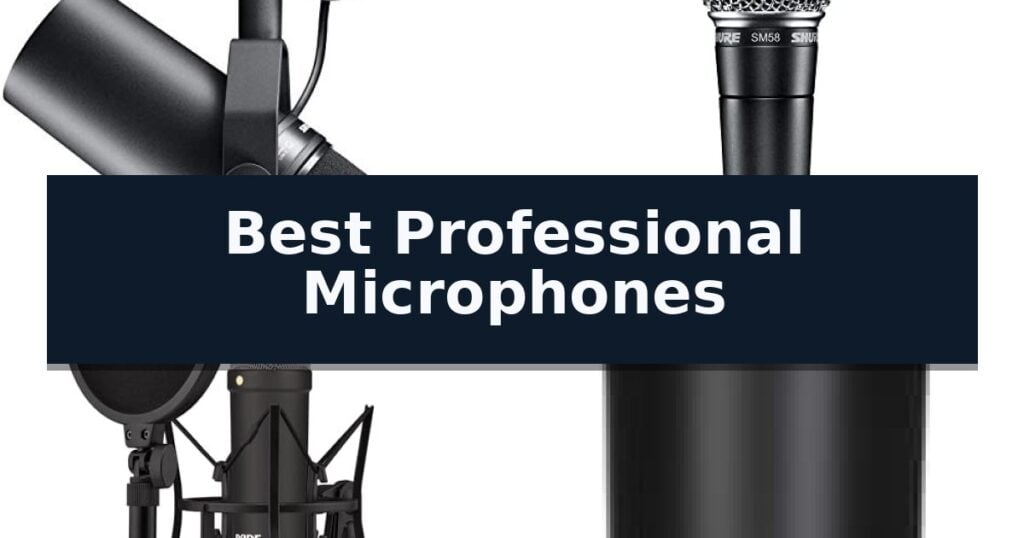
10 Best Professional Microphones in 2026 Reviews
Quick Comparison
| Product | Best For | Key Strength | Score |
|---|---|---|---|
| Shure SM7B Dynamic Vocal Microphone | Best Overall | Advanced electromagnetic shielding prevents unwanted hum and interference. | 4.9 |
| Shure SM58 Dynamic Vocal Microphone | Legendary Stage Performance | Legendary vocal clarity with a frequency response tuned for warm, articulate sound. | 4.4 |
| Rode NT1 Signature Studio Microphone | Ultra-Quiet Studio Condenser | Ultra-low 4.5dBA self-noise for clean, professional-grade recordings. | 4.4 |
| Sennheiser e 935 Dynamic Microphone | High-Output Stage Clarity | Cardioid pickup pattern provides excellent isolation from unwanted stage noise. | 4.3 |
| Shure SM57 Dynamic Instrument Microphone | Precision for Instruments | Contoured frequency response enhances instrument attack and detail. | 4.6 |
| Phenyx Pro Dual Wireless System | Reliable Multi-Channel Wireless | One-touch Auto Scan for rapid frequency selection. | 4.9 |
| JBL Wireless Microphone System | Simple Plug-and-Play Setup | Plug-and-play setup for immediate operation | 4.9 |
| Shure SM58S Dynamic Vocal Microphone | Convenient Integrated Mute | Integrated on/off switch for immediate muting control. | 4.7 |
| TONOR D5 Dynamic Vocal Microphone | Durable Hypercardioid Pickup | Hypercardioid pickup pattern effectively minimizes background noise. | 4.4 |
| Pyle PDMIC59 Dynamic Microphone | Versatile Budget-Friendly Choice | Cardioid pickup pattern minimizes feedback and background noise. | 4.7 |
How We Chose
Selecting the right professional microphone requires a technical evaluation of how a unit handles sound capture in real-world environments. We prioritize hardware that offers consistent frequency response and effective noise rejection, ensuring that the audio remains clean and usable for broadcast, studio, or live performance applications without requiring excessive post-processing.
- Polar pattern consistency and off-axis noise rejection
- Frequency response accuracy for vocal and instrument capture
- Build quality and long-term mechanical reliability
- Connectivity standards and integration with professional interfaces
- Integrated hardware features like shock isolation and pop protection
1 Shure SM7B Dynamic Vocal Microphone — Industry Standard for Broadcast
Achieving studio-grade audio requires equipment that prioritizes signal integrity and noise rejection. The Shure SM7B Dynamic Vocal Microphone is engineered with a specialized dynamic cartridge and a wide-range frequency response to capture warm, balanced vocals, making it a staple for professional podcasting, voiceover, and studio recording environments.
This microphone utilizes a precise cardioid pickup pattern paired with air suspension shock isolation. This design effectively minimizes background noise and mechanical vibrations, ensuring the voice remains the focal point even in less-than-ideal acoustic spaces. The rugged all-metal construction includes advanced electromagnetic shielding, which protects the signal from hum and interference generated by external electronics.
Usability is enhanced by broadcast-ready features such as built-in pop filtering and a detachable windscreen, which mitigate plosives and breath noise without requiring external accessories. The professional XLR output provides creators with full control over gain, EQ, and tone shaping when paired with external audio interfaces or mixers, allowing for a highly customizable sound profile.
With its charcoal gray finish and durable build, the Shure SM7B Dynamic Vocal Microphone is designed for consistent performance in demanding broadcast and streaming setups. It offers a reliable solution for engineers and creators who require a robust, studio-quality tool for close-mic vocal applications.
Best for: Professional podcasters, streamers, and studio engineers who require a reliable, noise-rejecting microphone for high-quality vocal capture.
Skip if: Users who prefer a plug-and-play USB microphone or those who do not have an external audio interface or mixer to provide the necessary XLR connectivity and gain control.
- Advanced electromagnetic shielding prevents unwanted hum and interference.
- Integrated air suspension shock isolation reduces handling noise and vibrations.
- Built-in pop filtering eliminates the need for additional external accessories.
- Rugged all-metal construction ensures long-term reliability in studio environments.
- Requires an external audio interface or mixer for XLR connectivity and gain management.
- Heavy design (2.7 pounds) necessitates a sturdy microphone arm or stand.
2 Shure SM58 Dynamic Vocal Microphone — Legendary Stage Performance
The Shure SM58 Pro XLR Dynamic Vocal Microphone is widely recognized for its finely tuned frequency response, which incorporates a subtle midrange lift to deliver warm, articulate vocal reproduction. This design choice ensures that vocals cut through a mix effectively, maintaining the clarity required for both studio recording and professional live performance environments.
Engineered with a precision cardioid pickup pattern, this microphone focuses tightly on the sound source while actively minimizing background noise and feedback. This directional capability makes it a reliable tool for podcasting, broadcast, and live stage use where isolation is critical for maintaining high-quality audio signals.
Built for the rigors of professional use, the Shure SM58 Pro XLR Dynamic Vocal Microphone features a rugged metal construction and a reinforced stand adapter. The unit also includes an integrated pop protection system, utilizing a refined spherical grille and a built-in filter to reduce plosives, breath, and wind noise without requiring external accessories.
This microphone provides a consistent, professional sound profile that has become an industry standard. With its durable build and specialized vocal-focused frequency response, it serves as a versatile solution for performers and creators who require a dependable, high-performance dynamic microphone for diverse recording and amplification tasks.
Best for: Professional vocalists, podcasters, and live performers who require a durable, industry-standard microphone with excellent feedback rejection.
Skip if: Users who require a condenser microphone for high-sensitivity studio recording or those who need a USB-native connection without an external audio interface.
- Legendary vocal clarity with a frequency response tuned for warm, articulate sound.
- Precision cardioid pickup pattern that effectively minimizes background noise and feedback.
- Integrated pop protection via a refined grille and filter to reduce plosives.
- Road-ready durability featuring rugged metal construction for professional use.
- XLR connectivity requires an external audio interface or mixer for digital recording.
- Dynamic design is less sensitive than condenser microphones for capturing subtle ambient sounds.
3 Rode NT1 Signature Studio Microphone — Ultra-Quiet Studio Condenser
Achieving studio-grade vocal clarity often relies on a signal chain that minimizes unwanted interference, and the Rode NT1 Signature Series Studio Condenser Microphone is engineered specifically for this purpose. Featuring a 4.5dBA self-noise rating, this large-diaphragm condenser is among the quietest microphones available, ensuring that your recordings capture only the intended source without adding a noise floor to your digital signal.
The Rode NT1 Signature Series Studio Condenser Microphone utilizes a tight cardioid polar pattern, which is designed to isolate the voice while effectively rejecting ambient noise from the surrounding room. This focus makes it a practical choice for both vocal tracking and streaming applications where acoustic treatment may be limited. The microphone relies on the legendary NT1 voicing, a sound profile that has been a staple in professional studio environments for two decades.
This package is designed as a complete vocal setup, providing the essential hardware needed to begin recording immediately once paired with an audio interface. Included in the box are an SM6 shock mount to reduce mechanical vibrations, a dedicated pop filter to mitigate plosives, an XLR cable, and a dust cover for storage. The unit is built with a durable finish, reflecting a focus on long-term utility in a studio environment.
With a 10-year warranty available upon registration, this microphone is positioned as a reliable component for consistent use. While it provides a high-quality capture for vocals and speech, it is a condenser microphone that requires 48V phantom power from an interface or mixer to operate, which is a standard requirement for this class of studio equipment.
Best for: Vocalists and streamers who require a low-noise floor and a complete, ready-to-record hardware bundle.
Skip if: Users who do not have an audio interface capable of providing 48V phantom power or those who require a dynamic microphone for untreated, noisy environments.
- Ultra-low 4.5dBA self-noise for clean, professional-grade recordings.
- Complete vocal setup includes an SM6 shock mount, pop filter, and XLR cable.
- Tight cardioid pattern effectively rejects off-axis room noise.
- 10-year warranty provides long-term support for the hardware.
- Requires 48V phantom power from an external audio interface.
- Condenser design is highly sensitive and may pick up unwanted room reflections if not used in a controlled space.
4 Sennheiser e 935 Dynamic Microphone — High-Output Stage Clarity
Capturing clear, articulate vocals on a busy stage requires a microphone that can isolate the performer while maintaining a consistent signal. The Sennheiser Pro Audio e 935 Cardioid Dynamic Vocal Microphone addresses this by utilizing a specialized cardioid pickup pattern, which effectively minimizes interference from other on-stage sound sources to ensure the primary vocal remains the focus.
Engineered for reliability in demanding environments, this microphone features a neodymium ferrous magnet with boron core. This technical choice ensures the microphone remains stable and maintains its performance characteristics regardless of fluctuating climate conditions. Its metal construction provides a rugged exterior designed to withstand the physical rigors of frequent transport and live stage use.
As a piece of equipment made in Germany, the build quality reflects a focus on longevity. The unit is supported by a 10 year warranty, offering significant peace of mind for professionals who rely on their gear for consistent, daily operation. Its compact size and weight make it a manageable addition to any touring kit.
While the Sennheiser Pro Audio e 935 Cardioid Dynamic Vocal Microphone excels at cutting through dense mixes, users should note that its high-output design is specifically tuned for vocal applications. It is a dedicated tool for those prioritizing stage presence and signal isolation over general-purpose recording versatility.
Best for: Professional vocalists and sound engineers who require a rugged, high-output microphone for consistent performance in live, high-pressure stage environments.
Skip if: Those who need a versatile, multi-purpose microphone for studio instrument recording or podcasting may find a large-diaphragm condenser microphone more suitable for their diverse requirements.
- Cardioid pickup pattern provides excellent isolation from unwanted stage noise.
- Neodymium ferrous magnet with boron ensures stable performance across varying climates.
- Rugged metal construction built for professional reliability.
- Comprehensive 10 year warranty.
- High-output tuning is optimized specifically for vocal stage use rather than general studio applications.
5 Shure SM57 Dynamic Instrument Microphone — Precision for Instruments
The Shure SM57 Pro XLR Dynamic Instrument Microphone is engineered with a contoured frequency response and a refined presence boost, specifically designed to enhance the attack and clarity of instruments such as snare drums, guitar amplifiers, and brass. This specialized tuning ensures that individual sources cut through a mix with precision, making it a staple for both live sound reinforcement and studio tracking.
Built for demanding environments, this microphone features legendary rugged construction that allows it to handle high sound pressure levels without compromising audio integrity. Its cardioid pickup pattern provides focused, low-bleed capture, which is essential for isolating a specific instrument while rejecting unwanted background noise in complex recording or stage setups.
Versatility remains a core strength of the Shure SM57, as it adapts seamlessly to a wide range of applications including percussion, bass cabinets, and acoustic instruments. The unit is designed for consistent, reliable performance, whether utilized in a home studio or on a major touring stage, backed by a 2-year limited warranty.
While highly effective for close-miking, users should note that this is a dynamic microphone requiring an XLR connection. It does not include integrated phantom power or USB connectivity, meaning it requires an external audio interface or mixer to function in a digital recording chain.
Best for: Musicians and engineers needing a durable, high-clarity microphone for close-miking instruments like guitar amps, snare drums, and brass.
Skip if: Users who require a USB-direct connection or a condenser microphone for capturing delicate, high-frequency room ambience.
- Contoured frequency response enhances instrument attack and detail.
- Cardioid pickup pattern minimizes bleed from surrounding noise sources.
- Rugged construction withstands high sound pressure levels and frequent transport.
- Versatile application across drums, amplifiers, and acoustic instruments.
- XLR-only connection requires an external interface or mixer.
- Lacks built-in features like USB connectivity or phantom power.
6 Phenyx Pro Dual Wireless System — Reliable Multi-Channel Wireless
The Phenyx Pro Dual Wireless System simplifies multi-user audio setups through its one-touch Auto Scan feature, which identifies the least-interference frequency for your specific environment. This system is engineered to retain settings after a power cycle, eliminating the need for repetitive synchronization and ensuring consistent performance for live vocals, worship services, or public speaking events.
Equipped with PLL frequency synthesized technology, this dual UHF cordless system operates across two channels with 100 selectable frequencies each, supporting up to 16 transmitters simultaneously. The system provides a stable transmission range between 290 ft and 328 ft line of sight, utilizing smooth IR synchronization to minimize dropouts and maximize feedback rejection during operation.
The included dynamic microphones feature a cardioid polar pattern specifically tuned to deliver a balanced frequency response with bright highs and full low-end output. Designed for longevity, the microphones incorporate a replaceable head design and a durable metal construction, complemented by a built-in mute function for immediate control during live performances.
The package includes a comprehensive set of accessories, such as anti-rolling rings, a 1/4-inch audio cable, and a 6.5 mm to 3.5 mm adapter. Powered by four AA batteries, the microphones are rated for 16 hours of use, providing reliable, long-duration operation for various professional applications.
Best for: Professional users requiring a reliable, multi-channel wireless microphone system for live events, worship services, or public speaking.
Skip if: Users who require a single-channel system or those who prefer a digital wireless connection over UHF frequency-based technology.
- One-touch Auto Scan for rapid frequency selection.
- Durable metal construction for enhanced longevity.
- 16-hour battery life on four AA batteries.
- Replaceable microphone head design.
- UHF frequency-based system may be subject to local signal interference in dense environments.
7 JBL Wireless Microphone System — Simple Plug-and-Play Setup
The JBL Wireless Microphone System prioritizes immediate usability through a plug-and-play design that eliminates complex configuration, allowing users to activate the receiver and microphones for instant operation. This system is engineered for vocal clarity, utilizing JBL Original Pro Sound to ensure audio output remains free from distortion, lag, or signal drops during use.
Designed for versatility, the unit features a rechargeable dual-channel UHF wireless receiver that supports simultaneous operation of two microphones. This dual-channel capability enables seamless mixing of two voices through a single speaker system, providing up to 6 hours of continuous playback on a single charge.
Maintenance and power management are simplified by the inclusion of replaceable AA batteries for the microphones, ensuring users can extend operation time without needing to wait for a recharge cycle. The hardware is built with a compact form factor, measuring approximately 9.16 inches in height and 1.95 inches in width, making it a portable solution for various vocal applications.
The system is backed by a 1-year manufacturer warranty, providing a standard level of support for the hardware components. By combining UHF wireless technology with straightforward battery-powered microphones, this system offers a practical approach for those requiring reliable vocal amplification without the need for intricate technical setups.
Best for: Users who need a straightforward, dual-microphone setup for events or presentations that requires minimal configuration and reliable vocal clarity.
Skip if: Professional audio engineers requiring advanced frequency management, XLR connectivity, or rechargeable internal batteries for the microphones themselves.
- Plug-and-play setup for immediate operation
- Dual-channel UHF receiver for simultaneous multi-user support
- Replaceable AA batteries for extended, uninterrupted use
- JBL Original Pro Sound for clear vocal reproduction
- AA battery dependence requires keeping spare batteries on hand
- Limited to 6 hours of playback time per receiver charge
8 Shure SM58S Dynamic Vocal Microphone — Convenient Integrated Mute
The Shure SM58S Dynamic Vocal Microphone distinguishes itself with an integrated on/off switch, providing immediate control for presenters and performers who need to mute their signal without adjusting a mixer or PA system. This feature makes it a versatile choice for live presentations, rehearsals, and studio recording where quick audio management is essential.
Engineered specifically for vocal applications, this microphone utilizes a tuned frequency response to deliver clear, warm, and present sound. Its cardioid polar pattern is highly effective at capturing sound directly from the front while rejecting off-axis noise, which helps isolate vocals from background instruments or crowd noise in demanding live environments.
Durability is central to its design, featuring a hardened grille and internal filtering that mitigate plosives, breath noise, and handling sounds. This robust construction ensures consistent performance in clubs, touring venues, and houses of worship, maintaining audio clarity even during energetic use.
Weighing approximately 0.66 pounds with a compact 6.37-inch length, the Shure SM58S Dynamic Vocal Microphone is built for portability and ease of handling. It is backed by a 2-year limited warranty, providing long-term support for its reliable, professional-grade vocal reproduction.
Best for: Performers, presenters, and podcasters who require a durable, professional-grade vocal microphone with the convenience of an integrated mute switch.
Skip if: Users who require a condenser microphone for high-frequency detail or those who do not need an on/off switch may prefer a different model.
- Integrated on/off switch for immediate muting control.
- Tuned frequency response optimized for clear vocal reproduction.
- Focused cardioid pickup to effectively reject off-axis noise.
- Hardened grille and internal filtering to reduce plosives and handling noise.
- Fixed polar pattern may limit versatility for non-vocal recording applications.
9 TONOR D5 Dynamic Vocal Microphone — Durable Hypercardioid Pickup
The TONOR D5 Dynamic Vocal Microphone utilizes a specialized hypercardioid pickup pattern designed to isolate your voice while actively rejecting off-axis background noise and feedback. This focused capture is paired with a 120dB SPL rating, allowing the microphone to handle high-volume sound sources without introducing distortion, making it a capable tool for both vocal performances and speech applications.
Engineered for longevity, the microphone features a robust zinc alloy, all-metal construction that provides significant impact resistance. This build quality ensures the unit can withstand the rigors of frequent handling, while the weighted feel of the metal body offers a stable, comfortable grip during extended use.
Usability is enhanced by a reinforced, smooth-action switch that allows for silent toggling, preventing the audible pops often associated with traditional mechanical switches. The microphone includes a generous 14.75ft (4.5m) XLR to 1/4" cable, providing immediate connectivity to a wide array of audio equipment, including studio mixers, amplifiers, and KTV setups.
Versatility is a core component of the TONOR D5 Dynamic Vocal Microphone, as its standard-sized body is compatible with most universal microphone stands. Whether integrated into a professional studio environment or used for casual party setups, the combination of high sensitivity and low impedance ensures reliable signal fidelity across various hardware configurations.
Best for: Singers and speakers who require a durable, noise-rejecting microphone for live performances or event hosting.
Skip if: Users who require a phantom-powered condenser microphone for high-frequency detail or those needing a wireless connection.
- Hypercardioid pickup pattern effectively minimizes background noise.
- All-metal zinc alloy construction provides superior durability.
- Reinforced silent switch prevents unwanted noise during operation.
- Includes a long 14.75ft XLR to 1/4" cable for immediate setup.
- Wired-only connection limits mobility compared to wireless alternatives.
10 Pyle PDMIC59 Dynamic Microphone — Versatile Budget-Friendly Choice
The Pyle PDMIC59 Dynamic Microphone is engineered for versatility, featuring a cardioid pickup pattern that effectively isolates your primary audio source while shunning off-axis background noise. This unidirectional design makes it a practical tool for capturing vocalists or amplified instruments without unwanted interference from stage speakers.
Built with a rugged, all-metal construction, this microphone utilizes a zinc die-cast case and a steel mesh windscreen equipped with an anti-dent ring to withstand the rigors of frequent use. The dynamic moving coil element is specifically designed to be moisture-resistant, allowing for high gain before feedback in live performance environments.
For clear and transparent sound reproduction, the unit offers an ultra-wide frequency response and includes an integrated pop filter to mitigate breath and plosive noises. It arrives as a complete package, including a 15 ft. XLR-to-1/4 inch audio cable, ensuring immediate connectivity for studio or stage setups.
This microphone serves as a reliable, all-purpose solution for those needing a durable handheld option that balances performance with a straightforward design. Its inclusion of essential cabling and robust build quality makes it a functional choice for bedroom studios and professional live applications alike.
Best for: Vocalists and musicians requiring a durable, versatile dynamic microphone for live stage performances or home studio recording.
Skip if: Users seeking a condenser microphone for high-sensitivity studio recording or those requiring specialized polar patterns beyond cardioid.
- Cardioid pickup pattern minimizes feedback and background noise.
- Rugged all-metal construction with a dent-resistant steel mesh windscreen.
- Includes 15 ft. XLR-to-1/4 inch cable for immediate use.
- Moisture-resistant dynamic element suitable for live vocal applications.
- Fixed cable connection type may require adapters for specific professional audio interfaces.
Best Professional Microphones Buying Guide
Dynamic vs. Condenser Microphones
Dynamic microphones are known for their ruggedness and ability to handle high sound pressure levels, making them ideal for live stages and untreated home studios. Their design naturally rejects background noise, which helps keep the focus strictly on the primary sound source.
Condenser microphones offer greater sensitivity and a wider frequency response, capturing more detail and nuance in the high end. These are typically preferred in sound-treated professional studios where capturing the subtle characteristics of a voice or acoustic instrument is the priority.
Understanding Polar Patterns
The polar pattern determines how a microphone captures sound from different directions. A cardioid pattern is the most common for professional work, as it focuses on the front of the mic while rejecting sound from the rear, which is essential for minimizing feedback.
Hypercardioid patterns offer an even tighter focus, providing increased isolation from side noise at the cost of a small pickup area at the rear. This is particularly useful in loud environments where bleed from other instruments or monitors is a significant concern.
Connectivity and Signal Chain
Professional microphones almost exclusively utilize XLR connections to ensure a balanced signal path. This balanced design is critical for preventing electromagnetic interference and hum, especially when running long cable lengths in a studio or venue.
Pairing a professional microphone with a high-quality audio interface or mixer is necessary to provide clean gain and precise EQ control. Without an interface that can provide sufficient clean power, even the most capable microphone will fail to reach its full performance potential.
Durability and Build Quality
Professional gear is expected to withstand frequent handling, transport, and the occasional impact. All-metal housings and reinforced grilles are standard requirements to protect the internal capsule from damage and to ensure the microphone remains functional over years of use.
Beyond the exterior, internal shock mounting and electromagnetic shielding are vital for maintaining signal integrity. These features prevent handling noise and external electrical interference from contaminating the recording, which is a common issue with lower-cost consumer alternatives.
Integrated Accessories
Many professional microphones include built-in pop filters or shock mounts, which simplify the setup process and reduce the need for external accessories. These integrated solutions are often tuned specifically to the microphone's capsule, providing better performance than generic third-party add-ons.
When a microphone does not include these features, it is important to budget for high-quality stands, shock mounts, and pop screens. Proper mounting is just as important as the microphone itself for achieving professional-grade results and preventing unwanted vibrations from reaching the recording.
Frequently Asked Questions
Do I need a separate audio interface for these microphones?
Yes, all professional XLR microphones require an audio interface or a dedicated mixer to convert the analog signal into a digital format for your computer and to provide the necessary gain.
What is the main advantage of a dynamic microphone?
Dynamic microphones are highly durable and excellent at rejecting background noise, making them ideal for podcasting, streaming, and live performances where the room is not perfectly soundproofed.
Can I use a studio microphone for live performances?
While possible, many studio condenser microphones are too sensitive and prone to feedback for live use. Dynamic microphones are generally the preferred choice for stage applications.
How do I prevent plosives in my recordings?
Using a pop filter or a microphone with an integrated pop shield helps diffuse the air blasts from 'p' and 'b' sounds before they hit the microphone capsule.
Does a more expensive microphone always sound better?
Not necessarily. The best microphone for you depends on your specific environment and use case. A well-placed, mid-range dynamic mic often outperforms an expensive, sensitive condenser in a noisy room.
Conclusion: Our Top Pick
Our top pick is Shure SM7B Dynamic Vocal Microphone. Choosing the right professional microphone involves balancing your specific recording environment with the technical requirements of your audio source. By prioritizing build quality, polar pattern suitability, and proper signal chain integration, you ensure that your equipment delivers consistent, high-quality results.
Take the time to evaluate whether your space requires the noise-rejecting capabilities of a dynamic microphone or the detailed capture of a condenser. Investing in a reliable, industry-proven model provides a foundation that will serve your production needs for years to come.