PNY GeForce RTX 5060 Ti Graphics Card is our pick for the Best 2-Slot GPUs because it balances high-bandwidth 16GB memory with a compact cooling solution that fits restricted chassis environments.
Selecting a graphics card for a small form factor build requires balancing thermal management with physical dimensions. While many modern high-performance cards occupy three or more slots, these dual-slot options provide the necessary clearance for tight layouts without sacrificing essential features like ray tracing or AI acceleration.
Beyond the primary pick, the NVIDIA RTX PRO 4000 SFF GPU offers a specialized professional-grade solution for workstation tasks, while the GIGABYTE Radeon RX 9060 XT GPU provides a high-performance alternative for those prioritizing a slim profile and aesthetic integration.
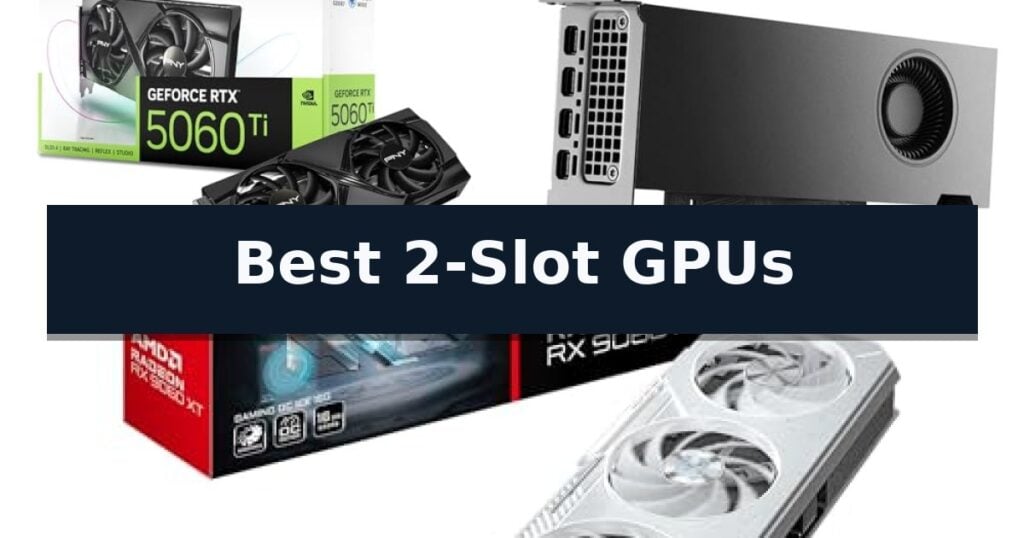
3 Best 2-Slot GPUs in 2026 Reviews
Quick Comparison
| Product | Best For | Key Strength | Score |
|---|---|---|---|
| PNY GeForce RTX 5060 Ti Graphics Card | Best Overall | Compact 2-slot design ideal for space-constrained SFF builds. | 4.9 |
| NVIDIA RTX PRO 4000 SFF GPU | Professional Low-Profile Power | Blackwell Architecture provides advanced performance for AI and professional tasks. | 4.6 |
| GIGABYTE Radeon RX 9060 XT GPU | Slim Profile High Performance | Compact 2-slot profile for versatile case compatibility. | 4.5 |
How We Chose
When evaluating the best 2-slot GPUs, we focus on the practical constraints of small form factor computing. An experienced reviewer must prioritize thermal efficiency and physical dimensions to ensure the card fits securely while maintaining stable boost clocks. We analyze how effectively these compact designs manage heat under load compared to their larger counterparts.
- Physical thickness and slot compatibility
- Thermal management and fan efficiency
- VRAM capacity and bandwidth
- Power delivery and connector requirements
- Architecture-specific features like AI and ray tracing
1 PNY GeForce RTX 5060 Ti Graphics Card — Compact Dual-Fan Cooling
Modern high-performance builds often struggle with space, making the PNY NVIDIA GeForce RTX™ 5060 Ti 16GB OC Dual-Fan Graphics Card a standout choice for those prioritizing a compact 2-slot footprint. By utilizing a dual-fan cooling system and a dense heatsink, this card maintains thermal efficiency without requiring the extra clearance of thicker, triple-slot alternatives.
Engineered with the NVIDIA Blackwell Architecture, this GPU integrates 5th-Gen Tensor Cores and 4th-Gen Ray Tracing Cores to handle demanding AI tasks and complex geometry. The inclusion of 16GB of GDDR7 memory provides a significant 448 GB/s bandwidth, ensuring that high-resolution textures and large-scale creative projects remain stable during heavy workloads.
Usability is enhanced through the VelocityX Software, which allows users to monitor real-time temperatures and manage custom fan curves. The card also features a vented metal backplate that provides passive cooling while reinforcing the structure to prevent sagging, a critical consideration for smaller chassis configurations.
While the card is optimized for SFF (Small Form Factor) builds, its performance capabilities are robust enough for 1440p gaming and professional creative applications. The PCIe® 5.0 compatibility ensures it remains relevant for future system upgrades, balancing current space constraints with long-term technical utility.
Best for: Users building high-performance, compact systems who require a 2-slot GPU with a large 16GB frame buffer for creative work and AI tasks.
Skip if: Users who prioritize maximum cooling headroom over space savings and have the chassis clearance for thicker, triple-slot cards.
- Compact 2-slot design ideal for space-constrained SFF builds.
- 16GB GDDR7 memory provides high bandwidth for textures and AI models.
- Vented metal backplate offers passive cooling and structural reinforcement.
- VelocityX Software allows for precise control over clocks and fan curves.
- Dual-fan cooling may run louder than larger, triple-fan solutions under sustained heavy loads.
2 NVIDIA RTX PRO 4000 SFF GPU — Professional Low-Profile Power
The NVIDIA RTX PRO 4000 SFF GPU is engineered for professionals requiring high-performance computing within a constrained workstation environment. By utilizing the advanced Blackwell Architecture, this card delivers significant computational capabilities while maintaining a Low-Profile Dual-Slot footprint that fits into compact chassis designs where standard-sized cards would be physically incompatible.
Equipped with 24GB of GDDR7 memory and ECC support, this workstation GPU is built to handle complex AI workloads and data-intensive tasks with high reliability. The inclusion of PCIe 5.0 x8 connectivity ensures high-speed data throughput, while the 4X mDP 2.1b outputs provide flexible multi-display configurations for demanding professional visualization setups.
Designed specifically for AI Workstation applications, this card balances thermal efficiency with raw processing power. Its compact design does not sacrifice the core technologies needed for modern ray tracing and accelerated computing, making it a specialized solution for developers and engineers working in space-limited environments.
When integrating this component, ensure your workstation chassis supports a dual-slot low-profile card and provides the necessary power delivery for the Blackwell platform. This unit is a purpose-built tool for professional environments where hardware density is a primary operational requirement.
Best for: Professionals and engineers needing high-performance AI and workstation computing power within a compact, low-profile chassis.
Skip if: Users who require full-height GPU compatibility or standard PCIe x16 bandwidth for non-SFF workstation builds.
- Blackwell Architecture provides advanced performance for AI and professional tasks.
- 24GB GDDR7 memory with ECC ensures stability for data-heavy workflows.
- Low-Profile Dual-Slot design allows for installation in compact workstation cases.
- PCIe 5.0 support offers modern high-speed connectivity.
- SFF-specific form factor may limit compatibility with standard full-height PC cases.
- PCIe 5.0 x8 interface may be a bottleneck for specific high-bandwidth applications compared to x16 lanes.
3 GIGABYTE Radeon RX 9060 XT GPU — Slim Profile High Performance
The GIGABYTE Radeon™ RX 9060 XT Gaming OC ICE 16G Graphics Card utilizes a specialized 2-slot design to provide high-performance graphics capabilities within a compact form factor. This card is built for longevity, featuring 16GB of GDDR6 VRAM and support for PCI Express Gen 5, making it a robust choice for users working with the latest AM5 platforms and Ryzen 9000 Series processors.
Thermal management is handled by the WINDFORCE cooling system, which integrates server-grade thermal conductive gel, composite copper heat pipes, and a copper plate to maintain stability during intensive tasks. The inclusion of Hawk fans with alternate spinning and 3D active fan technology helps manage airflow efficiently, while the reinforced metal backplate with a bent edge ensures structural integrity across the 11.06-inch length of the card.
For users prioritizing specific operational environments, the card includes a Dual BIOS feature that allows switching between Performance and Silent modes. The unit also supports RGB lighting with 16.7 million customizable colors, which can be synchronized through the GIGABYTE CONTROL CENTER. Connectivity is modernized with an updated Radiance Display Engine, supporting DisplayPort 2.1a and HDMI 2.1b for high-refresh-rate displays.
Best for: Users requiring a high-performance, 16GB VRAM graphics solution that fits within a strict 2-slot chassis constraint.
Skip if: Users with small form factor cases that cannot accommodate the 11.06-inch length of this card, or those requiring more than 2 slots for specialized cooling configurations.
- Compact 2-slot profile for versatile case compatibility.
- 16GB GDDR6 VRAM for demanding graphical workloads.
- Dual BIOS functionality for adjustable noise and performance profiles.
- Reinforced metal backplate for enhanced structural durability.
- 11.06-inch length may exceed clearance in some compact PC builds.
Best 2-Slot GPUs Buying Guide
The Importance of Slot Thickness
The primary constraint for small form factor builds is the physical width of the graphics card. A 2-slot design is often the maximum allowed in many ITX cases, making it a critical specification for ensuring the card fits without obstructing other components or airflow.
Buyers should verify the exact width measurements provided by the manufacturer. Even cards labeled as 2-slot can vary slightly in depth, which may impact clearance if your case has tight tolerances near the side panel or motherboard components.
Thermal Management in Compact Spaces
In a restricted chassis, heat dissipation is more challenging than in a standard mid-tower. Dual-fan cooling systems, such as those found on the PNY and GIGABYTE models, are designed to move air efficiently across a dense heatsink to prevent thermal throttling.
Look for features like vented backplates and server-grade thermal materials. These additions help pull heat away from the PCB, providing the thermal headroom necessary to sustain performance during extended gaming or rendering sessions.
VRAM and Performance Requirements
Modern creative projects and high-resolution gaming demand significant frame buffer capacity. A 16GB VRAM configuration, as seen in the PNY and GIGABYTE options, ensures that you can handle large textures and local AI models without running into memory bottlenecks.
While professional cards like the NVIDIA RTX PRO 4000 SFF may offer even higher VRAM capacities, they are optimized for specific workstation workflows. Gamers should prioritize cards that balance this memory with high boost clock speeds for better frame rates.
Connectivity and Future-Proofing
Modern GPUs should support the latest display standards to ensure compatibility with high-refresh-rate monitors. Features like DisplayPort 2.1 and HDMI 2.1 are essential for driving ultra-high-resolution displays without limitations.
Additionally, support for PCIe 5.0 ensures that your graphics card remains relevant as motherboard and CPU standards evolve. This forward-looking connectivity is a key factor for users planning to keep their build for several years.
Software and Customization
Control software allows users to fine-tune their GPU performance to match their specific cooling environment. Being able to adjust fan curves and monitor temperatures in real-time is vital for maintaining stability in a compact system.
Custom profiles enable you to switch between performance-focused modes for gaming and silent modes for lighter tasks. This flexibility helps manage noise levels and power consumption, which are often more noticeable in smaller, desktop-adjacent builds.
Frequently Asked Questions
Will a 2-slot GPU fit in any ITX case?
While 2-slot cards are designed for compact builds, you must always check your case's maximum GPU width and length specifications to ensure proper fitment.
Do 2-slot cards run hotter than 3-slot cards?
Generally, 2-slot cards have less heatsink volume than 3-slot cards, which can lead to higher temperatures. However, modern designs use high-efficiency fans and advanced thermal materials to mitigate this.
Is 16GB of VRAM necessary for a 2-slot gaming GPU?
16GB is highly beneficial for modern 1440p gaming and creative workloads, as it prevents performance drops when handling large assets or complex AI tasks.
Can I use a professional SFF GPU for gaming?
Professional cards like the NVIDIA RTX PRO 4000 SFF are optimized for workstation tasks and may not offer the same driver optimizations or clock speeds as gaming-specific cards.
What is the benefit of a vented backplate?
A vented backplate provides passive cooling by allowing heat to escape from the back of the PCB, which helps lower overall temperatures in confined spaces.
Conclusion: Our Top Pick
Our top pick is PNY GeForce RTX 5060 Ti Graphics Card. Choosing the right 2-slot GPU depends on your specific balance of thermal needs, VRAM requirements, and physical space constraints. By focusing on cards that utilize efficient cooling and modern architecture, you can achieve high performance in a compact build.
Always verify your case dimensions before purchasing to ensure the card fits comfortably. With the right selection, these dual-slot options provide a powerful, space-saving foundation for any high-performance system.