Seagate IronWolf NAS Hard Drive is our top recommendation for the Best 3.5-Inch HDD for NAS because it offers specialized health management features and robust vibration resistance for multi-bay environments.
The Western Digital Red Plus NAS HDD serves as a reliable alternative for users prioritizing continuous operation in smaller RAID arrays, while the Seagate IronWolf Pro Enterprise NAS HDD provides a performance-focused option for demanding, high-capacity enterprise storage needs.
Selecting the right drive involves balancing storage capacity, rotational speed, and workload endurance to ensure your data remains accessible and protected. Understanding these technical trade-offs is essential for maintaining a stable network-attached storage system that meets your specific file-sharing and backup requirements.
For a broader look at storage options, our guide to the Best 3.5-Inch Hard Drive for NAS provides additional context on selecting the right hardware for your specific enclosure.
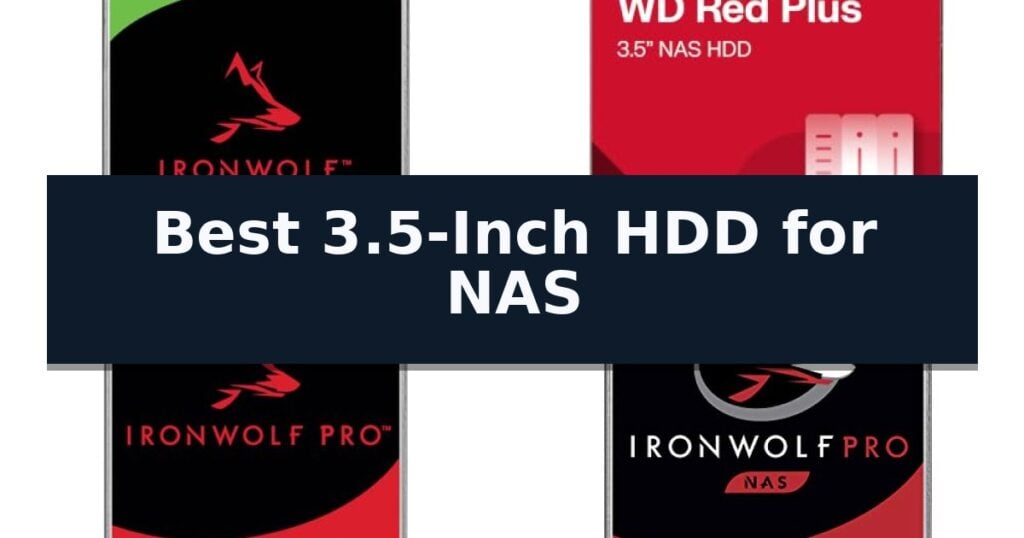
5 Best 3.5-Inch HDD for NAS in 2026 Reviews
Quick Comparison
| Product | Best For | Key Strength | Score |
|---|---|---|---|
| Seagate IronWolf NAS Hard Drive | Best Overall | NAS-optimized firmware for improved RAID performance. | 4.9 |
| Western Digital Red Plus NAS HDD | Reliable for Continuous Operation | CMR technology ensures better compatibility and performance for RAID arrays compared to SMR drives. | 4.9 |
| Seagate IronWolf Pro Enterprise NAS HDD | High-Performance Enterprise Reliability | All-CMR architecture ensures consistent, high-performance data access. | 4.4 |
| Seagate IronWolf Pro NAS HDD | Built for Large RAID Arrays | IronWolf Health Management for proactive drive monitoring | 4.7 |
| WD Red Plus 6TB NAS 3.5" Internal Hard Drive – 5400 RPM Class | Versatile for Home Office Storage | CMR technology ensures reliable performance for RAID array rebuilding. | 4.3 |
How We Chose
To identify the best 3.5-inch hard drive for NAS, we evaluate technical specifications against the unique demands of network-attached storage. An experienced reviewer focuses on drive longevity, vibration mitigation, and RAID-specific firmware, ensuring that the selected hardware can handle the constant read/write cycles typical of home and business server environments.
- Workload Rating: Assessing the drive's capability to handle sustained data transfers and continuous 24/7 operation.
- RAID Compatibility: Evaluating features like vibration sensors and error recovery controls that ensure stability in multi-drive enclosures.
- Data Recovery Support: Checking for included recovery services that provide an extra layer of protection against hardware failure.
- Cache Size and RPM: Comparing buffer sizes and rotational speeds to determine the balance between power efficiency and data access performance.
- Warranty and Reliability: Reviewing the manufacturer's MTBF ratings and the duration of the limited warranty coverage.
1 Seagate IronWolf NAS Hard Drive — Optimized for Multi-User Environments
Maintaining data integrity in a multi-user environment requires hardware specifically engineered to handle constant read and write cycles. The Seagate IronWolf 4TB NAS Internal Hard Drive is purpose-built for NAS enclosures, offering a specialized design that minimizes wear and tear while maintaining consistent performance in systems with up to 8 bays.
This drive utilizes CMR (Conventional Magnetic Recording) technology, which is essential for the sustained workloads found in RAID configurations. With a 5400 RPM spindle speed and a 64MB cache, it balances power efficiency with the responsiveness needed for active file-sharing environments. The drive is designed to operate with little to no noise or vibration, ensuring that your storage array remains unobtrusive.
Beyond raw storage, the drive integrates the IronWolf Health Management system. This feature allows users to actively monitor drive health, helping to prevent potential downtime before it occurs. The unit is rated for a 1M hours MTBF (Mean Time Between Failures), reflecting its focus on long-term reliability for continuous operation.
Each unit includes a three-year limited warranty and is bundled with three years of Rescue Data Recovery Services, providing an added layer of security for your stored files. Measuring 3.5 inches, it is a standard form factor compatible with most modern NAS enclosures, though users should always verify their specific enclosure's drive bay capacity and interface requirements before installation.
Best for: Small to medium-sized NAS environments requiring reliable, 24/7 operation for multi-user file sharing.
Skip if: Users seeking high-performance drives for intensive enterprise-level virtualization or those requiring speeds higher than 5400 RPM for specific latency-sensitive applications.
- NAS-optimized firmware for improved RAID performance.
- Integrated IronWolf Health Management for proactive monitoring.
- Includes three-year Rescue Data Recovery Services.
- Designed for low noise and vibration in multi-drive enclosures.
- 5400 RPM speed may be slower than 7200 RPM alternatives for high-throughput tasks.
- 64MB cache is smaller than some higher-capacity models in the same series.
2 Western Digital Red Plus NAS HDD — Reliable for Continuous Operation
Maintaining data integrity in a multi-drive environment requires hardware specifically engineered for the rigors of constant uptime. The Western Digital 4TB WD Red Plus NAS Internal Hard Drive HDD is built for this exact purpose, utilizing CMR (Conventional Magnetic Recording) technology to ensure stable performance in RAID-optimized configurations.
Designed for systems with up to 8 bays, this drive is tuned for NAS environments using the integrated NASware firmware. This optimization helps manage the complexities of multi-drive arrays, balancing power consumption and performance to support continuous operation without the premature wear often associated with standard desktop drives.
With a capacity of 4TB, this 3.5-inch drive provides a balance of storage density and reliability for home or small office servers. It operates at 5400 RPM and features a 128 MB cache, providing consistent data throughput for streaming, file sharing, and automated backups.
The drive is backed by a 3-year limited warranty and Western Digital's support infrastructure, offering a layer of assurance for critical data storage. Its physical dimensions are standard for 3.5-inch bays, measuring approximately 1.03 inches in height and 5.78 inches in length, ensuring broad compatibility with most NAS enclosures.
Best for: Home and small office users requiring a reliable, RAID-optimized drive for continuous 24/7 operation in NAS enclosures with up to 8 bays.
Skip if: Users seeking maximum performance for high-speed scratch disks or those requiring capacities beyond 12TB should consider enterprise-grade or higher-density alternatives.
- CMR technology ensures better compatibility and performance for RAID arrays compared to SMR drives.
- NASware optimization specifically tunes the drive for the demands of multi-bay NAS systems.
- Engineered for continuous operation to support 24/7 server environments.
- Includes a 3-year limited warranty for added peace of mind.
- 5400 RPM spindle speed may be slower than 7200 RPM drives for intensive random read/write tasks.
- Limited to a maximum capacity of 12TB within the product line.
3 Seagate IronWolf Pro Enterprise NAS HDD — High-Performance Enterprise Reliability
Reliability in a 24/7 storage environment often hinges on drive architecture, and the Seagate IronWolf Pro Enterprise NAS HDD addresses this with an all-CMR (conventional magnetic recording) design. This approach ensures consistent performance for demanding workloads, providing the stability required for continuous data access in multi-bay network attached storage systems.
Engineered for high-density environments, the drive integrates AgileArray technology, which utilizes dual-plane balancing and rotational vibration (RV) sensors to maintain performance during intensive RAID operations. The inclusion of time-limited error recovery (TLER) further supports system health by preventing the drive from dropping out of a RAID array during minor read/write errors.
The drive is built for longevity and heavy usage, featuring a workload rating of up to 550TB/year and a mean time between failures (MTBF) of 2.5 million hours. To assist in long-term maintenance, IronWolf Health Management provides actionable prevention and recovery recommendations, while the 5-year limited warranty reflects its enterprise-grade positioning.
Data protection is a core component of this model, highlighted by the inclusion of complimentary 3-year Rescue Data Recovery Services. This service provides a safety net for data recovery, adding a layer of security for users managing critical files across their NAS infrastructure.
Best for: Professional and power users requiring high-capacity, 24/7 reliable storage for multi-bay NAS and RAID environments.
Skip if: Users with single-bay home setups or light, intermittent storage needs may find the enterprise-grade pricing and feature set more than what their specific use case requires.
- All-CMR architecture ensures consistent, high-performance data access.
- Enterprise-grade durability with a 550TB/year workload rating and 2.5M hours MTBF.
- Integrated health monitoring via IronWolf Health Management.
- Complimentary 3-year data recovery services included for added security.
- Enterprise-focused pricing may exceed the budget for casual home storage users.
4 Seagate IronWolf Pro NAS HDD — Built for Large RAID Arrays
Reliability in a high-density storage environment often hinges on the drive's ability to manage vibration and thermal stress, which is where the Seagate IronWolf Pro 4TB NAS Internal Hard Drive HDD excels. Designed specifically for NAS systems supporting up to 24 bays, this 3.5-inch drive is engineered to maintain consistent performance in multi-user environments.
The drive operates at 7200 RPM and features a 128MB cache, enabling data transfer speeds up to 214MB/s. This throughput is optimized for demanding workloads, ensuring that file-sharing tasks remain fluid even when multiple users are accessing the storage array simultaneously.
Data integrity and longevity are central to its design, evidenced by a 1.2 million-hour MTBF (Mean Time Between Failures) rating. The inclusion of the IronWolf Health Management system allows for proactive monitoring of drive health, while the three-year Rescue Data Recovery Services plan provides an additional layer of security for critical information.
Built for continuous operation, the drive is optimized to reduce wear and tear, minimize noise and vibration, and lower power consumption. It is backed by a five-year limited product warranty, reflecting its intended use in professional and intensive network-attached storage configurations.
Best for: Professional and power users managing multi-user NAS environments with up to 24 drive bays who require high reliability and data recovery support.
Skip if: Users seeking a basic, low-cost drive for single-bay, light-duty home media storage where the advanced vibration management and data recovery features are not required.
- IronWolf Health Management for proactive drive monitoring
- Three-year Rescue Data Recovery Services included
- Optimized for up to 24-bay NAS environments
- Five-year limited warranty for long-term support
- Higher cost compared to standard desktop-grade hard drives
5 WD Red Plus 6TB NAS 3.5" Internal Hard Drive – 5400 RPM Class — Versatile for Home Office Storage
Managing data across small- to medium-sized business environments requires hardware that balances consistent uptime with reliable data integrity. The WD Red Plus 6TB NAS 3.5" Internal Hard Drive – 5400 RPM Class is engineered specifically for these demands, offering a robust solution for archiving, file sharing, and complex RAID array rebuilding.
Built with a 5400RPM performance class architecture, this drive is optimized for the sustained operations typical of network-attached storage. It is designed to handle a workload rate of up to 180TB/yr, providing the necessary endurance for SOHO customers who require dependable access to their digital assets without the overhead of enterprise-grade hardware.
Versatility is a core component of its design, as the drive is tested for compatibility with systems using up to 8 bays. By utilizing CMR (Conventional Magnetic Recording) technology, it ensures stable performance during intensive tasks like ZFS file system operations. The inclusion of a 256MB cache further assists in managing data throughput efficiently across multi-user environments.
Choosing the right storage involves balancing capacity needs with system constraints. While this model is part of a series ranging from 1TB to 14TB, the 6TB capacity provides a middle ground for users scaling their storage infrastructure. Its SATA 6 Gb/s interface ensures standard connectivity, making it a straightforward integration for most modern NAS enclosures.
Best for: Small office and home office users requiring reliable, high-capacity storage for multi-bay NAS systems and RAID configurations.
Skip if: Users who require high-speed 7200RPM performance for intensive, real-time data processing or those operating systems exceeding an 8-bay configuration.
- CMR technology ensures reliable performance for RAID array rebuilding.
- Supports a robust 180TB/yr workload rate for consistent operation.
- Validated for use in up to 8-bay NAS systems.
- Optimized for ZFS and other file systems.
- 5400RPM class speed may be slower than 7200RPM alternatives for high-performance needs.
Best 3.5-Inch HDD for NAS Buying Guide
Understanding CMR vs. SMR Technology
For NAS applications, Conventional Magnetic Recording (CMR) is the industry standard. These drives provide consistent write speeds and are far more reliable when rebuilding RAID arrays compared to Shingled Magnetic Recording (SMR) alternatives.
Always verify that your chosen drive utilizes CMR technology to avoid performance degradation during parity calculations. Using the wrong drive type can lead to significant latency issues or system timeouts during intensive data operations.
The Importance of Vibration Protection
NAS enclosures often house multiple drives in close proximity, which creates significant mechanical vibration. Drives equipped with rotational vibration (RV) sensors are designed to compensate for this movement, preventing data corruption and mechanical wear.
If you are planning to use a NAS with four or more bays, prioritize models that explicitly list vibration-dampening technology. This feature is a critical factor in extending the lifespan of your storage array.
Workload and Reliability Ratings
NAS drives are built for different duty cycles, often measured in terabytes per year. A drive designed for a small home office may have a lower workload rating than an enterprise-grade model intended for 24/7 high-traffic environments.
Match the drive's workload rating to your actual usage patterns. Over-provisioning with enterprise drives for light home use is possible, but choosing a drive with too low a rating for a busy server can lead to premature failure.
Balancing Performance and Power Consumption
Higher rotational speeds, such as 7,200 RPM, offer faster data access but typically consume more power and generate more heat. In contrast, 5,400 RPM class drives are often quieter and more energy-efficient, making them ideal for living room or bedroom NAS setups.
Consider the thermal constraints of your NAS enclosure. If your unit has limited ventilation, choosing a cooler-running, lower-RPM drive can help maintain system stability and reduce fan noise.
Data Recovery and Warranty Coverage
Hard drive failure is an inevitable reality, making the manufacturer's warranty and data recovery services vital components of your purchase. Look for drives that include multi-year recovery plans, which can save significant costs if a drive fails.
A longer warranty period is often a strong indicator of the manufacturer's confidence in the drive's reliability. Always register your drives upon purchase to ensure you can easily access support and warranty claims if needed.
Frequently Asked Questions
Can I use desktop hard drives in a NAS?
While desktop drives may physically fit, they lack the firmware optimizations and vibration protection required for multi-drive NAS environments, which can lead to premature failure.
What is the difference between IronWolf and IronWolf Pro?
IronWolf Pro models are designed for larger, high-performance arrays and typically feature higher workload ratings, faster RPMs, and longer warranty periods compared to the standard IronWolf line.
Do I need to match drive capacities in a RAID array?
Yes, for most RAID configurations, it is best to use drives of the same capacity. If you mix capacities, the array will often be limited to the size of the smallest drive.
How often should I check my NAS drive health?
You should monitor your drives regularly using the manufacturer's health management software or your NAS operating system's built-in SMART monitoring tools.
Is 5400 RPM fast enough for a home NAS?
For media streaming, file backups, and general home office use, 5400 RPM drives provide more than enough speed while remaining quiet and power-efficient.
Conclusion: Our Top Pick
Our top pick is Seagate IronWolf NAS Hard Drive. Choosing the right NAS drive requires careful consideration of your specific storage environment, from the number of drive bays to your expected daily workload. By prioritizing CMR technology and vibration-resistant features, you ensure your data remains secure and your system performs reliably over time.
Whether you opt for the balanced performance of the Seagate IronWolf or the specialized endurance of the Pro series, investing in purpose-built NAS hardware is the most effective way to protect your digital assets.