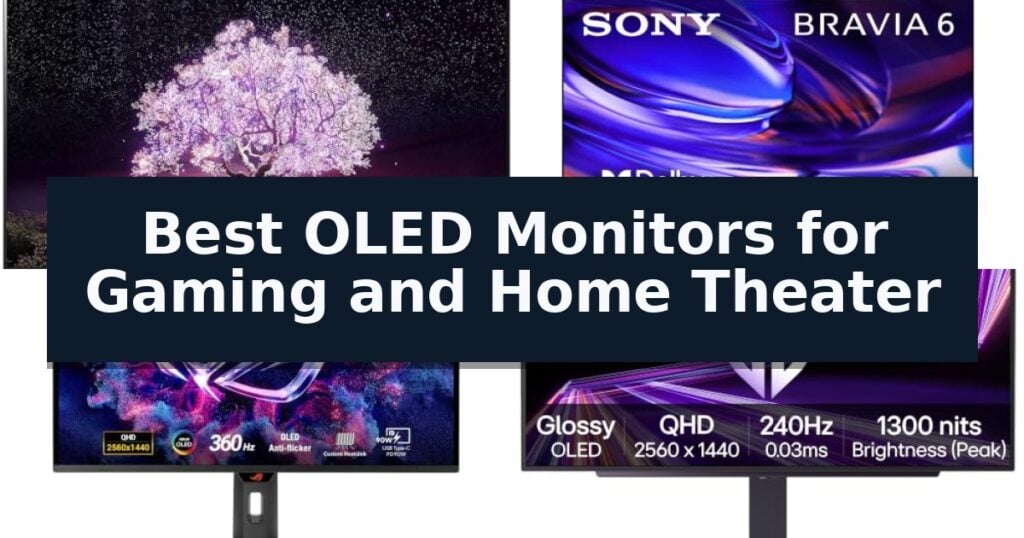
LG C1 Series OLED TV is our pick for the Best OLED Monitors for Gaming and Home Theater because its combination of self-lit pixels and dedicated gaming features provides a versatile experience that bridges the gap between high-end console gaming and cinematic viewing.
The Sony BRAVIA 6 OLED TV stands out for users prioritizing a cinematic home theater experience, while the ASUS ROG Strix QD-OLED Monitor is tailored for those who demand high-speed competitive performance. Selecting the right display requires balancing the immersive contrast of OLED technology with the specific connectivity and motion handling needs of your primary use case.
When choosing between a large-format OLED TV and a dedicated desktop monitor, consider your viewing distance and the intended balance of media consumption. While TVs offer expansive screens for movies, dedicated monitors often include specialized gaming features like higher refresh rates and ergonomic stands to support long-term desk use.
For those looking to refine their setup, our guide on Best OLED Gaming Monitors offers deeper insights into specific panel performance. If you specifically need 4K resolution, explore our Best OLED 4K Gaming Monitors to see how high-resolution panels handle modern titles.
10 Best OLED Monitors for Gaming and Home Theater in 2026 Reviews
Quick Comparison
| Product | Best For | Key Strength | Score |
|---|---|---|---|
| LG C1 Series OLED TV | Best Overall | Self-lit OLED pixels providing infinite contrast and deep black levels. | 4.9 |
| Sony BRAVIA 6 OLED TV | Cinematic contrast for home theater | HDMI 2.1 support for 4K/120Hz, VRR, and ALLM gaming features. | 4.6 |
| ASUS ROG Strix QD-OLED Monitor | High-speed competitive gaming performance | 360Hz refresh rate and 0.03ms response time for fluid motion. | 4.9 |
| LG UltraGear OLED Gaming Monitor | Glossy panel for vivid visuals | 0.03ms response time for minimal motion blur | 4.6 |
| Acer Predator QD-OLED Gaming Monitor | Smooth motion for eSports | 0.03ms response time for minimal ghosting. | 4.4 |
| LG UltraGear 4K OLED Monitor | Crisp 4K resolution for immersion | Dual-Mode functionality allows for seamless switching between 4K/165Hz and 1080p/330Hz. | 4.8 |
| Samsung Odyssey OLED G6 Monitor | Glare-free display for bright rooms | 0.03ms response time for ultra-smooth motion | 4.4 |
| ASUS ROG OLED Gaming Monitor | Pro-grade burn-in protection | 0.03ms response time for exceptional motion clarity. | 4.4 |
| LG UltraGear Dual-Mode OLED Monitor | Flexible refresh rates for versatility | Dual-Mode functionality enables switching between 4K 240Hz and FHD 480Hz. | 4.3 |
| AOC Gaming QD-OLED Monitor | Vibrant color for immersive play | Ultra-fast 0.03ms response time for minimal motion blur. | 4.7 |
How We Chose
Selecting the best OLED monitors for gaming and home theater requires a rigorous assessment of how these displays handle both high-motion gaming and high-fidelity video. We prioritize panels that offer true black levels, rapid response times for fluid motion, and the necessary input bandwidth to support modern gaming consoles and high-end PC hardware.
- Panel Technology and Contrast Ratio
- Refresh Rate and Response Time
- Resolution and Pixel Density
- Connectivity Options (HDMI 2.1, DisplayPort)
- OLED Burn-in Protection Features
- Ergonomic Adjustability and Mounting
1 LG C1 Series OLED TV — Versatile OLED for gaming and movies
The LG C1 Series OLED TV distinguishes itself through its 8 million self-lit OLED pixels, which operate independently to produce deep blacks and infinite contrast. This display technology allows for a level of color depth and precision that makes it a compelling choice for both high-end gaming and immersive home theater setups.
Engineered with the α9 Gen 4 AI Processor 4K, the unit automatically optimizes picture and sound based on the content being viewed. For cinematic viewing, it includes Filmmaker Mode, Dolby Vision IQ, and Dolby Atmos support, ensuring that media is presented in accordance with original production standards.
Gamers can utilize the Game Optimizer interface, which provides quick access to settings that reduce input lag and enhance performance. The monitor is NVIDIA G-SYNC and FreeSync Premium Compatible, features that work alongside HDMI 2.1 connectivity to minimize screen tearing during fast-paced action sequences.
The device offers integrated access to major streaming platforms like Netflix, Prime Video, and Disney+, centralizing home entertainment options. While it includes a Magic Remote and essential power components, users should note that the stand is sold separately and wall mounting requires a compatible VESA 300 x 300 mount.
Best for: Users seeking a high-contrast display that bridges the gap between competitive gaming performance and premium home theater cinematic quality.
Skip if: Users who require a dedicated desktop monitor form factor or those who prefer an included stand, as this unit is designed primarily as a large-format television.
- Self-lit OLED pixels providing infinite contrast and deep black levels.
- HDMI 2.1 support and NVIDIA G-SYNC/FreeSync Premium compatibility for smooth gaming.
- α9 Gen 4 AI Processor for automated picture and sound enhancement.
- Integrated Dolby Vision IQ and Dolby Atmos for high-fidelity home theater audio and video.
- TV stand is sold separately, requiring additional purchase for tabletop placement.
- VESA mount required for wall installation is not included.
2 Sony BRAVIA 6 OLED TV — Cinematic contrast for home theater
The Sony 77 Inch BRAVIA 6 OLED 4K HDR Smart Google TV distinguishes itself through the use of over 8 million self-lit pixels, which are individually managed to achieve pure black levels and high-contrast imagery. This display technology is complemented by the Triluminos Pro engine, designed to reproduce a wider palette of over a billion accurate colors for more lifelike visuals.
For those integrating this unit into a home theater, it features support for Dolby Vision, Dolby Atmos, and DTS:X, creating an immersive audio-visual environment. The panel is factory-calibrated to ensure consistent performance, and its wide viewing angle maintains color accuracy regardless of your seating position. An ambient light sensor automatically adjusts brightness, ensuring the picture remains optimized for both daytime and evening viewing.
Gamers can utilize the four HDMI 2.1 ports, which support advanced features such as 4K/120Hz, Variable Refresh Rate (VRR), Auto Low Latency Mode (ALLM), and Source-Based Tone Mapping (SBTM). These specifications provide the necessary bandwidth for high-performance gaming consoles and PCs, ensuring smooth motion and reduced input lag.
The physical design focuses on integration, featuring a narrow-bezel aesthetic and a two-position adjustable stand. This allows users to elevate the display to accommodate a soundbar, keeping the setup clean. Additionally, the inclusion of Google TV with Gemini provides centralized access to streaming services and smart home controls, while Sony Pictures Core offers a selection of IMAX Enhanced content.
Best for: Users seeking a high-performance display that balances advanced gaming specifications like 4K/120Hz with cinematic home theater features such as Dolby Vision and Atmos.
Skip if: Users who require a smaller screen size or a display that does not rely on a smart TV operating system for their specific home theater setup.
- HDMI 2.1 support for 4K/120Hz, VRR, and ALLM gaming features.
- Self-lit OLED pixels providing pure black and high contrast.
- Factory-calibrated panel for consistent image quality.
- Adjustable two-position stand to accommodate soundbars.
- Large 77-inch footprint may be restrictive for smaller rooms or specific mounting locations.
3 ASUS ROG Strix QD-OLED Monitor — High-speed competitive gaming performance
Achieving fluid motion in high-stakes gaming requires hardware that minimizes latency and maximizes visual clarity. The ASUS ROG Strix 26.5” 1440P QD-OLED Gaming Monitor (XG27ACDNG) addresses this through a high-speed 360Hz refresh rate and an ultra-fast 0.03ms response time, ensuring that every frame is rendered with precision. By utilizing QD-OLED technology, this display delivers deep contrast and vibrant color reproduction, making it a compelling choice for both competitive gaming and immersive media consumption.
Durability and long-term performance are central to the design of this monitor. ASUS has integrated a custom heatsink combined with an advanced airflow layout to manage thermal output effectively. To further protect the panel, the OLED Care+ suite provides automated functions that mitigate the risk of burn-in, allowing users to maintain image quality over extended periods of use. The inclusion of ROG-exclusive OLED Anti-flicker technology also helps maintain visual stability during fluctuating frame rates.
Usability is enhanced through the DisplayWidget Center software, which allows for granular control over monitor settings and OLED protection features directly from a mouse interface. The monitor is G-SYNC Compatible, facilitating a tear-free experience that aligns with high-performance graphics hardware. With VESA DisplayHDR 400 True Black compliance and a 99% DCI-P3 color gamut, the display provides the color accuracy required for both gaming and creative workflows.
This monitor is backed by a 3-year warranty that explicitly includes burn-in coverage, providing a layer of assurance for the panel's longevity. While the 26.5-inch QHD resolution is optimized for sharp detail at a standard desktop viewing distance, the inclusion of AI Gaming features offers intelligent optimization to further refine the user experience during intense sessions.
Best for: Competitive gamers and enthusiasts who prioritize high refresh rates, rapid response times, and deep contrast for both gaming and HDR media.
Skip if: Users who require a larger 4K display for professional-grade productivity or those who prefer a non-OLED panel to avoid any concerns regarding burn-in maintenance.
- 360Hz refresh rate and 0.03ms response time for fluid motion.
- Custom heatsink and OLED Care+ for thermal management and panel longevity.
- VESA DisplayHDR 400 True Black for high-contrast visuals.
- 3-year warranty including burn-in coverage.
- QHD resolution may be less desirable than 4K for users prioritizing maximum pixel density on larger screens.
4 LG UltraGear OLED Gaming Monitor — Glossy panel for vivid visuals
The LG 27GX704A-B 27-inch Ultragear QHD OLED Gaming Monitor distinguishes itself with a high-performance glossy OLED panel that delivers deep blacks and vibrant colors while maintaining a 240Hz refresh rate. This combination of a high-speed display and a glossy finish is designed to enhance visual clarity and reduce distractions during intense gaming sessions.
Engineered for responsiveness, this monitor features a 0.03ms response time to minimize ghosting, ensuring sharp motion in fast-paced titles. The display is VESA DisplayHDR True Black 400 certified, providing a 1.5M:1 contrast ratio that brings out detail in both dark and bright scenes. With 98.5% DCI-P3 color coverage, it offers a wide color gamut suitable for both gaming and media consumption.
Connectivity options are robust, featuring dual HDMI 2.1 ports, a DisplayPort 1.4, and a USB 3.2 hub for peripherals. The monitor supports NVIDIA G-SYNC Compatible and AMD FreeSync Premium Pro technologies to facilitate tear-free, low-latency gameplay. The stand is fully adjustable, offering height, tilt, swivel, and pivot controls to accommodate various desk setups.
To address the longevity of the OLED technology, the monitor includes built-in OLED Care features, such as automatic pixel cleaning cycles that run during standby or shutdown. The panel is also UL-certified for Anti-Glare, Flicker-Free, and Low Blue Light performance, prioritizing visual comfort for extended use.
Best for: Gamers and media enthusiasts who prioritize high-speed motion clarity and deep contrast ratios in a 27-inch form factor.
Skip if: Users who require a larger screen size for productivity or those who prefer a matte display finish to mitigate reflections in brightly lit rooms.
- 0.03ms response time for minimal motion blur
- 240Hz refresh rate for fluid gameplay
- Glossy OLED panel provides superior color vibrancy and contrast
- Comprehensive connectivity including dual HDMI 2.1
- 27-inch size may be limiting for users seeking a larger immersive display
- Glossy finish may be prone to reflections in rooms with strong ambient light
5 Acer Predator QD-OLED Gaming Monitor — Smooth motion for eSports
The Acer Predator 26.5in QHD 2560×1440 QD-OLED 240Hz Gaming Monitor X27U W1 brings high-performance visuals to the desktop by leveraging quantum dot OLED technology. This display is designed to deliver deep contrast and cinematic color accuracy, utilizing a 10-bit panel to ensure vibrant imagery for both gaming and home theater applications.
Engineered for speed, the monitor features a 240Hz refresh rate and an ultra-fast 0.03ms (G to G) response time. These specifications work to minimize ghosting and motion blur, providing fluid movement during fast-paced sequences. To further ensure visual stability, the unit incorporates AMD FreeSync Premium and is NVIDIA G-Sync Compatible, effectively synchronizing frame rates to eliminate screen tearing.
The 26.5-inch screen size is optimized for a focused field of view, making it a functional choice for competitive eSports. The ZeroFrame design minimizes bezel presence, which helps maintain immersion by keeping the focus entirely on the screen content. Color reproduction is supported by a DCI-P3 99% color gamut and HDR10 compliance, ensuring that colors remain rich and accurate with a Delta E
Connectivity is handled through a versatile array of ports, including 2x HDMI 2.1 and 2x DisplayPort inputs. The monitor also includes an Ergo Stand for adjustable positioning, allowing users to tailor the viewing angle to their specific desk setup. To maintain display longevity, the monitor includes image retention-refresh technology to prevent static elements from sticking to the screen over time.
Best for: Competitive gamers and home theater enthusiasts who prioritize color accuracy, high refresh rates, and a compact, bezel-free viewing experience.
Skip if: Users who require a larger screen size for multitasking or those who prefer a 4K resolution display for high-fidelity media consumption.
- 0.03ms response time for minimal ghosting.
- Quantum dot OLED technology for superior contrast and color.
- 240Hz refresh rate for smooth motion in fast-paced games.
- ZeroFrame design for an immersive, bezel-less view.
- 26.5-inch size may be too small for users seeking a large-format home theater experience.
- WQHD resolution is lower than 4K for those prioritizing maximum pixel density.
6 LG UltraGear 4K OLED Monitor — Crisp 4K resolution for immersion
The LG 32GX850A-B 32" UltraGear 4K OLED Monitor centers on a high-performance 32-inch 4K UHD glossy OLED display that utilizes Micro Lens Array+ technology to achieve a typical brightness of 275 nits. This design choice enhances viewing angles and color vibrancy, ensuring that high-resolution content remains sharp and immersive for both gaming and home theater applications.
Engineered for versatility, the monitor features a Dual-Mode capability that allows users to toggle between 4K UHD at 165Hz for visually demanding, story-driven titles and Full HD at 330Hz for high-speed competitive gaming. This flexibility is supported by an ultra-fast 0.03ms (GtG) response time, which minimizes ghosting and motion blur during rapid on-screen action.
Visual fidelity is maintained through VESA DisplayHDR True Black 400 certification and a 1.5M:1 contrast ratio, providing deep black levels and a wide color gamut covering up to 98.5% of DCI-P3. To ensure smooth, tear-free performance, the display is NVIDIA G-SYNC Compatible and includes AMD FreeSync Premium Pro support.
Beyond raw performance, the unit prioritizes user comfort and ergonomics. It holds three UL certifications for anti-glare, flicker-free operation, and low blue light emission. The physical chassis includes a highly adjustable stand that supports tilt, height, swivel, and pivot movements, housed within a virtually borderless, ultra-thin frame that fits efficiently into most desk setups.
Best for: Gamers and media enthusiasts who require a single high-end display capable of switching between high-resolution cinematic gaming and ultra-fast competitive refresh rates.
Skip if: Users who prioritize maximum sustained peak brightness for extremely well-lit rooms may find the OLED panel's typical brightness less suitable than high-end Mini-LED alternatives.
- Dual-Mode functionality allows for seamless switching between 4K/165Hz and 1080p/330Hz.
- 0.03ms (GtG) response time provides near-instantaneous pixel transitions.
- VESA DisplayHDR True Black 400 ensures deep contrast and accurate color reproduction.
- Triple UL-certified for eye comfort, including flicker-free and low blue light features.
- Typical brightness of 275 nits may be lower than some specialized non-OLED gaming monitors.
- Glossy finish may require careful placement to avoid unwanted reflections in bright environments.
7 Samsung Odyssey OLED G6 Monitor — Glare-free display for bright rooms
The Samsung 27" Odyssey OLED G6 (G61SH) distinguishes itself through its advanced QD-OLED display technology, which provides high brightness and an expansive color gamut designed for immersive gaming and media consumption. This monitor is engineered to handle the demands of high-speed action, utilizing a 240Hz refresh rate and a rapid 0.03ms response time to maintain visual clarity during fast-paced sequences.
To address common concerns with organic display panels, the monitor incorporates OLED Safeguard technology, which utilizes a thermal modulation system to actively mitigate the risk of burn-in. The screen is also Pantone Validated, ensuring accurate reproduction of over 2,100 colors and 110 skin tones, making it suitable for both entertainment and color-sensitive tasks.
Usability is enhanced by Glare-Free Technology, which minimizes distracting reflections from external light sources, and HDR10 support that improves depth by balancing bright highlights with nuanced shadows. The included height-adjustable ergonomic stand allows for versatile positioning through pivot, tilt, and swivel adjustments, providing flexibility for various desk setups.
The Samsung 27" Odyssey OLED G6 (G61SH) balances high-end visual performance with practical protective features. While it offers premium image quality and speed, users should note that its QHD resolution is tailored specifically for the 27-inch form factor, and it requires a stable environment to fully benefit from its specialized glare-reduction and thermal management systems.
Best for: Gamers and media enthusiasts who require a high-refresh-rate display with advanced burn-in protection and accurate color reproduction.
Skip if: Users who require 4K resolution for professional-grade creative work or those who prefer a larger screen size beyond the 27-inch specification.
- 0.03ms response time for ultra-smooth motion
- OLED Safeguard technology for burn-in prevention
- Glare-Free Technology reduces external light interference
- Pantone Validated color accuracy
- QHD resolution may not satisfy users seeking 4K density
- 27-inch size is fixed and may be too small for some home theater setups
8 ASUS ROG OLED Gaming Monitor — Pro-grade burn-in protection
The ASUS ROG XG27AQDMGR 27 Inch 1440p 240Hz Glossy OLED HDR Gaming Monitor distinguishes itself through its TrueBlack Glossy WOLED panel, which prioritizes visual clarity and contrast for both high-end gaming and media consumption. By utilizing a Neo Proximity Sensor, the monitor actively manages its OLED Care Pro suite, automatically dimming the display when it detects the user is away to mitigate the risk of burn-in.
Engineered for competitive performance, this display features a 240 Hz refresh rate paired with an ultra-fast 0.03ms gray-to-gray response time. These specifications are designed to minimize ghosting and motion blur during intense sequences. The integration of ROG Gaming A.I technology further assists in optimizing the gaming experience through automated feature adjustments.
Color fidelity is a primary focus, with the monitor offering 99% DCI-P3 gamut coverage, true 10-bit color, and a Delta E < 2 color difference. It meets VESA DisplayHDR 400 True Black standards, ensuring deep blacks and high-contrast HDR performance. Users can manage these advanced settings and protection features via the ASUS DisplayWidget Center software, which allows for intuitive mouse-based control.
The package includes a 3-year warranty that specifically covers burn-in, providing long-term assurance for OLED technology. Additionally, buyers receive a complimentary 3-month Adobe Creative Cloud subscription, adding utility for creative workflows beyond gaming. The monitor is built to be a versatile centerpiece for both PC setups and console gaming on platforms like the PS5 and Xbox.
Best for: Gamers and media enthusiasts who prioritize high-contrast, glossy OLED visuals and require integrated burn-in protection features.
Skip if: Users who require a larger screen size for productivity or those who prefer a matte display surface to combat bright, direct ambient lighting.
- 0.03ms response time for exceptional motion clarity.
- TrueBlack Glossy WOLED panel for superior contrast and color depth.
- OLED Care Pro with proximity sensor for automated burn-in protection.
- 3-year warranty inclusive of burn-in coverage.
- 27-inch size may be limiting for users seeking a larger home theater experience.
- Glossy finish can be prone to reflections in brightly lit environments.
9 LG UltraGear Dual-Mode OLED Monitor — Flexible refresh rates for versatility
The LG 32GX870A-B 32-inch Ultragear 4K UHD OLED Gaming Monitor distinguishes itself through a versatile Dual-Mode capability, allowing users to toggle via hotkey between a high-fidelity 4K UHD resolution at 240Hz for immersive titles and a high-speed Full HD mode at 480Hz for competitive gaming. This flexibility ensures the display adapts to different genres without requiring multiple monitors.
Engineered for performance, the monitor features a near-instantaneous 0.03ms (GtG) response time, which minimizes ghosting during fast-paced action. It is officially validated as NVIDIA G-SYNC Compatible and supports AMD FreeSync Premium Pro, providing a tear-free experience across various hardware configurations. The integration of Micro Lens Array+ technology allows for a peak brightness of up to 1300 nits, significantly enhancing the visual impact of HDR content.
The display is certified for VESA DisplayHDR True Black 400, utilizing a 1.5M:1 contrast ratio to deliver deep black levels and precise shadow detail. To maintain panel longevity, the monitor includes integrated OLED Care tools such as pixel cleaning, backed by a 2-year limited warranty that specifically covers the OLED panel.
Designed for a clean battle station, the unit features a virtually borderless, ultra-thin profile with adjustable height, tilt, swivel, and pivot settings. Connectivity is streamlined through USB Type-C and DP2.1 ports, while the built-in Switch app allows users to split the screen into six sections or toggle between PC inputs and the integrated webOS streaming platform.
Best for: Gamers who require a single display capable of switching between high-resolution 4K visuals and ultra-high-refresh-rate competitive play.
Skip if: Users who primarily perform static office work or professional color-grading tasks where a non-OLED panel might be preferred to avoid potential long-term burn-in concerns.
- Dual-Mode functionality enables switching between 4K 240Hz and FHD 480Hz.
- 0.03ms response time ensures minimal motion blur.
- Micro Lens Array+ technology achieves high peak brightness of 1300 nits.
- Integrated OLED Care tools and a 2-year panel warranty.
- OLED technology requires active care tools to mitigate burn-in risks.
- High-end feature set may exceed the needs of casual users.
10 AOC Gaming QD-OLED Monitor — Vibrant color for immersive play
The AOC Gaming QD-OLED Monitor leverages advanced QD-OLED technology to achieve deep, true blacks and a wide color gamut, supporting 147% sRGB and 110% DCI-P3 color spaces. This panel configuration is designed to bridge the gap between high-fidelity home theater media consumption and the high-performance requirements of competitive gaming, providing a versatile display for varied entertainment setups.
For fast-paced gameplay, the monitor features a 240Hz refresh rate paired with an ultra-fast 0.03ms response time. These specifications work to significantly minimize motion blur and ghosting, ensuring that rapid movements remain clear. The inclusion of NVIDIA G-SYNC Compatible technology further supports this by synchronizing the display with the GPU to facilitate smooth, tear-free performance during intense gaming sessions.
The QHD 1440p resolution offers a balance of image sharpness, while HDMI 2.1 and DisplayPort 1.4 connectivity ensure compatibility with modern PC hardware, PS5, and Xbox Series X consoles at high refresh rates. This connectivity suite allows users to maximize the capabilities of their hardware across multiple platforms without needing to swap cables frequently.
Ergonomics and long-term usability are addressed through an adjustable stand that supports height, tilt, swivel, and pivot configurations. The monitor also includes Flicker-Free technology to assist with visual comfort during extended use, and an integrated USB 3.2 hub provides additional workspace flexibility. The package is rounded out by VESA mount compatibility and a 3-year manufacturer warranty for added support.
Best for: Competitive gamers and home theater enthusiasts who prioritize high-contrast OLED performance and high refresh rates.
Skip if: Users who require 4K resolution for professional creative work or those with limited desk space for a 27-inch monitor.
- Ultra-fast 0.03ms response time for minimal motion blur.
- QD-OLED panel providing infinite contrast and vivid color reproduction.
- HDMI 2.1 connectivity supporting high-refresh-rate console and PC gaming.
- Ergonomic stand with full height, tilt, swivel, and pivot adjustments.
- QHD resolution may not satisfy users prioritizing 4K clarity for media consumption.
Best OLED Monitors for Gaming and Home Theater Buying Guide
Understanding OLED Panel Benefits
OLED technology uses self-lit pixels that turn on and off independently, resulting in infinite contrast ratios and perfect black levels. This capability is essential for home theater enthusiasts who want to see deep shadows and vibrant highlights without the blooming or halo effects common in traditional LED-backlit displays.
For gamers, the primary benefit of an OLED panel is its instantaneous response time. Unlike LCD panels that can suffer from ghosting or motion blur, OLED displays provide crisp, clear movement, which is critical for fast-paced competitive titles and immersive story-driven games.
Refresh Rates and Motion Handling
High refresh rates are a cornerstone of a smooth gaming experience. Monitors offering 240Hz or higher allow for incredibly fluid motion, reducing input lag and making fast-paced action feel more responsive and natural.
When choosing a display, ensure it supports variable refresh rate (VRR) technologies like NVIDIA G-SYNC or AMD FreeSync. These features synchronize the monitor's refresh rate with your graphics card's output, effectively eliminating screen tearing and stuttering during intense gaming sessions.
Connectivity and Input Requirements
To get the most out of modern consoles and high-end PCs, look for monitors equipped with HDMI 2.1 ports. This interface supports 4K resolution at high refresh rates, which is necessary for maximizing the visual fidelity of current-generation gaming hardware.
DisplayPort 1.4 or higher is also a standard requirement for PC gamers. Having multiple input options allows you to connect a PC and a console simultaneously, making it easier to switch between work, gaming, and home theater entertainment without swapping cables.
Burn-in Protection and Longevity
OLED burn-in is a valid concern for users who display static elements like taskbars or HUDs for extended periods. Modern monitors mitigate this risk through specialized software, such as pixel cleaning cycles and automatic brightness limiters that run during standby.
Look for models that include dedicated OLED care features and robust manufacturer warranties. These protections provide peace of mind, ensuring that your investment remains in good condition even after thousands of hours of use.
Ergonomics and Desktop Integration
If you are using an OLED monitor at a desk, ergonomics are just as important as image quality. An adjustable stand that offers tilt, swivel, and height adjustments helps maintain a comfortable viewing angle, reducing neck and eye strain during long sessions.
Consider the physical size of the monitor in relation to your desk depth. A 27-inch display is often ideal for standard desk setups, while larger 32-inch or TV-sized panels may require more distance to ensure you can comfortably view the entire screen without excessive head movement.
Frequently Asked Questions
Can I use an OLED TV as a PC monitor?
Yes, many modern OLED TVs are excellent for PC gaming due to their low input lag and high-quality panels. However, ensure your desk is deep enough to accommodate the larger screen size and that your PC hardware supports the TV's native resolution and refresh rate.
What is the main difference between QD-OLED and standard OLED?
QD-OLED (Quantum Dot OLED) combines OLED's self-lit pixels with a quantum dot layer to enhance color brightness and volume. This typically results in more vibrant colors and higher peak brightness compared to traditional WOLED panels.
How do I prevent burn-in on my OLED monitor?
Most modern OLED monitors include built-in features like pixel shifting, automatic screen savers, and pixel cleaning cycles. You can further reduce risk by hiding your taskbar, using dark mode, and avoiding keeping static images on the screen at maximum brightness for long periods.
Do I need HDMI 2.1 for gaming?
HDMI 2.1 is highly recommended if you play on a PS5 or Xbox Series X, as it supports 4K gaming at 120Hz. For PC gaming, DisplayPort is often the preferred connection, but HDMI 2.1 remains a versatile choice for multi-device setups.
Is 1440p enough for a 27-inch gaming monitor?
Yes, 1440p (QHD) resolution on a 27-inch screen provides a high pixel density, resulting in sharp, detailed images. It is often considered the 'sweet spot' for gaming, offering a balance between visual clarity and high performance requirements.
Conclusion: Our Top Pick
Our top pick is LG C1 Series OLED TV. Choosing the right OLED display depends on whether you prioritize the expansive, cinematic experience of a large-format TV or the high-speed, ergonomic precision of a dedicated gaming monitor. Both paths offer the deep blacks and vibrant colors that define the OLED experience.
By focusing on your specific needs—such as refresh rate for competitive play or resolution for immersive media—you can select a display that enhances your setup. Always consider your available space and the primary devices you intend to connect to ensure long-term satisfaction.