Rode VideoMic GO II earns our recommendation for the Best On-Camera Microphones because it offers a versatile hybrid design that functions seamlessly with both professional cameras and mobile devices via its dual 3.5mm and USB outputs.
Selecting the right microphone requires balancing your specific recording environment with the technical requirements of your camera or mobile setup. An effective on-camera microphone must provide consistent, directional audio pickup while remaining lightweight enough to avoid disrupting your camera's balance during handheld shooting.
Experienced creators prioritize reliable mounting systems and simple power solutions that eliminate the need for constant battery management. By focusing on connectivity options and the physical footprint of the microphone, you can ensure your audio setup remains as portable as your camera gear.
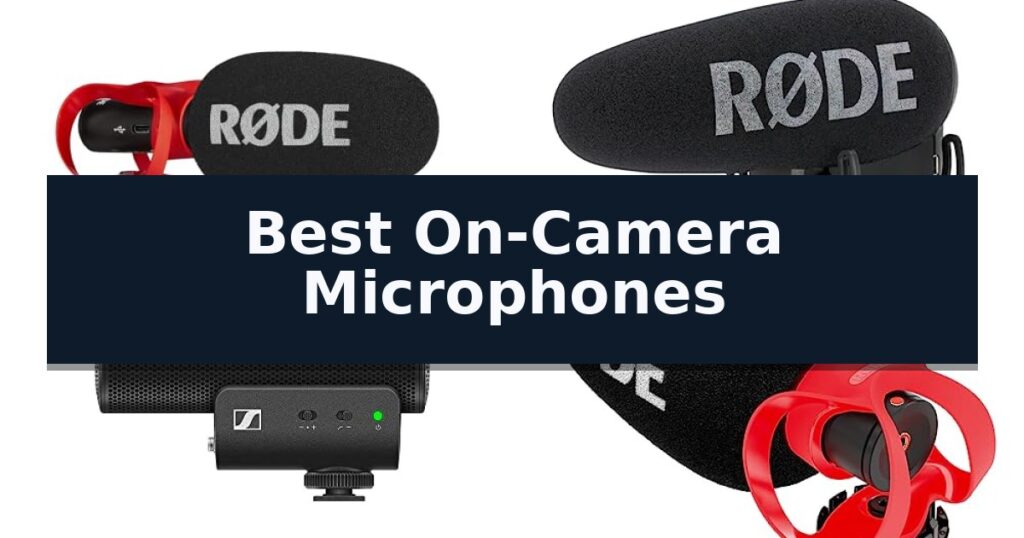
10 Best On-Camera Microphones in 2026 Reviews
Quick Comparison
| Product | Best For | Key Strength | Score |
|---|---|---|---|
| Rode VideoMic GO II | Best Overall | Hybrid connectivity via 3.5mm TRS and USB-C outputs. | 4.9 |
| Rode VideoMic Pro+ | Premium Audio for Run-and-Gun | Automatic Power Function saves battery life by syncing with camera connection status. | 4.5 |
| Sennheiser MKE 400 | Highly Directional for Isolated Audio | Super-cardioid pickup pattern for excellent audio isolation. | 4.5 |
| Rode VideoMicro II | Ultra-Compact for Minimalist Setups | Ultra-compact and lightweight design for maximum portability. | 4.3 |
| Movo VXR10 | Budget-Friendly Universal Compatibility | Universal compatibility with cameras, laptops, and smartphones. | 4.4 |
| Audio-Technica ATV-SG1 | Large Diaphragm for Natural Sound | 14 mm large-diameter diaphragm for high-resolution sound | 4.4 |
| Rode VideoMic NTG | Broadcast-Grade with Variable Gain | Infinitely variable gain control for precise audio level management. | 4.5 |
| Rode VideoMic Pro | Standard Choice for DSLR Filmmakers | Integrated Rycote Lyre shockmount for superior vibration isolation | 4.3 |
| Sennheiser MKE 200 | Sleek Design for Daily Vlogging | Directional pickup pattern for focused audio capture | 4.8 |
| Comica CVM-V30 LITE | Battery-Free Plug-and-Play | Battery-free operation eliminates the need for charging or spare batteries. | 4.3 |
How We Chose
To determine the best on-camera microphones, we evaluate how each unit integrates into a mobile or professional video workflow. We prioritize practical criteria such as mounting stability, power efficiency, and the flexibility of output options, ensuring that the chosen hardware provides high-quality audio without adding unnecessary complexity to your production setup.
- Connectivity versatility (3.5mm TRS/TRRS and USB compatibility)
- Power requirements (battery-free vs. rechargeable options)
- Physical footprint and weight for handheld stability
- Isolation mount effectiveness against handling noise
- Directional pickup pattern and off-axis sound rejection
1 Rode VideoMic GO II — Versatile Hybrid USB and Camera Mic
The RØDE VideoMic GO II distinguishes itself with a versatile hybrid design that bridges the gap between traditional camera audio and digital workflows. By offering both a 3.5mm TRS output for standard camera connections and a digital USB-C output for direct recording to smartphones, tablets, and computers, it provides a flexible solution for diverse recording environments.
Engineered for simplicity, this microphone requires no battery and features no complex switches, making it an accessible choice for creators who prioritize a streamlined setup. The unit includes an innovative HELIX isolation mount system designed to protect audio integrity by mitigating handling noise, bumps, and vibrations during active use.
Beyond its physical design, the microphone integrates with RØDE’s software ecosystem. Users can connect to RØDE Central or RØDE Connect to access advanced signal processing, including a high-pass filter, a high-frequency boost, and a pad, allowing for tailored audio capture in varied acoustic conditions.
Weighing approximately 0.12 pounds, the RØDE VideoMic GO II maintains a compact, lightweight profile that minimizes bulk on camera rigs. The package includes a deluxe windshield to assist in reducing wind noise and plosives, ensuring clearer sound capture in outdoor or high-airflow settings.
Best for: Content creators who need a single microphone capable of switching seamlessly between camera-mounted use and direct-to-computer digital recording.
Skip if: Users who require an integrated battery-powered system or specific onboard physical gain dials, as this model relies on software-based adjustments.
- Hybrid connectivity via 3.5mm TRS and USB-C outputs.
- Battery-free operation for simplified, maintenance-free use.
- Innovative HELIX isolation mount to reduce handling noise.
- Access to advanced software features like high-pass filtering and pad settings.
- Software-dependent controls for advanced audio processing features.
- No physical gain adjustment on the microphone body.
2 Rode VideoMic Pro+ — Premium Audio for Run-and-Gun
Capturing professional-grade audio on the go requires equipment that minimizes setup time while maximizing signal clarity. The RØDE VideoMic Pro+ addresses this with an Automatic Power Function that detects when the microphone is unplugged from the camera, ensuring the device powers down to conserve energy without manual intervention.
Designed for versatility in the field, this shotgun microphone features Digital Switching to help users maintain optimal audio capture at the source, which can streamline post-production workflows. The unit is built with the Rycote Lyre suspension system, providing mechanical isolation to reduce handling noise during active filming sessions.
Power management is highly flexible, offering three distinct options: the included RØDE LB-1 Lithium-Ion Rechargeable Battery, standard 2 x AA batteries, or continuous operation via Micro USB. The design also incorporates a built-in battery door, which secures the power source and prevents the component from being misplaced during location shoots.
This microphone includes advanced signal processing tools such as a high-pass filter, a high-frequency boost, and a pad to manage varying acoustic environments. These features, combined with a safety channel option, provide filmmakers with reliable tools to protect audio integrity during content creation.
Best for: Run-and-gun filmmakers and content creators who require a versatile, power-efficient shotgun microphone with flexible charging options.
Skip if: Users who require a compact, non-shotgun microphone or those who do not need professional-grade signal processing and suspension features.
- Automatic Power Function saves battery life by syncing with camera connection status.
- Flexible power options including rechargeable lithium-ion, AA batteries, or USB.
- Rycote Lyre suspension effectively minimizes unwanted handling noise.
- Digital Switching simplifies audio signal management at the source.
- Larger physical footprint compared to compact, non-shotgun on-camera microphones.
3 Sennheiser MKE 400 — Highly Directional for Isolated Audio
The Sennheiser MKE 400 is a highly directional, super-cardioid shotgun microphone engineered to isolate audio sources, ensuring clear dialogue capture while effectively rejecting off-axis background noise. This precision makes it a reliable choice for videographers who need to maintain professional audio quality in challenging acoustic environments.
Designed for seamless integration into mobile production workflows, the microphone features interchangeable 3.5 mm TRS and TRRS connectivity. This versatility allows creators to switch between DSLR/mirrorless cameras and mobile devices without requiring additional adapters. To further ensure clean audio, the unit incorporates integrated wind protection and an internal suspension mount, both of which work to minimize handling noise and mechanical vibrations during handheld shooting.
Practical control is central to the design, with a built-in low-cut filter and a 3-step sensitivity switch that allow users to tailor the microphone’s frequency response and gain levels to their specific recording conditions. For real-time monitoring, an integrated headphone output jack with volume adjustment is included, providing immediate feedback on audio levels to prevent clipping or low signal issues before the recording is finalized.
While the Sennheiser MKE 400 excels in focused, front-facing audio capture, its fixed shotgun design represents a trade-off for those who require wide-angle or omnidirectional pickup patterns. It is a purpose-built tool for content creators who prioritize directional isolation and on-camera convenience over the flexibility of multi-pattern studio microphones.
Best for: Content creators and videographers needing a directional, camera-mounted microphone with real-time audio monitoring capabilities.
Skip if: Users who require an XLR-based microphone system or a multi-pattern studio microphone for non-camera-mounted applications.
- Super-cardioid pickup pattern for excellent audio isolation.
- Integrated headphone monitoring with volume control.
- Versatile connectivity with included TRS and TRRS cables.
- Built-in low-cut filter and sensitivity adjustments for environmental control.
- Fixed shotgun design limits use in scenarios requiring wide-angle or omnidirectional pickup.
4 Rode VideoMicro II — Ultra-Compact for Minimalist Setups
Achieving clear, professional-grade audio for video production often hinges on minimizing ambient noise while maintaining a compact footprint. The RØDE VideoMicro II addresses this requirement through its ultra-compact design, measuring just 80mm in length and weighing only 39g, making it a highly portable solution for creators who prioritize mobility without sacrificing sound quality.
Engineered for versatility, this microphone features a highly directional pickup pattern designed to isolate the subject’s voice while reducing distracting background interference. The inclusion of an innovative Helix isolation mount system provides a significant mechanical advantage, effectively protecting recordings from unwanted handling noise, bumps, and vibrations during active shooting.
Usability is central to the design of the RØDE VideoMicro II, which integrates a built-in shoe mount for direct attachment to cameras. The unit also incorporates thoughtful cable management features, ensuring that the connection remains tidy and secure during operation. Its lightweight construction ensures it fits easily into any camera kit, handbag, or backpack, serving as a practical tool for both mobile devices and dedicated camera setups.
The microphone includes a 1-year warranty, which can be extended to 2 years upon product registration, providing long-term support for the hardware. By combining a streamlined form factor with specialized isolation technology, this microphone offers a balanced approach for those seeking to improve their production audio through a simple, plug-and-play interface.
Best for: Content creators and videographers who need a lightweight, highly directional microphone for run-and-gun filming and minimalist camera setups.
Skip if: Users who require advanced features like gain control, battery-powered amplification, or XLR connectivity for professional studio-grade audio interfaces.
- Ultra-compact and lightweight design for maximum portability.
- Helix isolation mount system effectively reduces handling noise.
- Highly directional pickup pattern focuses audio on the subject.
- Integrated cable management and shoe mount simplify setup.
- Lacks manual gain control or onboard audio processing features.
5 Movo VXR10 — Budget-Friendly Universal Compatibility
The Movo VXR10 simplifies mobile audio capture by utilizing a solid aluminum body that provides durability for travel while housing a built-in shock mount to minimize handling noise. This compact shotgun microphone is designed to function across a wide range of hardware, including DSLRs, mirrorless cameras, camcorders, laptops, and mobile devices like iPhones and Android smartphones.
Engineered for versatility, the microphone features a directional pickup pattern that focuses on audio directly in front of the capsule while rejecting peripheral distractions. This makes it a practical choice for vlogging, interviews, and social media content creation where background noise reduction is necessary for clear voice recording.
The package includes a comprehensive set of accessories to support various recording environments, such as a fuzzy windscreen for outdoor use, a carrying case, and both TRS and TRRS cables for camera and smartphone connectivity. Users should note that the device requires a 3.5mm mic input and plug-in power; those using newer smartphones may require a Lightning-to-3.5mm or USB-C-to-3.5mm adapter.
For optimal results, the manufacturer recommends maintaining a distance of 1 to 5 feet from the subject to avoid audio distortion or muffled sound. It is also important to ensure the microphone is disconnected from mobile devices during playback to allow the phone to output audio through its internal speakers or headphones.
Best for: Content creators seeking a versatile, portable, and directional microphone that works with both cameras and mobile devices.
Skip if: Users whose specific camera models, such as certain Canon Rebel or VIXIA units, do not support external microphone inputs.
- Universal compatibility with cameras, laptops, and smartphones.
- Directional audio pickup reduces unwanted background noise.
- Comprehensive accessory kit includes windscreen, cables, and shock mounts.
- Durable aluminum construction suitable for travel.
- Requires external adapters for modern smartphones lacking a 3.5mm port.
- Distance-sensitive performance requires careful positioning to avoid distortion.
6 Audio-Technica ATV-SG1 — Large Diaphragm for Natural Sound
The Audio-Technica ATV-SG1 On-Camera Shotgun Mic is engineered to elevate audio capture through a newly designed 14 mm large-diameter diaphragm. This component is specifically intended to provide high-resolution, natural sound reproduction, making it a capable tool for videographers who require professional-grade fidelity in a compact form factor.
Performance is anchored by a highly directional 100 mm acoustic tube. This design effectively narrows the microphone's pickup pattern, ensuring that the primary sound source remains the focus while minimizing the intrusion of unwanted background noise. To maintain clean signal integrity during active filming, the unit includes an integrated shock mount that dissipates handling noise and vibrations transmitted through the camera body.
Usability is a key consideration, evidenced by the unique 12-sided shoe mounting plate. This mechanism allows for 30-degree rotation increments, providing the flexibility to adjust the microphone's horizontal orientation to suit various camera rig configurations or shooting angles. Weighing approximately 0.86 pounds, the device is built for consistent field use and is supported by a 2-year warranty.
While the microphone offers significant technical advantages, the trade-off for its robust construction and acoustic tube length is its weight. At 0.86 pounds, it is a substantial addition that may feel unbalanced on smaller, lightweight camera setups. Users should verify their rig's stability to ensure the microphone's size and weight do not interfere with handheld operation.
Best for: Content creators and videographers who require high-resolution, directional audio capture in a compact, adjustable on-camera form factor.
Skip if: Users who require an ultra-lightweight microphone for travel may find the 0.86-pound weight and 5-inch length more substantial than desired compared to smaller, lighter alternatives.
- 14 mm large-diameter diaphragm for high-resolution sound
- Highly directional 100 mm acoustic tube for noise isolation
- 12-sided shoe mounting plate for precise 30-degree rotation
- Integrated shock mount to reduce handling noise
- 0.86-pound weight may be noticeable on smaller, lightweight camera setups
7 Rode VideoMic NTG — Broadcast-Grade with Variable Gain
Achieving professional-grade audio for video production often requires a versatile microphone that adapts to various recording environments. The Rode VideoMic NTG distinguishes itself with a broadcast-grade acoustic design derived from the acclaimed NTG5, ensuring natural, uncoloured sound capture for both cameras and mobile devices.
This microphone offers significant flexibility through digital switching, which provides direct access to a high-pass filter, a -20dB pad, a high frequency boost, and a safety channel. A standout feature is the infinitely variable gain control, allowing for precise output adjustments to match specific camera or recorder requirements without stepping through fixed increments.
Connectivity is streamlined via an auto-sensing 3.5mm output that automatically detects whether it is connected to a camera or a mobile device, eliminating the need for specialized adaptor cables. Beyond its on-camera utility, the Rode VideoMic NTG functions as a fully-featured USB microphone, enabling direct digital recording to computers, tablets, or smartphones while utilizing the 3.5mm jack for seamless headphone monitoring.
Designed for diverse workflows, the unit integrates digitally with Android and iOS devices. While it provides robust performance for creators, users should note that connecting to iOS devices requires an additional SC15 Lightning Accessory Cable to maintain digital connectivity.
Best for: Content creators and videographers who require a single, versatile microphone that functions equally well as an on-camera shotgun and a USB desktop microphone.
Skip if: Users who exclusively require a lightweight, battery-free microphone that does not need the advanced digital switching or USB interface capabilities provided by this model.
- Infinitely variable gain control for precise audio level management.
- Auto-sensing 3.5mm output that eliminates the need for complex adapter cables.
- Dual-functionality as both a camera-mount shotgun and a USB microphone.
- Comprehensive digital switching including safety channel and high-pass filter.
- Requires specific accessory cables for digital connectivity with certain iOS devices.
- Advanced feature set may be more complex than necessary for basic plug-and-play users.
8 Rode VideoMic Pro — Standard Choice for DSLR Filmmakers
The Rode VideoMic Pro distinguishes itself through its specialized integrated Rycote Lyre shockmount system, which is engineered to isolate the microphone capsule from handling noise and mechanical vibrations. This design choice makes it a reliable tool for filmmakers using camcorders, DSLRs, and portable audio recorders who require consistent audio capture in dynamic shooting environments.
As a supercardioid shotgun condenser microphone, this unit is optimized for directional audio recording, focusing on the subject while minimizing peripheral sound. The microphone is built with a compact form factor, measuring approximately 5 inches in height and 9 inches in length, ensuring it remains unobtrusive when mounted atop a camera.
Power management is a key consideration for field production, and this model supports extended use with a 70-hour battery life. This longevity allows for prolonged recording sessions without the frequent need for power swaps, providing a practical advantage for long-form content creators.
The Rode VideoMic Pro is backed by a 10-year warranty, reflecting the manufacturer's commitment to the longevity of the hardware. While it offers high-quality directional audio, users should ensure their camera equipment supports external microphone inputs to fully utilize its capabilities.
Best for: Videographers and content creators who need a directional, camera-mounted microphone with long battery life for extended field recording.
Skip if: Users who require a wireless audio solution or those whose recording devices lack a standard external microphone input.
- Integrated Rycote Lyre shockmount for superior vibration isolation
- 70-hour battery life for extended recording sessions
- Supercardioid polar pattern for focused, directional audio capture
- 10-year warranty providing long-term support
- Requires external microphone input on the host camera or recorder
- Wired connection limits movement compared to wireless systems
9 Sennheiser MKE 200 — Sleek Design for Daily Vlogging
Capturing professional-grade audio for video projects often requires moving beyond the limitations of built-in camera hardware. The Sennheiser MKE 200 is engineered to solve this by utilizing a directional microphone design, which prioritizes sound sources directly in front of the lens while actively minimizing ambient noise from the sides and rear. This focus is essential for vloggers and videographers who need to isolate a subject's voice in dynamic or noisy environments.
To ensure high-quality signal capture during handheld recording, the unit features integrated wind protection and an internal suspension mount. These components work in tandem to reduce mechanical handling noise—such as the sound of fingers gripping the camera body—and mitigate wind interference. By addressing these common audio pitfalls at the hardware level, the microphone provides a cleaner, more stable signal without requiring complex external accessories.
Versatility remains a core strength of this design, as it includes both 3.5mm TRS and TRRS connectors. This dual-compatibility allows users to transition seamlessly between DSLR cameras, mirrorless systems, and mobile devices without the need for additional adapters. The standard cold shoe mount ensures the microphone remains compatible with most camera cages and rigs, maintaining a compact profile that avoids obstructing the camera's viewfinder or screen.
The Sennheiser MKE 200 serves as a dedicated solution for creators seeking to improve audio quality without the burden of external power requirements or bulky setups. While its fixed pickup pattern is ideal for focused recording, it represents a trade-off for those who might occasionally require a wider, omnidirectional field for ambient room sound. Its sleek, lightweight construction makes it a practical addition to any mobile-first production kit.
Best for: Vloggers and videographers who require a compact, directional audio solution that works seamlessly across cameras and mobile devices.
Skip if: Users who need a long-range wireless lavalier system or a multi-pattern microphone for capturing wide-area ambient sound.
- Directional pickup pattern for focused audio capture
- Integrated wind protection and suspension mount
- Dual TRS and TRRS connectivity for cross-device compatibility
- Compact, lightweight design suitable for mobile setups
- Fixed directional polar pattern limits versatility for wide-field audio recording
10 Comica CVM-V30 LITE — Battery-Free Plug-and-Play
Capturing clear audio for vlogs and interviews often requires a setup that balances sensitivity with portability. The Comica CVM-V30 LITE addresses this by utilizing a super-cardioid polar pattern, which provides excellent off-axis rejection to isolate the subject's voice while minimizing distracting ambient noise.
Designed for versatility, this microphone features a no-battery drive design that relies on plug-in power from your camera or smartphone. This configuration eliminates the need for external batteries and helps reduce weight, making it a practical choice for long-form recording sessions where power management is a concern.
Usability is enhanced through a simple switch on the body that toggles between Camera and Phone modes, removing the need for complex cable adapters. The unit also includes an integrated shock-absorption mount to dampen vibrational and handling noise, ensuring cleaner audio during handheld operation.
The Comica CVM-V30 LITE is built with a cold-shoe mount and a 1/4-inch thread at the base, allowing for secure attachment to various tripods, cages, and camera accessories. Before recording, ensure your device has an external microphone input enabled and perform a test clip to verify proper signal levels.
Best for: Content creators and vloggers who need a lightweight, battery-free microphone that works seamlessly across both DSLR cameras and smartphones.
Skip if: Users operating older DSLR models that lack a 3.5mm external microphone input will require a different audio solution.
- Battery-free operation eliminates the need for charging or spare batteries.
- Universal compatibility via a simple switch for cameras and phones.
- Integrated shock mount effectively reduces handling and vibrational noise.
- Super-cardioid pattern provides focused audio capture with strong off-axis rejection.
- Dependent on device plug-in power, which may not be supported by all legacy cameras.
- Requires a 3.5mm input, limiting use with devices that only feature digital ports without an adapter.
Best On-Camera Microphones Buying Guide
Understanding Polar Patterns
Most on-camera microphones utilize a super-cardioid or directional pickup pattern. This design is intended to focus on the sound directly in front of the lens while rejecting ambient noise from the sides and rear.
Choosing a highly directional mic is essential for outdoor vlogging or interviews where background noise is prevalent. A tighter pickup pattern helps isolate your subject's voice, resulting in cleaner audio that requires less processing in post-production.
Connectivity and Device Compatibility
Modern microphones often include both 3.5mm TRS and TRRS cables to ensure compatibility with cameras, smartphones, and tablets. Some newer models also feature USB-C outputs, which allow for direct digital recording to computers or mobile devices.
Always verify the input requirements of your specific camera or phone before purchasing. While some devices provide plug-in power to the microphone, others may require an external power source or a specific adapter to function correctly.
The Importance of Isolation Mounts
Handling noise, such as the sound of your fingers gripping the camera or the mechanical noise of a lens focusing, can easily ruin a recording. An integrated shock mount is a critical component that physically decouples the microphone from the camera body.
Look for advanced suspension systems that use durable materials to absorb vibrations. A well-designed mount ensures that your audio remains clear even when you are moving or adjusting your camera settings during a shoot.
Power Management Strategies
Battery-free microphones are highly convenient for run-and-gun shooting as they draw power directly from the camera's mic jack. This eliminates the risk of a dead battery mid-session but depends on your camera's ability to provide sufficient plug-in power.
For more demanding setups, microphones with internal rechargeable batteries or AA support offer more consistent performance. These models often include advanced features like high-pass filters or gain control, which require their own power source to operate effectively.
Wind Protection and Environmental Control
Wind noise is one of the most common issues in outdoor video production. A high-quality windshield or 'deadcat' is essential for diffusing air movement before it hits the microphone capsule.
Many professional microphones include built-in low-cut filters that help reduce low-frequency rumble caused by wind or traffic. Using these tools in combination with a proper windscreen provides the best defense against environmental noise.
Frequently Asked Questions
Do I need a battery for all on-camera microphones?
No, many compact shotgun microphones are designed to be battery-free, drawing power directly from the camera's 3.5mm input jack. However, larger, feature-rich models often require internal batteries to power advanced digital features.
Can I use a camera microphone with my smartphone?
Yes, provided the microphone supports the correct output connection. You may need a specific TRRS cable or a USB-C adapter to ensure the microphone is recognized by your mobile device.
What is the difference between a TRS and TRRS cable?
TRS cables are typically used for cameras and external recorders, while TRRS cables are designed for smartphones and tablets. Many modern microphones include both or feature auto-sensing technology to detect the connected device.
How do I minimize handling noise?
Using an integrated shock mount is the most effective way to reduce handling noise. Additionally, ensuring your gain settings are optimized can prevent the need to boost quiet signals, which often amplifies unwanted background noise.
Why is a high-pass filter useful?
A high-pass filter cuts out low-frequency sounds, such as wind rumble or air conditioning hum, which can make your audio sound muddy. It helps keep the focus on the mid-range frequencies where human speech resides.
Conclusion: Our Top Pick
Our top pick is Rode VideoMic GO II. Selecting the right microphone depends on your primary recording device and the environment in which you film. For most users, a versatile model that supports both analog and digital connections offers the best long-term value.
By prioritizing build quality, effective vibration isolation, and proper wind protection, you can significantly improve your production value. Ensure your chosen model matches your camera's power capabilities to avoid unnecessary technical hurdles during your shoots.