Edifier M60 Multimedia Speaker earns our recommendation for the Best PC Speakers for Video Editing thanks to its Hi-Res Audio certification and integrated digital signal processing, which provide the accurate sound reproduction necessary for precise editing workflows.
When selecting speakers for editing, prioritize models that offer a balanced frequency response and minimal signal noise. The inclusion of dedicated tweeters and mid-bass drivers ensures that dialogue and sound effects remain distinct, allowing for more reliable mixing decisions during long sessions.
Connectivity also plays a vital role in a professional environment. Versatile inputs like USB-C and AUX allow for seamless integration with various workstations, while compact form factors help maintain an organized desk space without sacrificing the acoustic performance required for critical audio monitoring.
If you are setting up a professional workspace, you may also want to explore the Best PC Speakers for Office to ensure your audio equipment complements your overall productivity goals.
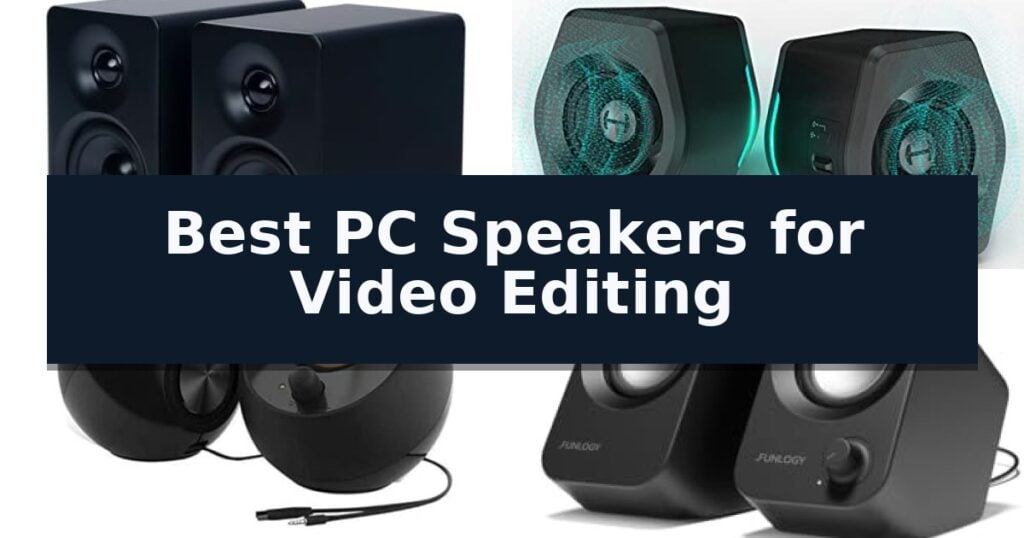
10 Best PC Speakers for Video Editing in 2026 Reviews
Quick Comparison
| Product | Best For | Key Strength | Score |
|---|---|---|---|
| Edifier M60 Multimedia Speaker | Best Overall | Hi-Res Audio certification for both wired and wireless transmission. | 4.9 |
| Edifier G2000 Multimedia Speakers | Balanced Sound for Creative Work | Versatile connectivity including USB, Bluetooth, and 3.5mm AUX. | 4.8 |
| Creative Pebble 2.0 Desktop Speakers | Compact Clarity for Tight Desks | Single USB cable connectivity simplifies desk setup. | 4.9 |
| FUNLOGY Stereo PC Speakers | Angled Design for Direct Monitoring | 30-degree tilt design optimizes sound projection for near-field listening. | 4.3 |
| Nylavee Computer Sound Bar | Rich Stereo for Detailed Audio | Four-driver configuration provides rich, high-fidelity stereo sound. | 4.5 |
| Amazon Basics Stereo PC Speakers | Essential Audio for Basic Editing | USB-powered design reduces cable clutter. | 4.5 |
| LENRUE G11 Computer Speakers | Clear Sound for Desktop Projects | Space-saving design that fits perfectly under a monitor. | 4.5 |
| Redragon GS520 Desktop Speakers | Enhanced Audio for Creative Setups | USB powered for simplified cable management. | 4.4 |
| LENRUE A39PRO Computer Speakers | Noiseless Stereo for Clear Playback | Top-mounted volume knob for quick, accessible adjustments. | 4.9 |
| Cyber Acoustics USB Speaker Bar | Space-Saving Audio for Monitors | Space-saving design mounts to monitors to reduce desk clutter. | 4.9 |
How We Chose
Selecting the best PC speakers for video editing requires a focus on acoustic precision and workspace integration. We evaluate these systems based on their ability to deliver a balanced, uncolored sound profile that allows editors to hear subtle details in their audio tracks, while also considering how physical design affects desk ergonomics and connection stability.
- Frequency response accuracy for neutral sound reproduction
- Driver configuration and separation for clear audio imaging
- Connectivity options including USB-C and analog inputs
- Physical footprint and desktop ergonomics
- Build quality and signal processing capabilities
1 Edifier M60 Multimedia Speaker — Hi-Res Audio for Precise Editing
Achieving precise audio monitoring for video production requires equipment that balances clarity with desktop space efficiency. The Edifier M60 Multimedia Speaker addresses this by integrating high-resolution audio capabilities into a compact footprint, measuring just 100mm wide and 168mm high per speaker.
Engineered for accuracy, the system utilizes a precise two-way active crossover and a built-in DSP to manage its 66W RMS output. The hardware features 1" silk dome tweeters paired with 3" long-throw aluminum diaphragm mid-low drivers, driven by a high-efficiency closed-loop Class-D amplifier. This configuration is designed to provide a balanced sound profile suitable for editing tasks.
Connectivity is a primary strength, offering both wired and wireless options. The M60 supports Bluetooth 5.3 with LDAC codec, allowing for high-resolution streaming up to 24-bit/96kHz from compatible devices. For wired workflows, the speakers include dedicated USB-C and AUX inputs, ensuring low-latency connections for desktop editing suites.
Usability is enhanced through a cap-sensitive touch panel that features an automatic backlight triggered by proximity. To optimize the listening angle, the speakers include aluminum stands angled at 15 degrees, which help direct audio toward the user's ears while minimizing potential desktop surface distortion.
Best for: Video editors and content creators who require high-resolution audio monitoring within a space-constrained desktop environment.
Skip if: Users who require dedicated studio monitor features like balanced XLR inputs or those who prefer physical volume knobs over touch-sensitive controls.
- Hi-Res Audio certification for both wired and wireless transmission.
- Compact footprint that fits easily on crowded editing desks.
- Versatile connectivity including Bluetooth 5.3 with LDAC, USB-C, and AUX.
- Bundled 15-degree aluminum stands for improved sound direction.
- Touch-sensitive controls may lack the tactile feedback preferred by some professionals.
- Limited to consumer-grade inputs rather than professional balanced audio connections.
2 Edifier G2000 Multimedia Speakers — Balanced Sound for Creative Work
Achieving precise audio monitoring during video editing requires equipment that balances clarity with a compact footprint. The Edifier G2000 Multimedia Speakers utilize a 10-degree elevation design and a 0.65L isometric cavity, which helps direct sound toward the listener while maintaining a small desktop presence.
These speakers feature 2.75-inch full-range drivers capable of delivering 16W RMS power and 32W total peak power. To support various content types, the system includes professional acoustic-team tuning with three distinct EQ modes: Game, Music, and Movie, allowing for quick adjustments based on the audio profile of your project.
Connectivity is a major strength, as the Edifier G2000 Multimedia Speakers support 3.5mm AUX, Bluetooth, and USB sound card inputs. This versatility ensures compatibility with a wide range of workstations and mobile devices. A dedicated subwoofer output interface is also included if you require additional low-end frequency response for more demanding sound design tasks.
Aesthetically, the speakers incorporate 12 RGB lighting effects housed within a column-shaped cabinet. The build quality includes a matte panel finish, metal laser engraving, and anti-slip foot pads to ensure stability on your workspace surface.
Best for: Editors working in space-constrained environments who need versatile connectivity and multiple EQ profiles for different media types.
Skip if: Professional audio engineers requiring flat, studio-reference frequency response or those who prefer a dedicated external subwoofer included in the box.
- Versatile connectivity including USB, Bluetooth, and 3.5mm AUX.
- Three dedicated EQ modes for customized sound profiles.
- Compact 10-degree elevation design for improved desktop sound projection.
- Subwoofer output interface for future low-end expansion.
- No dedicated subwoofer included in the package.
- RGB lighting may not suit all professional editing environments.
3 Creative Pebble 2.0 Desktop Speakers — Compact Clarity for Tight Desks
Achieving accurate audio monitoring for video production requires equipment that balances desk footprint with clear sound reproduction. The Creative Pebble 2.0 Desktop Speakers utilize a distinct 45° elevated driver design, which directs audio output toward the listener's ears to improve clarity during editing sessions.
These speakers are designed for a streamlined workspace, relying on a single USB cable for both power and audio input. This configuration eliminates the need for an external power adapter, reducing cable clutter behind your workstation. The unit features a compact, minimalist aesthetic that integrates easily into modern office environments.
For audio performance, the system incorporates far-field drivers paired with rear-facing passive radiators. This combination is engineered to enhance bass reproduction and provide a broader soundstage than standard integrated laptop speakers. The frequency response of 100 Hz to 17 kHz covers the essential range needed for monitoring dialogue and general sound design.
Usability is prioritized through front-facing volume controls, allowing for immediate adjustments without reaching behind the unit. While these speakers provide a functional solution for desktop audio, their compact size and specific driver orientation are optimized for near-field listening rather than filling large rooms.
Best for: Editors working in space-constrained environments who need a simple, USB-powered audio solution for monitoring dialogue and basic sound editing.
Skip if: Users requiring high-fidelity studio monitoring or deep sub-bass response for professional sound mixing will find the 100 Hz to 17 kHz frequency range insufficient.
- Single USB cable connectivity simplifies desk setup.
- 45° elevated drivers improve direct audio projection.
- Compact footprint fits easily on crowded workstations.
- Front-facing volume control allows for quick adjustments.
- Limited frequency response may not capture the full spectrum required for professional audio mastering.
- USB-only power may limit volume output compared to dedicated AC-powered monitors.
4 FUNLOGY Stereo PC Speakers — Angled Design for Direct Monitoring
Achieving precise audio monitoring during video editing requires speakers that deliver clarity without occupying excessive desk space. The FUNLOGY Stereo PC Speakers address this need with a distinctive 30-degree upward-facing tilt design, which directs sound output toward the listener's ears to improve immersion and accuracy while maintaining a compact footprint.
These speakers utilize dual 48mm full-range drivers paired with passive radiators to produce a total output of 14W. This configuration is engineered to provide a balanced frequency response, emphasizing clear mids and crisp highs while maintaining a punchy low-end presence suitable for monitoring dialogue and sound effects during post-production.
Usability is prioritized through a straightforward plug-and-play setup that relies on standard USB power and a 3.5mm AUX connection. By eliminating the need for complex driver installations or wireless pairing, the system ensures a stable, low-latency audio stream. The inclusion of a volume dial control allows for immediate, tactile adjustments during the editing workflow.
To ensure signal integrity, the FUNLOGY Stereo PC Speakers incorporate noise-reducing audio components and a gold-plated AUX input. These features are designed to minimize electrical interference and static, providing a clean audio floor even during the power-up or power-down cycles of a workstation. The unit is finished in a matte coating and backed by a 1-year manufacturer warranty.
Best for: Editors working in space-constrained environments who require direct, clear audio monitoring without the complexity of external amplifiers or wireless connectivity.
Skip if: Users who require high-fidelity studio reference monitors with balanced XLR inputs or those needing deep sub-bass frequencies for professional sound mixing.
- 30-degree tilt design optimizes sound projection for near-field listening.
- Compact, palm-sized footprint saves valuable desk space.
- Noise-reducing circuitry minimizes signal interference and static.
- Simple USB-powered operation eliminates the need for external power bricks.
- Limited to 3.5mm AUX input, lacking digital or balanced connection options.
- 14W total output is designed for near-field monitoring rather than room-filling audio.
5 Nylavee Computer Sound Bar — Rich Stereo for Detailed Audio
Achieving precise audio monitoring for video projects requires equipment that balances clarity with desk space efficiency. The Nylavee Computer Sound Bar addresses this by utilizing a specialized cavity design and four dedicated speaker units paired with two independent bass diaphragms to deliver a balanced sound profile for editing tasks.
This soundbar features premium components, including double-layer neodymium magnets and mica fiber diaphragms, which work together to ensure high-fidelity audio reproduction. Its compact form factor, measuring approximately 16.5 inches in width, allows it to fit easily beneath most monitors without obstructing the workspace.
Connectivity is handled through either Bluetooth 5.0 or a standard 3.5mm AUX wired connection, providing flexibility for various workstation setups. The unit is USB-powered, eliminating the need for bulky external power bricks, and features a single side-mounted knob for intuitive control over volume and power functions.
Constructed from non-toxic materials, the Nylavee Computer Sound Bar is designed for consistent use in office or studio environments. While it provides a robust audio upgrade over standard integrated monitor speakers, its reliance on a USB power source makes it best suited for setups where a powered USB port or adapter is readily available near the display.
Best for: Editors and creators seeking a space-saving audio solution that provides clear stereo sound and versatile wired or wireless connectivity.
Skip if: Users who require professional-grade studio reference monitors with flat frequency response for critical audio mastering should consider dedicated bookshelf speakers instead.
- Four-driver configuration provides rich, high-fidelity stereo sound.
- Space-saving design fits neatly under most desktop monitors.
- Dual connectivity options including Bluetooth 5.0 and 3.5mm AUX.
- USB-powered operation simplifies cable management.
- No built-in battery requires a constant USB power source.
- Single-knob control lacks the granular EQ adjustments found on larger studio monitors.
6 Amazon Basics Stereo PC Speakers — Essential Audio for Basic Editing
Achieving accurate audio monitoring during video production requires a reliable, space-saving solution that integrates seamlessly into a workstation. The Amazon Basics Stereo PC Speakers provide a straightforward approach to desktop audio, utilizing a USB-powered design that eliminates the need for bulky external power adapters.
These speakers feature a compact footprint, measuring approximately 3.94 inches in length and 2.6 inches in width, making them suitable for crowded editing desks. The system includes an in-line volume control for quick adjustments and a bottom radiator designed to enhance low-end frequency response, providing a more balanced sound profile compared to standard laptop speakers.
Durability and aesthetics are addressed through a metal finish and a scratch-free padded base, which helps protect desk surfaces from wear. The inclusion of blue LED lights offers a distinct visual indicator when the unit is active, while the 3.5mm aux input ensures broad compatibility with various PC and laptop audio outputs.
While these speakers are designed for general amplification, they serve as a functional entry-level monitoring tool for editors who prioritize a clutter-free environment. The USB-powered nature of the device simplifies cable management, though users should ensure their computer's USB port provides sufficient power for consistent output.
Best for: Editors working in space-constrained environments who require a simple, USB-powered audio solution for basic project monitoring.
Skip if: Professional editors requiring high-fidelity, flat-response studio monitors for critical sound mixing and mastering tasks.
- USB-powered design reduces cable clutter.
- Compact footprint fits easily on crowded desks.
- In-line volume control allows for quick audio adjustments.
- Scratch-free padded base protects workspace surfaces.
- Limited frequency range compared to dedicated studio monitors.
- USB power dependency may be limited by the output of specific computer ports.
7 LENRUE G11 Computer Speakers — Clear Sound for Desktop Projects
The LENRUE G11 Computer Speakers feature a unique Touch Angular Game Lights design, allowing users to toggle lighting with a simple touch rather than traditional buttons. This compact unit is engineered to fit directly under a monitor, helping to maintain a clean workspace by utilizing integrated, glued-together cabling.
Designed for straightforward operation, these speakers offer Plug And Play functionality that requires no driver installation. Users simply connect the USB power cable and the 3.5mm audio cable to their PC or laptop. A top-mounted volume knob provides quick, tactile control over audio levels during editing sessions.
The system utilizes 4 large amplifier IC horns to deliver what is described as surge stereo sound, aiming for a distortion-free audio experience. While the speakers are compatible with Windows, Mac OS, and Chrome OS via the included Type C adapter, they are strictly wired devices and do not support Bluetooth, microphones, or headphone connections.
These speakers are a practical choice for editors who prioritize a clutter-free desk and simple, wired connectivity. Because they are designed for a specific desktop footprint, they are best suited for users who want a permanent, space-saving audio solution for their workstation.
Best for: Desktop users who need a compact, space-saving wired speaker system with integrated lighting controls.
Skip if: Users who require Bluetooth connectivity, a dedicated headphone jack, or compatibility with televisions.
- Space-saving design that fits perfectly under a monitor.
- Touch-sensitive lighting control for a modern aesthetic.
- Plug and play setup with no driver requirements.
- Included Type C adapter for broader computer compatibility.
- No Bluetooth or wireless connectivity options.
- Lacks headphone port and microphone input.
8 Redragon GS520 Desktop Speakers — Enhanced Audio for Creative Setups
Achieving precise audio monitoring during video production requires reliable output, and the Redragon GS520 Wired 2.0 Channel Stereo Sound Desktop RGB Computer Speakers offer a dedicated solution for creators needing clear, full-range sound. These speakers utilize an advanced sound drive unit to deliver a 2.0 channel enhanced stereo core, providing a consistent auditory experience for editing workflows.
Designed with a minimalist, brushed-material aesthetic, these speakers integrate easily into modern workspaces. The Redragon GS520 Desktop Speakers feature a compact footprint measuring approximately 7.48 x 6.69 x 4.33 inches, ensuring they do not clutter a desk while providing necessary audio feedback. The 31-inch cable length between the two speakers allows for flexible placement around monitors of various sizes.
Usability is centered on physical controls, including dedicated volume up and volume down buttons for quick adjustments. The system is USB powered and utilizes standard 3.5mm audio and microphone cables, facilitating a straightforward plug-and-play setup across PCs, laptops, and other compatible hardware without requiring complex software drivers.
For those who value workspace personalization, the speakers include touch-controlled RGB lighting with six distinct modes. This lighting can be adjusted or switched off entirely depending on the user's preference, allowing the hardware to blend into different studio environments while maintaining its functional role as a stereo audio output device.
Best for: Editors seeking a compact, USB-powered stereo speaker system with physical volume controls for basic audio monitoring.
Skip if: Users requiring high-fidelity studio reference monitors or balanced XLR inputs for professional-grade audio mixing.
- USB powered for simplified cable management.
- Physical volume buttons provide precise, easy-access control.
- Compact dimensions suitable for space-constrained desks.
- Touch-controlled RGB lighting with multiple modes.
- Limited connectivity restricted to 3.5mm audio and microphone jacks.
- Fixed cable length between speakers may limit wide-monitor setups.
9 LENRUE A39PRO Computer Speakers — Noiseless Stereo for Clear Playback
Achieving clear, reliable audio monitoring during video editing requires a setup that balances desk space with consistent output. The LENRUE A39PRO Computer Speakers provide a streamlined solution for creators, utilizing upgraded 2x5W technology to deliver stereo sound directly from a compact soundbar form factor.
Designed for immediate integration into a workstation, these speakers feature plug-and-play functionality that eliminates the need for complex driver installations. The unit connects via a standard 3.5mm headphone jack for audio input, while the integrated USB cable handles power requirements, ensuring a tidy cable management setup for your editing desk.
Usability is prioritized through a top-mounted volume knob, allowing for precise, tactile adjustments without needing to navigate software menus or reach for in-line controls. The soundbar also includes a colorful breathlight design that can be toggled via a physical switch on the back, providing a customizable aesthetic for various workspace environments.
Measuring 12.6 inches in length and 2.17 inches in height, the LENRUE A39PRO Computer Speakers are engineered to fit unobtrusively beneath most monitors. While the system is optimized for clear audio playback, users should ensure that both their monitor and media player volume settings are correctly configured to achieve the desired output levels.
Best for: Video editors and desktop users seeking a compact, USB-powered soundbar that offers simple physical volume control and a small footprint.
Skip if: Users who require high-fidelity studio monitoring or deep bass response for professional audio mixing, as this unit is designed for general playback rather than critical audio production.
- Top-mounted volume knob for quick, accessible adjustments.
- Plug-and-play connectivity with no driver requirements.
- Compact soundbar design that saves valuable desk space.
- Integrated colorful lighting with a dedicated physical on/off switch.
- Limited audio fidelity compared to dedicated studio monitors or multi-driver systems.
- Dependent on external volume settings from the connected source for maximum output.
10 Cyber Acoustics USB Speaker Bar — Space-Saving Audio for Monitors
Maintaining a clean workspace while managing audio for video production often requires balancing desk real estate with functional connectivity. The Cyber Acoustics USB Speaker Bar addresses this by utilizing a space-saving design that attaches directly to the bottom of a monitor, keeping the desktop clear of bulky peripheral footprints.
This speaker bar provides USB and Bluetooth 5.0 connectivity, allowing for versatile input options. Users can maintain a simultaneous connection to a PC or Mac via USB while pairing a smartphone over Bluetooth, which facilitates seamless switching between devices. The unit includes a USB A to USB C converter, ensuring compatibility with modern laptops that lack legacy ports.
Integrated controls are positioned for quick access, featuring a multi-function button for toggling between audio sources, volume adjustments, and playback control. For virtual meetings or voice-over work, the device includes a dedicated mic mute button with an LED indicator, providing a visual confirmation of status during active recording or communication sessions.
The system is designed for plug and play operation, requiring no software installation. With a 5W power output, it serves as a straightforward audio solution for editors who prioritize a streamlined setup and quick access to essential communication features without the complexity of external amplifiers or multi-cable configurations.
Best for: Editors working in compact spaces who need a low-profile audio solution with integrated mic controls and multi-device connectivity.
Skip if: Users requiring high-fidelity studio monitoring or deep bass response for professional sound mixing will find the 5W output and compact form factor insufficient.
- Space-saving design mounts to monitors to reduce desk clutter.
- Dual connectivity supports simultaneous USB and Bluetooth 5.0 inputs.
- Plug and play setup with included USB-C adapter.
- Integrated mic mute button with LED status indicator.
- Limited 5W power output is not intended for professional-grade audio monitoring.
- Fixed form factor may not be compatible with all monitor stand designs.
Best PC Speakers for Video Editing Buying Guide
The Importance of Frequency Balance
For video editing, you need speakers that provide a flat, accurate representation of your audio. Unlike gaming speakers that might boost bass for impact, editing-focused speakers should offer clear mids and highs so you can accurately balance dialogue levels and detect background noise.
Look for systems that utilize separate drivers for different frequency ranges, such as silk dome tweeters for crisp highs and dedicated mid-bass drivers. This separation prevents the sound from becoming muddy, ensuring that your final mix translates well across different playback devices.
Connectivity and Signal Integrity
A reliable connection is essential to avoid latency and interference. USB-C inputs are often preferred for their ability to handle high-resolution digital audio directly from your computer, bypassing the potentially noisy internal sound cards of some motherboards.
If you use multiple devices, such as a laptop and a desktop, look for speakers that offer multiple input methods including AUX or Bluetooth. This flexibility allows you to switch between sources without constantly unplugging cables, streamlining your creative process.
Desktop Ergonomics and Placement
The physical placement of your speakers significantly impacts how you perceive sound. Speakers with an upward tilt or those bundled with angled stands help direct the audio toward your ears, which is crucial for accurate monitoring when you are seated at a desk.
Consider the footprint of the speakers relative to your monitor setup. Compact designs that fit neatly under or beside your display prevent clutter, allowing you to maintain a focused workspace without compromising on the physical size needed for decent sound projection.
Digital Signal Processing (DSP)
Modern speakers often include built-in DSP to manage dynamic range and crossover points. This technology helps the speakers maintain consistent performance levels, preventing distortion even when you are monitoring complex audio sequences at higher volumes.
By handling audio processing internally, these systems can compensate for the physical limitations of smaller cabinets. This results in a more controlled sound that is less prone to the peaks and dips that can lead to inaccurate editing decisions.
Build Quality and Long-Term Reliability
Video editing sessions can be lengthy, so your audio equipment needs to be durable. Sturdy cabinets made from quality materials help reduce unwanted vibrations and resonance that can color the sound and lead to listener fatigue.
Check for features like touch-sensitive controls or robust volume knobs that provide tactile feedback. These small design choices improve the user experience, making it easier to make quick, precise adjustments to your audio levels while you work.
Frequently Asked Questions
Do I need a subwoofer for video editing?
While a subwoofer can help you monitor low-end frequencies, many high-quality 2.0 systems with dedicated mid-bass drivers are sufficient for most video editing tasks. A subwoofer is only necessary if you are specifically mixing content with deep bass requirements.
Is Bluetooth connectivity good enough for editing?
Bluetooth is convenient for casual listening, but for professional video editing, a wired connection via USB or AUX is recommended to ensure zero latency and maximum audio fidelity.
Why does speaker angle matter?
Directing sound toward your ears ensures that you hear the high-frequency details accurately. If speakers are pointed at your chest or desk surface, you may lose clarity and make incorrect adjustments to your audio mix.
Can I use gaming speakers for video editing?
Some gaming speakers can be used for editing, but be cautious of those with aggressive EQ profiles that artificially boost bass or treble. Always look for speakers that offer a more neutral sound signature.
What is the benefit of USB-C input?
USB-C inputs often allow the speaker to act as an external sound card, which can provide a cleaner, more consistent audio signal compared to the standard 3.5mm headphone jack on a computer.
Conclusion: Our Top Pick
Our top pick is Edifier M60 Multimedia Speaker. Choosing the right speakers for video editing is about finding a balance between accurate sound reproduction and a setup that fits your specific desk environment. By focusing on frequency clarity, reliable connectivity, and ergonomic design, you can create a monitoring environment that supports your creative work.
Whether you prioritize a compact footprint or advanced digital signal processing, the options listed provide a range of solutions to help you achieve professional-grade audio results. Ensure your final choice aligns with your primary editing needs to get the best performance from your workstation.