Sennheiser MKE 400 Shotgun Microphone is our top choice for the Best Professional Directional Microphones, offering a highly directional super-cardioid pattern that excels at isolating subjects in noisy environments. The Movo X1-Mini provides a versatile high-fidelity alternative for creators needing both digital and analog connectivity, while the Sound Shark Parabolic Microphone serves as a specialized solution for long-range audio capture.
Selecting the right microphone requires balancing your recording environment against the specific polar pattern of the device. Shotgun microphones are essential for narrowing the field of capture to a single subject, whereas parabolic designs prioritize distance, making them better suited for field recording or capturing audio from sources far beyond the reach of standard camera-mounted gear.
Professional audio capture depends on how well a microphone rejects off-axis noise while maintaining frequency integrity. Whether you are recording for film, broadcast, or field documentation, understanding the physical limitations of your microphone's pickup pattern ensures that your final audio track remains clean and free from unwanted ambient interference.
For those building a comprehensive audio setup, our guide to Best Pro Studio Microphones provides additional insights into stationary recording solutions. If you are specifically looking for field production gear, we also cover Best Pro Shotgun Microphones to help you find the right tool for location work.
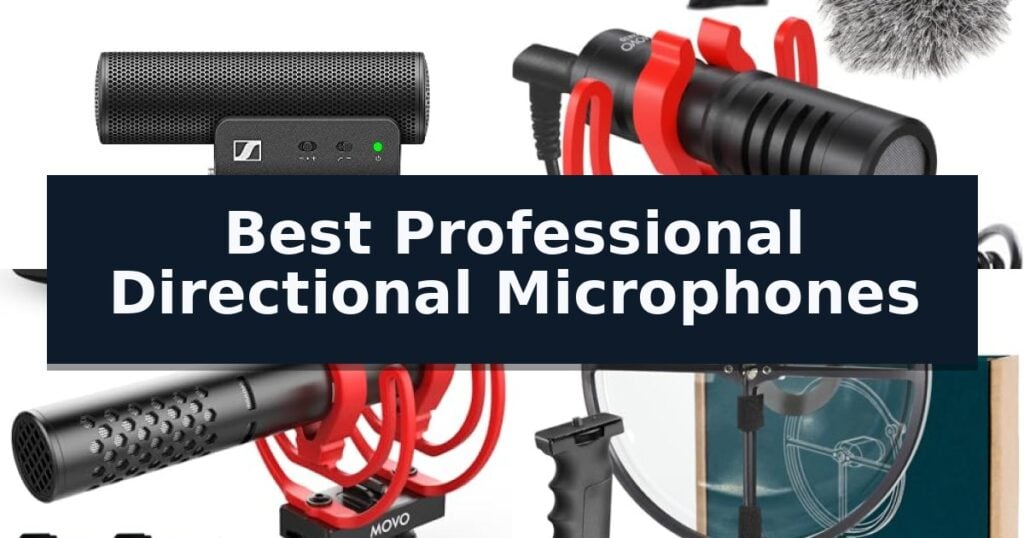
9 Best Professional Directional Microphones in 2026 Reviews
Quick Comparison
| Product | Best For | Key Strength | Score |
|---|---|---|---|
| Sennheiser MKE 400 Shotgun Microphone | Best Overall | Highly directional super-cardioid pickup pattern for superior audio isolation. | 4.9 |
| Movo VXR10 Shotgun Microphone | Compact Directional Vlogging Essential | Directional shotgun design effectively rejects side-noise for clearer vocal capture. | 4.4 |
| Movo X1-Mini Shotgun Microphone | High-Fidelity Broadcast Quality Audio | Universal compatibility with cameras, mobile devices, and computers via included cables. | 4.8 |
| Sound Shark Parabolic Microphone | Long Range Precision Capture | 6X mechanical amplification for long-range audio capture | 4.5 |
| Rode VideoMic Me-C+ Microphone | Mobile Content Creation Standard | USB-C direct connectivity for modern mobile devices. | 4.9 |
| FIFINE K688 Dynamic Microphone | Versatile Studio Podcast Performance | Dual-output versatility with both USB and XLR connections. | 4.9 |
| Pyle PDMIC58 Dynamic Microphone | Rugged Cardioid Stage Reliability | Unidirectional cardioid pattern effectively isolates the primary sound source. | 4.9 |
| Audio-Technica PRO 45 Hanging Microphone | Superior Overhead Choir Capture | Hi-SPL handling for loud acoustic environments | 4.4 |
| Pyle PDMIC58X2.5 Dynamic Microphone | Dual Pack Vocal Clarity | Unidirectional design effectively isolates vocals and reduces background noise. | 4.4 |
How We Chose
To identify the best professional directional microphones, we evaluate how effectively each model isolates a primary sound source while minimizing ambient interference. An experienced reviewer focuses on the physical construction, the reliability of the included mounting hardware, and the compatibility of output connections with modern recording devices to ensure seamless integration into professional workflows.
- Polar pattern precision and off-axis noise rejection capabilities.
- Connectivity versatility across DSLR, mirrorless, and mobile platforms.
- Physical build quality and integration of shock-mount systems.
- Signal-to-noise ratio and frequency response consistency.
- Ease of use for run-and-gun versus stationary production setups.
1 Sennheiser MKE 400 Shotgun Microphone — Professional On-Camera Audio Isolation
Achieving clear, isolated audio in dynamic environments often requires moving beyond built-in camera microphones. The Sennheiser MKE 400 Shotgun Microphone addresses this need with a highly directional, super-cardioid polar pattern, specifically engineered to focus on the sound source directly in front of the lens while minimizing off-axis noise.
Designed for versatility, this microphone features a built-in low-cut filter and a 3-step sensitivity switch, allowing users to tailor the input signal to their specific recording environment. These onboard controls provide immediate adjustments without needing to navigate complex camera menus, making it a practical tool for run-and-gun videography.
The physical design prioritizes stability and noise reduction. It includes integrated wind protection and an internal suspension mount to effectively mitigate handling noise during mobile shoots. These features work in tandem to ensure that the audio signal remains clean even when the camera is handheld or moving.
Connectivity is streamlined through interchangeable 3.5 mm TRS and TRRS cables, ensuring compatibility with both DSLR/mirrorless cameras and mobile devices. Additionally, the integrated headphone output jack with dedicated volume adjustment allows for real-time audio monitoring, providing essential feedback to ensure levels are optimized before and during recording.
Best for: Content creators and videographers who require a compact, directional microphone that offers real-time monitoring and versatile connectivity for both cameras and mobile devices.
Skip if: Users who require a multi-mic wireless system or a professional XLR-based setup for complex studio productions will find this on-camera shotgun microphone too limited in scope.
- Highly directional super-cardioid pickup pattern for superior audio isolation.
- Integrated suspension mount and wind protection to reduce handling noise.
- Real-time audio monitoring via an integrated headphone jack with volume control.
- Flexible connectivity with included 3.5mm TRS and TRRS cables.
- Fixed shotgun design may not be suitable for wide-area or ambient sound recording.
- Requires battery power for operation, unlike some passive microphone options.
2 Movo VXR10 Shotgun Microphone — Compact Directional Vlogging Essential
The Movo VXR10 Universal Shotgun Mic for Camera simplifies mobile and field audio by utilizing a directional shotgun design that prioritizes sound directly in front of the capsule while rejecting unwanted peripheral noise. This compact microphone is engineered for versatility, functioning across a wide range of devices including DSLRs, mirrorless cameras, camcorders, laptops, and smartphones.
Constructed with a solid aluminum body, the microphone is built to withstand the rigors of travel and frequent handling. It includes a built-in shock mount to minimize vibrations and handling noise, ensuring cleaner audio capture during active recording sessions. The unit is designed to be plug-and-play, requiring a 3.5mm mic input and plug-in power to operate effectively.
The package provides a comprehensive set of accessories, including a fuzzy windscreen for outdoor wind noise reduction, a carrying case, and dedicated cables for both cameras and smartphones. This all-in-one approach allows creators to transition quickly between different recording setups without needing additional hardware.
For optimal results, the manufacturer recommends positioning the microphone 1–5 feet from the subject. Users should note that while the device is compatible with many modern electronics, some specific camera models may not support external microphones, and mobile devices with USB-C or Lightning ports will require a 3.5mm adapter to establish a connection.
Best for: Content creators and vloggers who need a versatile, compact directional microphone that works seamlessly across both professional cameras and mobile devices.
Skip if: Users operating cameras that lack a 3.5mm microphone input or those requiring a wireless audio solution for long-distance recording.
- Directional shotgun design effectively rejects side-noise for clearer vocal capture.
- Solid aluminum construction provides durability for travel and field use.
- Comprehensive accessory kit includes shock mounts, cables, and a fuzzy windscreen.
- Universal compatibility with cameras, smartphones, and laptops.
- Requires external adapters for modern smartphones lacking a dedicated 3.5mm jack.
- Limited to wired connectivity, which may not suit all production environments.
3 Movo X1-Mini Shotgun Microphone — High-Fidelity Broadcast Quality Audio
The Movo X1-Mini Shotgun Microphone offers a versatile solution for creators needing high-fidelity audio across multiple recording environments. Its supercardioid polar pattern is engineered to isolate sound sources by minimizing off-axis noise, making it effective for both run-and-gun vlogging on a camera and controlled interview setups on a boom pole.
Designed for modern workflows, this microphone features universal compatibility through its analog and digital connection options. It includes a 3.5mm TRS cable for cameras, a 3.5mm TRRS cable for mobile devices, and a USB-C digital output cable for direct connection to computers and smartphones. In digital mode, it supports up to 24-bit resolution for broadcast-quality audio capture.
The hardware is built with durable aluminum and utilizes a battery-free design, drawing power directly from the connected device. To ensure clean audio, it comes with a Rycote shockmount to reduce handling noise, along with both foam and furry windscreens to mitigate wind interference during outdoor use.
This system provides a comprehensive kit for immediate deployment, including a hard-sided carrying case for protection during transport. By offering both analog and digital connectivity, the Movo X1-Mini Shotgun Microphone serves as a flexible tool for vloggers, podcasters, and filmmakers who require a reliable, compact audio solution.
Best for: Content creators who need a single microphone capable of switching between DSLR cameras, smartphones, and computers for various production styles.
Skip if: Users who require a wireless microphone system or a specialized shotgun microphone with integrated gain control and high-pass filtering.
- Universal compatibility with cameras, mobile devices, and computers via included cables.
- Battery-free operation simplifies setup and reduces maintenance.
- High-fidelity digital audio support up to 24-bit resolution.
- Durable aluminum construction with an included Rycote shockmount.
- No onboard gain control or physical switches for audio processing.
4 Sound Shark Parabolic Microphone — Long Range Precision Capture
Capturing audio from significant distances requires specialized equipment that moves beyond the limitations of standard shotgun microphones. The SOUND SHARK Parabolic Directional Microphone utilizes industry-leading parabolic technology to isolate and amplify sound from up to 50 feet away, providing a level of presence and clarity that is difficult to achieve with traditional recording setups.
Designed for versatility, this microphone features 6X mechanical amplification and a tight polar pattern, which effectively rejects ambient noise and distractions in busy environments. This focus ensures that your primary subject remains clear and present in the recording, even when the surrounding area is chaotic.
The SOUND SHARK Parabolic Directional Microphone is built for durability in the field, featuring an impact-resistant polycarbonate dish and a rust-proof anodized aluminum frame. These materials allow creators to operate in various environments without compromising the integrity of the hardware.
Integration is straightforward thanks to the RTG (Ready-To-Go) system. The unit includes a standard 3.5mm output for laptops and tablets, along with dedicated TRS and USB-C adapters. This compatibility allows for quick transitions between DSLR cameras and smartphones, making it a practical tool for professionals who require broadcast-grade precision across multiple platforms.
Best for: Professionals and creators who need to capture clear, isolated audio from distant subjects in noisy or outdoor environments.
Skip if: Users who require a compact, handheld microphone for close-proximity interviews or those who do not have the space to transport a parabolic dish setup.
- 6X mechanical amplification for long-range audio capture
- Impact-resistant polycarbonate dish for field durability
- Includes TRS and USB-C adapters for broad device compatibility
- Tight polar pattern to minimize ambient noise interference
- Large physical footprint compared to standard shotgun microphones
5 Rode VideoMic Me-C+ Microphone — Mobile Content Creation Standard
Capturing clear audio on the go requires reliable hardware, and the RØDE VideoMic Me-C+ Directional Microphone simplifies this process with its direct USB-C plug-and-play interface. Designed specifically for modern mobile devices, this microphone eliminates the need for complex setups or external apps, allowing for immediate recording upon connection.
The microphone features a directional pickup pattern that focuses on the sound source in front of the camera while minimizing background noise. For professional monitoring, an integrated 3.5mm headphone output allows users to listen to their audio in real-time, ensuring levels are balanced during the recording process.
Compatibility is a primary focus for this model, as it is MFi certified for seamless integration with iPhone 15 and 16 series, USB-C equipped iPads, and various Android smartphones. This certification ensures full functionality with native camera apps, voice memo tools, and third-party recording software.
Built for versatility, the RØDE VideoMic Me-C+ Directional Microphone includes a furry windshield to reduce wind noise during outdoor shoots. The compact design measures approximately 2.91 inches in length, making it a portable solution for mobile content creators who require high-quality audio without heavy equipment.
Best for: Mobile content creators using USB-C smartphones or tablets who need a compact, plug-and-play directional audio solution.
Skip if: Users with older devices utilizing Lightning ports or those requiring an XLR-based professional studio microphone setup.
- USB-C direct connectivity for modern mobile devices.
- Integrated 3.5mm headphone jack for real-time monitoring.
- MFi certified for reliable iOS compatibility.
- Includes a furry windshield for outdoor noise reduction.
- Not compatible with Lightning-based devices like the iPhone 14 or older.
6 FIFINE K688 Dynamic Microphone — Versatile Studio Podcast Performance
The FIFINE K688 USB/XLR Dynamic Microphone offers a dual-output design that provides both USB and XLR connectivity, making it a versatile tool for various recording environments. This dynamic microphone features a cardioid polar pattern specifically engineered to minimize background noise from sources like computer fans or hard drives, ensuring your vocal recordings remain clear and focused.
Designed for professional-grade adaptability, the microphone boasts a high SPL of 130dB, which helps prevent audio distortion during intense recording sessions. When utilizing the XLR output, users can connect to external mixers or sound cards to achieve a higher signal-to-noise ratio, exceeding 80dB, which enhances audio detail and resonance for studio-quality results.
The USB connection simplifies the workflow by allowing for direct plug-and-play functionality on Windows and Mac OS without requiring additional software. For added convenience, the front panel includes a tap-to-mute function and a dedicated gain control knob, while a 3.5mm headphone jack enables real-time monitoring of your audio levels.
To ensure clean broadcast audio, the package includes a windscreen to dampen plosives and an external shock mount that isolates the microphone from low-frequency vibrations and mechanical desk noise. This combination of hardware features makes the FIFINE K688 Dynamic Microphone a robust solution for podcasting, streaming, and vocal voice-overs.
Best for: Content creators and podcasters who require a flexible microphone that can transition between simple USB setups and professional XLR studio configurations.
Skip if: Users who exclusively require an XLR-only microphone with integrated phantom power or those who need a lightweight, portable microphone for field recording without a desk stand.
- Dual-output versatility with both USB and XLR connections.
- Integrated tap-to-mute and gain control for immediate audio management.
- Cardioid polar pattern effectively reduces ambient background noise.
- Real-time monitoring via a built-in 3.5mm headphone jack.
- USB-exclusive features like mute and gain control are unavailable when using the XLR output.
- Essential accessories such as the boom arm, mic stand, and XLR cable are not included.
7 Pyle PDMIC58 Dynamic Microphone — Rugged Cardioid Stage Reliability
Capturing clean, isolated audio in demanding live environments requires a microphone capable of rejecting off-axis noise, and the Pyle PDMIC58 Dynamic Microphone is engineered specifically for this task. Featuring a unidirectional cardioid pickup pattern, this microphone focuses its sensitivity on the sound source directly in front of the capsule, effectively minimizing feedback and ambient background interference.
The construction of the Pyle PDMIC58 Dynamic Microphone prioritizes longevity through a rugged zinc die-cast body and a reinforced steel mesh windscreen. This passive design requires no external power or batteries, allowing for a straightforward setup where you simply connect the included 15ft XLR cable to your interface or mixer to begin operation immediately.
Designed for versatility, this microphone offers an ultra-wide frequency response of 50Hz-15KHz, making it suitable for both vocal performances and amplified instrument recording. The integrated acoustic pop filter further enhances audio quality by mitigating breath and plosive noises, ensuring a transparent signal output even during high-gain applications.
While the Pyle PDMIC58 Dynamic Microphone excels in stage and studio settings, its fixed cardioid pattern means it is less suited for ambient room recording or scenarios requiring omnidirectional sensitivity. Its robust, all-metal build provides a reliable, high-output solution for users seeking a dedicated, unidirectional tool for professional sound reinforcement.
Best for: Live vocal performances and recording amplified instruments where background noise isolation is critical.
Skip if: Users requiring an omnidirectional pickup pattern or a microphone with an integrated on/off switch for manual control.
- Unidirectional cardioid pattern effectively isolates the primary sound source.
- Rugged zinc die-cast construction ensures durability in demanding environments.
- Passive design eliminates the need for external power or batteries.
- Integrated pop filter reduces unwanted breath and plosive noises.
- Fixed cardioid pattern limits use in scenarios requiring wide-area or omnidirectional recording.
- No integrated on/off switch requires external signal management.
8 Audio-Technica PRO 45 Hanging Microphone — Superior Overhead Choir Capture
Achieving precise audio capture in large acoustic spaces often requires specialized hardware designed for overhead placement. The Audio-Technica PRO 45 ProPoint Cardioid Condenser Hanging Microphone is engineered specifically for this purpose, featuring a wide-range condenser element paired with a low-mass diaphragm to ensure clear, accurate sound reproduction from elevated positions.
This microphone is built for demanding environments such as choirs and orchestras where high sound pressure levels are common. Its Hi-SPL handling capability allows it to manage loud performances without distortion, while the flat, smooth frequency response ensures that the audio remains natural and uncolored across the audible spectrum.
Usability is enhanced by the inclusion of self-contained electronics, which remove the requirement for bulky external power modules. The unit comes equipped with a 25' (7.6 m) cable that is permanently attached, providing ample reach for suspension from ceilings or rafters while maintaining a direct connection to an XLRM-type input.
Designed for professional installations, the microphone maintains a compact footprint, measuring approximately 2.25 inches in height. With its two-year warranty on parts and labor, it offers a reliable solution for permanent sound reinforcement setups where consistent, high-quality overhead audio is a priority.
Best for: This microphone is best for professional sound reinforcement in choirs, orchestras, and large venues requiring discreet overhead suspension.
Skip if: Skip this model if you require a handheld or desk-mounted microphone, or if you need a detachable cable system for varied installation lengths.
- Hi-SPL handling for loud acoustic environments
- Self-contained electronics simplify installation
- Flat, smooth frequency response for accurate audio
- 25' permanently attached cable included
- Fixed cable length limits installation flexibility
- Hanging-only design is not suitable for handheld use
9 Pyle PDMIC58X2.5 Dynamic Microphone — Dual Pack Vocal Clarity
The Pyle PDMIC58X2.5 Dynamic Microphone utilizes a specialized unidirectional design to isolate primary sound sources while effectively minimizing background noise, making it a functional choice for vocal-heavy applications. This dynamic microphone system is engineered to provide consistent audio capture, supported by an ultra-wide frequency response that aims to deliver clear, distortion-free output during live performances or studio recording sessions.
Built for demanding environments, the microphone features a rugged zinc alloy body paired with a steel mesh grill to resist wear during frequent use. The inclusion of a built-in pop filter helps manage plosive sounds, while the high signal output ensures that vocal nuances are captured with precision, even during high-volume stage performances.
Connectivity is managed via the included 15 ft. XLR to 1/4" audio cable, which provides significant reach for various stage or studio setups. This cable length allows for greater freedom of movement for presenters and performers, ensuring the microphone can integrate easily into existing sound systems without requiring immediate hardware upgrades.
As a dual-pack solution, this set offers a streamlined approach for users needing multiple microphones for karaoke, presentations, or collaborative recording. The combination of durable construction and reliable signal handling makes this package a practical consideration for those seeking consistent vocal performance across diverse audio environments.
Best for: Singers, presenters, and performers requiring a durable, unidirectional microphone solution for live stage or studio vocal applications.
Skip if: Users who require specialized condenser microphones for high-sensitivity acoustic instrument recording or those who prefer wireless connectivity.
- Unidirectional design effectively isolates vocals and reduces background noise.
- Rugged zinc alloy construction and steel mesh grill provide long-lasting durability.
- 15 ft. XLR cable included for extended range and flexible setup options.
- Built-in pop filter helps maintain audio clarity by reducing plosive sounds.
- Wired connection limits mobility compared to wireless microphone systems.
- Dynamic capsule may lack the extreme sensitivity required for certain delicate studio recording tasks.
Best Professional Directional Microphones Buying Guide
Understanding Polar Patterns
Directional microphones rely on specific polar patterns, such as super-cardioid or shotgun, to focus on sound directly in front of the capsule. This design is critical for rejecting sound from the sides and rear, which is necessary when recording in uncontrolled or noisy environments.
Choosing the correct pattern depends on your proximity to the subject. While shotgun mics provide a tight, narrow focus, parabolic microphones use a reflective dish to amplify distant sounds, offering a distinct advantage when you cannot physically move closer to the source.
Connectivity and Compatibility
Modern professional microphones must bridge the gap between legacy XLR equipment and contemporary digital devices. Many top-tier models now include interchangeable 3.5mm TRS and TRRS cables, or even direct USB-C digital outputs, to accommodate smartphones and tablets.
Before purchasing, verify the input requirements of your primary recording device. Some cameras require plug-in power, while others may need an external interface to handle professional-grade XLR signals without introducing noise or signal loss.
Handling Noise and Vibration
Mechanical noise is a common enemy in field recording, often caused by camera adjustments or movement. High-quality directional microphones incorporate internal suspension systems or dedicated external shock mounts to decouple the capsule from the camera body.
If you frequently record handheld or on a boom pole, the effectiveness of the shock mount is as important as the microphone's frequency response. A robust mount prevents low-frequency thumps from ruining an otherwise clean recording.
Wind Protection and Environmental Control
Outdoor recording introduces wind noise that can easily overwhelm sensitive condenser elements. Professional directional microphones often include or support the use of foam windscreens or furry wind muffs, which are essential for maintaining audio clarity in breezy conditions.
Look for microphones that offer built-in low-cut filters. These electronic controls help reduce the impact of wind rumble and other low-frequency environmental noise before the signal is even recorded, saving time during post-production.
Build Quality for Field Reliability
Professional gear must withstand the rigors of frequent transport and varied environments. Metal-bodied microphones generally offer better durability and shielding against electromagnetic interference compared to lightweight plastic alternatives.
Consider the weight and balance of the microphone when mounted on a camera. A heavy mic can make a small mirrorless setup top-heavy, whereas a compact, durable unit maintains the ergonomics of your rig during long shooting sessions.
Frequently Asked Questions
What is the main difference between a shotgun and a parabolic microphone?
A shotgun microphone uses an interference tube to create a narrow pickup pattern, ideal for dialogue and general video production. A parabolic microphone uses a large dish to focus sound waves onto a central element, allowing for the capture of audio from much greater distances.
Do I need a battery for these microphones?
Many modern on-camera shotgun microphones are designed to run on plug-in power provided by the camera or mobile device. However, some professional models may require internal batteries or phantom power via an XLR connection.
Can I use a professional shotgun microphone with my smartphone?
Yes, provided the microphone supports TRRS connectivity or you have the correct adapter. Many current models include both TRS and TRRS cables to ensure compatibility with mobile devices and cameras alike.
What does a low-cut filter do?
A low-cut filter, or high-pass filter, reduces the sensitivity of the microphone to low-frequency sounds. This is useful for eliminating wind rumble, traffic noise, or mechanical vibrations that can muddy your recording.
Is a shock mount necessary?
Yes, a shock mount is essential for isolating the microphone from vibrations caused by handling the camera or tripod. Without it, even minor adjustments to your camera settings can introduce audible noise into your audio track.
Conclusion: Our Top Pick
Our top pick is Sennheiser MKE 400 Shotgun Microphone. Selecting the right directional microphone requires matching the device's pickup pattern and connectivity to your specific production needs. Whether you prioritize the tight isolation of a shotgun mic or the long-range reach of a parabolic system, the right choice will significantly improve your audio quality.
Always consider your primary recording environment and the devices you use most often. Investing in a model with robust build quality and effective noise-reduction features ensures your audio remains professional and clear across all your projects.