Roland GO:PIANO88 Digital Piano is our top choice for the Best Professional Entry-Level Keyboards, offering a premium, full-size 88-note playing experience in a highly portable, lightweight chassis designed for musicians on the move.
For those prioritizing a slim, mechanical typing experience for office or creative workflows, the Keychron K17 Max Mechanical Keyboard provides a versatile, low-profile solution. Alternatively, the HK GAMING GK61 Mechanical Keyboard serves users who need a compact, high-speed optical switch response for gaming and rapid input tasks.
Selecting a keyboard at this level requires balancing tactile feedback, sound fidelity, and connectivity. Whether you are focusing on piano performance or precision typing, understanding the trade-offs between full-size weighted keys and compact mechanical layouts ensures you invest in a tool that matches your specific creative or professional requirements.
If you are looking to upgrade your office setup, our guide on Best Productivity Keyboards provides additional insights into choosing the right hardware for your professional needs.
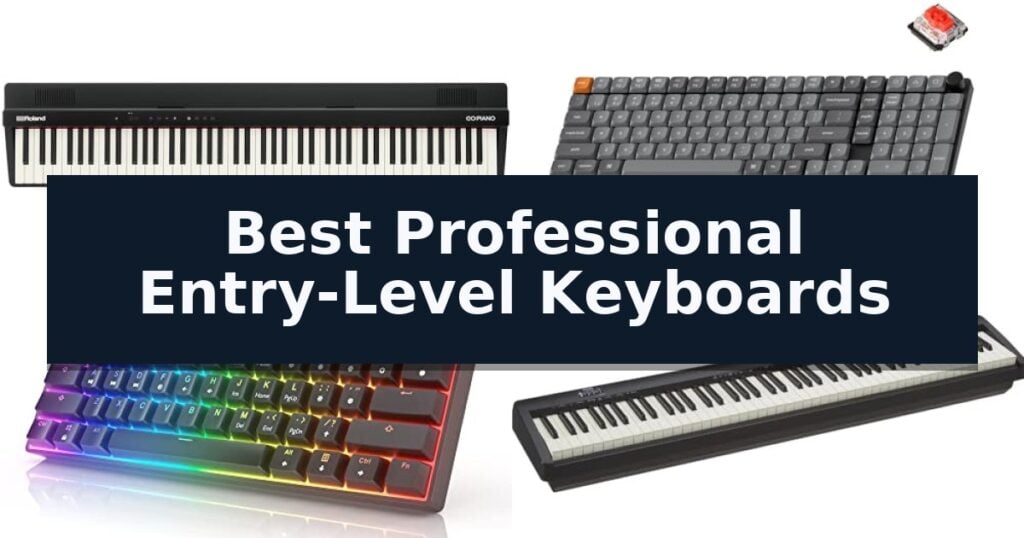
5 Best Professional Entry-Level Keyboards in 2026 Reviews
Quick Comparison
| Product | Best For | Key Strength | Score |
|---|---|---|---|
| Roland GO:PIANO88 Digital Piano | Best Overall | Full-size 88-note keyboard in a highly portable 5.8 kg chassis. | 4.9 |
| Keychron K17 Max Mechanical Keyboard | Ultra-slim wireless productivity | Ultra-slim aluminum frame for a compact and portable footprint. | 4.6 |
| HK GAMING GK61 Mechanical Keyboard | Fast optical switch response | Hot-swappable optical switches allow for easy maintenance without soldering. | 4.5 |
| HJDFRTE 88-Key Digital Piano | Authentic feel for practice | PHA-4 Standard keyboard provides an authentic weighted feel. | 4.9 |
| RTGHYTY Portable Electronic Keyboard | Versatile sound library | 88 full-size, responsive keys that simulate acoustic piano feel. | 4.9 |
How We Chose
Evaluating professional entry-level keyboards requires a focus on the intersection of hardware reliability and functional versatility. We analyze how each model handles input precision, connection stability, and long-term usability. By prioritizing these core performance metrics, we distinguish instruments that offer genuine utility for developing skills or enhancing professional workflows from those that lack essential features.
- Key action and tactile response consistency
- Connectivity options including MIDI and wireless protocols
- Build quality and chassis portability
- Sound engine fidelity and preset variety
- Integration with external software and mobile applications
1 Roland GO:PIANO88 Digital Piano — Portable 88-key performance
Transitioning from basic practice to serious musical exploration requires an instrument that balances authentic playability with modern utility. The Roland GO:PIANO88 Digital Piano addresses this need by providing a full-size 88-note keyboard in a remarkably lightweight 5.8 kg (12.8 lb.) frame, making it a viable choice for musicians who require portability without sacrificing the standard piano layout.
At the heart of the instrument is a focus on versatility, offering 40 sound presets that extend beyond traditional piano tones. The integrated stereo speaker system is designed to deliver a full sound profile, while the inclusion of both USB-C and Bluetooth connectivity allows for seamless integration with music software and streaming audio. This connectivity is further supported by the Roland Piano App, which provides wireless remote control and interactive learning tools.
Designed for both practice and performance, the unit features a built-in recording function that enables users to capture and review their playing. Power flexibility is a key design choice, as the keyboard can be operated via an AC adaptor or AA batteries, allowing for use in environments where power outlets are not readily available.
While the instrument offers a comprehensive feature set for its class, users should note that its primary utility is centered on portability and digital integration. It provides an efficient interface that prioritizes ease of use, ensuring that the focus remains on performance rather than complex menu navigation.
Best for: Musicians and students who require a full-size 88-key instrument that is lightweight enough for frequent transport and offers modern digital connectivity.
Skip if: Players seeking the specific mechanical resistance and weighted action of a traditional acoustic piano or a high-end hammer-action digital stage piano.
- Full-size 88-note keyboard in a highly portable 5.8 kg chassis.
- Dual power options including battery operation for mobile use.
- Comprehensive connectivity with Bluetooth MIDI/audio and USB-C support.
- Integrated recording and app-based learning features.
- Lacks the weighted hammer action found in heavier, stationary digital pianos.
2 Keychron K17 Max Mechanical Keyboard — Ultra-slim wireless productivity
The Keychron K17 Max Mechanical Keyboard distinguishes itself with an ultra-slim aluminum frame that houses low-profile Gateron switches, measuring 31% thinner than standard mechanical alternatives. This design choice provides a tactile typing experience while maintaining a remarkably low profile, making it a versatile choice for professionals seeking a compact, high-performance input device.
Engineered for both productivity and gaming, the keyboard features a 96% layout that balances space efficiency with a full set of keys. Connectivity is highly flexible, offering 2.4 GHz wireless, Bluetooth 5.1, and wired options. The 2.4 GHz connection supports a 1000 Hz polling rate, ensuring responsive performance for demanding tasks, while Bluetooth allows for seamless switching between three distinct devices.
Customization and transparency are central to its operation, as the device runs on open-source QMK firmware. Users can leverage the Keychron Launcher web app to manage key mappings and firmware updates across different operating systems. The build quality is further reinforced by double-shot PBT keycaps, which are designed to resist oil and shine, ensuring the legends remain clear over extended periods of use.
Visual customization is provided through an integrated RGB backlight system, offering over 22 lighting effects alongside a static white mode. While the legends are non-shine-through, the vibrant lighting provides a customizable aesthetic for various work environments. With its combination of a slim form factor, hot-swappable switches, and robust connectivity, this keyboard serves as a comprehensive tool for modern professional setups.
Best for: Professionals who require a compact, ultra-slim mechanical keyboard that supports multi-device wireless connectivity and deep firmware customization.
Skip if: Users who specifically require shine-through keycap legends for visibility in low-light environments.
- Ultra-slim aluminum frame for a compact and portable footprint.
- Tri-mode connectivity including 2.4 GHz, Bluetooth 5.1, and wired options.
- QMK firmware support for extensive customization via the Keychron Launcher.
- Hot-swappable switches allowing for easy maintenance and personalization.
- Non-shine-through keycaps may limit visibility in dark environments.
- 96% layout requires adjustment for those accustomed to traditional full-sized keyboards.
3 HK GAMING GK61 Mechanical Keyboard — Fast optical switch response
The HK GAMING GK61 Mechanical Gaming Keyboard utilizes advanced optical switch technology to achieve rapid response times, positioning it as a distinct entry-level option for users prioritizing speed. By replacing traditional mechanical contacts with light-based sensors, these switches are rated for 100 million keystrokes, offering a durable foundation for both gaming and typing tasks.
This keyboard features a compact 60% layout with 61 keys, which helps maximize desk space while maintaining full functionality through programmable layers. The unit includes Full RGB backlighting with 16.8 million color combinations and multiple lighting effects, all adjustable without the need for external drivers. Its plug-and-play design ensures compatibility across Windows and Mac OS environments.
For customization, the device supports macro recording and advanced lighting configurations via dedicated software. It is built with spill and dust-resistant properties, providing a layer of protection against accidental contact during use. The package includes a detachable USB-C to Type-A cable, facilitating easier storage and transport for users who move between setups.
The hot-swappable nature of the optical switches allows for maintenance or customization without the need for soldering. While the compact form factor is efficient, users should note that the 60% layout requires the use of function layers to access keys typically found on full-sized boards, such as dedicated arrow keys or a number pad.
Best for: Gamers and professionals seeking a compact, customizable, and responsive keyboard with hot-swappable switch capabilities.
Skip if: Users who require a dedicated number pad or physical arrow keys for frequent data entry or specific productivity workflows may find the 60% layout restrictive.
- Hot-swappable optical switches allow for easy maintenance without soldering.
- Compact 60% form factor saves significant desk space.
- Full RGB illumination with extensive color and effect customization.
- Spill and dust-resistant design enhances durability.
- 60% layout lacks a dedicated number pad and physical arrow keys.
- Function layers are required to access standard keys, which may involve a learning curve.
4 HJDFRTE 88-Key Digital Piano — Authentic feel for practice
The HJDFRTE 88-Key Digital Piano provides a foundational experience for aspiring musicians through its PHA-4 Standard keyboard, which is engineered to deliver a reassuringly authentic touch. This entry-level instrument is designed to bridge the gap between initial interest and serious practice, offering a tactile response that mimics traditional acoustic piano mechanics.
Beyond its weighted feel, the unit integrates evocative Super piano tones that can be projected through built-in stereo speakers or private headphones. The inclusion of a MIDI/USB interface allows for digital connectivity, making it a versatile tool for those looking to explore music production or integrate with educational software alongside their standard practice routines.
Functionality is enhanced by the Twin Piano Mode, a feature that splits the keyboard into two identical ranges, facilitating side-by-side jamming or one-on-one instruction. To support technical development, the system includes an onboard metronome to help players maintain consistent timing during their daily sessions.
With a sturdy and compact design weighing approximately 22 pounds, this keyboard is built for portability and home use. It serves as a practical solution for beginners who require a reliable, space-saving instrument that can be easily moved or stored without sacrificing the essential features needed for effective skill building.
Best for: Beginners seeking an authentic weighted key feel and compact design for home practice and music education.
Skip if: Professional performers requiring advanced sound synthesis engines or a wider array of professional-grade connectivity options beyond standard MIDI/USB.
- PHA-4 Standard keyboard provides an authentic weighted feel.
- Twin Piano Mode enables effective side-by-side lessons.
- Compact, portable design suitable for home practice.
- Integrated MIDI/USB interface for digital connectivity.
- No manufacturer warranty provided.
- Limited to entry-level features compared to professional stage pianos.
5 RTGHYTY Portable Electronic Keyboard — Versatile sound library
The RTGHYTY Portable Electronic Keyboard provides an accessible entry point for music creation, featuring 88 full-size, responsive piano-style keys designed to simulate the tactile feel and sound of an acoustic piano. This instrument is built for those who want to explore musical expression without requiring prior experience, offering an immediate, engaging way to start playing.
Beyond its core keyboard functionality, the unit acts as a versatile sound library. It includes the ability to simulate 128 distinct timbres and rhythms, allowing users to experiment with a wide range of musical styles. The inclusion of realistic simulated sounds, such as string sections and brass ensembles, provides additional depth for those looking to diversify their compositions.
Designed with a focus on comfort and ease of use, the keyboard encourages spontaneous creativity. Its meticulously crafted sound engine aims to deliver rich, realistic expression across its various settings, making it a practical tool for beginners who want to explore different inspirations instantly.
While this model offers a broad array of electronic sounds and rhythms, it remains a dedicated entry-level instrument. Users should note that it is designed specifically for those seeking a portable, all-in-one solution for learning and casual composition rather than a professional-grade stage piano.
Best for: Beginners seeking an all-in-one, portable keyboard with a wide variety of built-in sounds and rhythms to explore music creation.
Skip if: Experienced pianists or professional performers who require weighted hammer-action keys and advanced MIDI connectivity for studio production.
- 88 full-size, responsive keys that simulate acoustic piano feel.
- Extensive library of 128 different timbres and rhythms.
- Includes realistic simulated sounds like strings and brass.
- Comfortable touch design suitable for beginners.
- No warranty coverage provided.
- Lacks advanced professional connectivity features.
Best Professional Entry-Level Keyboards Buying Guide
Understanding Key Action
The feel of the keys is the most critical factor for any musician or typist. Digital pianos often utilize weighted or semi-weighted actions to simulate the resistance of acoustic instruments, which is vital for developing proper finger strength and technique.
Mechanical keyboards, conversely, focus on switch travel and actuation force. Choosing between linear, tactile, or clicky switches allows you to customize the typing experience to your specific preference, whether you prioritize speed for gaming or comfort for long writing sessions.
Connectivity and Integration
Modern keyboards must integrate seamlessly with your existing digital ecosystem. Look for models that offer USB-C or Bluetooth support, as these allow for easy connection to computers, tablets, and smartphones for recording or software-based sound manipulation.
For professional use, MIDI compatibility is essential. This feature enables your keyboard to act as a controller for virtual instruments, significantly expanding your sonic palette beyond the built-in sounds provided by the hardware.
Portability Versus Stability
If you frequently move your equipment, weight and dimensions are paramount. Lightweight designs like those found in portable digital pianos allow for easy transport, but they often require a sturdy stand to prevent wobbling during intense performance.
For desk-bound users, a heavier, aluminum-framed keyboard provides a more stable typing surface. While these are less portable, the added mass prevents the device from sliding during rapid input, contributing to a more professional and secure feel.
Sound Engine and Presets
The quality of onboard sounds determines the immediate usability of a digital piano. High-quality sampling ensures that your practice sessions are rewarding, as realistic tones provide better feedback on your dynamics and phrasing.
Entry-level models often include a variety of presets, such as strings, organs, and electric pianos. While these are useful for exploration, prioritize the primary acoustic piano sound, as it will be the one you use for the majority of your development.
Build Quality and Longevity
Durability is a major consideration for any professional tool. Look for double-shot PBT keycaps on mechanical models, as they resist the shine and wear that occur with heavy daily use, keeping your keyboard looking and feeling new.
For digital pianos, check the quality of the interface and the robustness of the chassis. A well-constructed instrument should withstand the rigors of frequent setup and teardown without developing loose connections or failing buttons.
Frequently Asked Questions
What is the difference between weighted and non-weighted keys?
Weighted keys simulate the resistance of an acoustic piano, which is necessary for proper technique. Non-weighted or synth-action keys are lighter and faster, making them better suited for electronic music production or rapid typing.
Can I use these keyboards with my computer?
Yes, most modern entry-level keyboards feature USB-MIDI connectivity, allowing them to communicate directly with digital audio workstations or typing software on your computer.
Are mechanical keyboards good for professional work?
Mechanical keyboards are highly regarded for professional work due to their durability, tactile feedback, and customization options, which can significantly improve typing speed and comfort.
Do I need an external amplifier for these keyboards?
Most digital pianos in this category feature built-in stereo speakers. However, for professional recording or live performance, connecting to an external monitor or sound system is recommended for better audio fidelity.
What does hot-swappable mean for a keyboard?
Hot-swappable refers to a keyboard's ability to have its mechanical switches removed and replaced without soldering, allowing you to change the feel of your keyboard easily.
Conclusion: Our Top Pick
Our top pick is Roland GO:PIANO88 Digital Piano. Selecting the right professional entry-level keyboard depends on your specific goals, whether you are mastering piano technique or optimizing your workstation for productivity. By focusing on key action, connectivity, and build quality, you can find a reliable tool that supports your growth.
The models highlighted here offer distinct advantages, from the authentic feel of the Roland GO:PIANO88 to the versatile, slim design of the Keychron K17 Max. Choose the option that best aligns with your daily usage patterns to ensure the best long-term value.