Shure SM57 Dynamic Instrument Microphone is our top choice for the Best Recording Microphones for Vocals and Guitar, offering a rugged, industry-standard design that excels at capturing the nuanced attack of acoustic instruments and guitar cabinets. For those prioritizing vocal warmth, the Shure SM58 Dynamic Vocal Microphone provides a tailored frequency response that minimizes plosives, while the MXL 990/991 Condenser Microphone Bundle offers a versatile dual-mic kit for capturing detailed, high-end studio transients.
Selecting the right microphone requires balancing your recording environment with the specific sound source. Dynamic microphones are generally preferred for loud sources like guitar amplifiers or live settings due to their durability and focused pickup, whereas condenser microphones are better suited for capturing the delicate, airy details of acoustic guitars and vocal performances in controlled studio spaces.
Understanding your interface requirements is equally vital, as many condenser models necessitate phantom power to operate. Whether you are building a home studio from scratch or upgrading your current setup, choosing between a dedicated instrument mic and a versatile vocal-focused unit depends on your primary recording goals and the acoustic treatment of your room.
For those specifically focused on vocal performance, our guide on Best Recording Microphones for Singing provides further insight into choosing the right capsule for your voice. If you are setting up a dedicated space, our Best Recording Microphones for Home Studio guide covers essential gear for a complete recording environment.
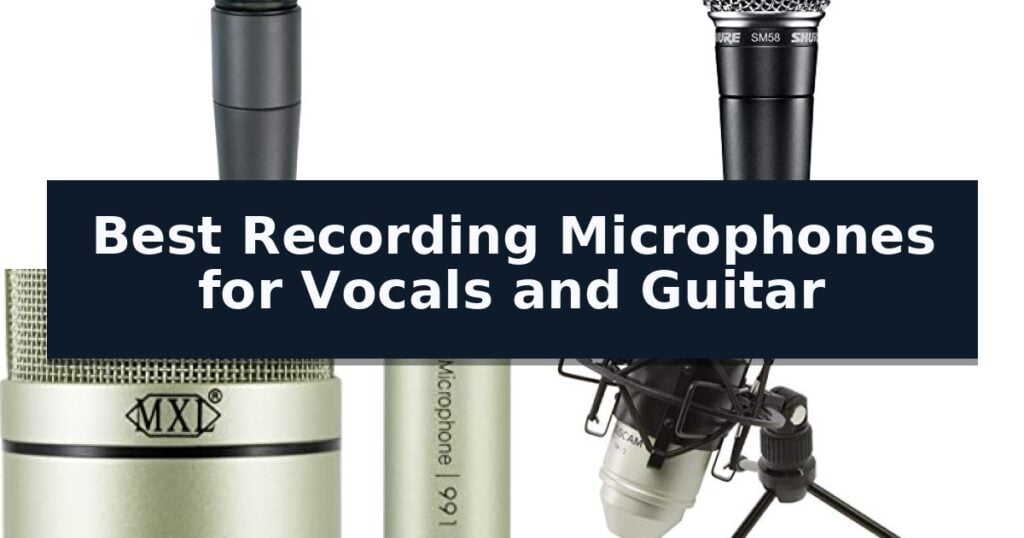
10 Best Recording Microphones for Vocals and Guitar in 2026 Reviews
Quick Comparison
| Product | Best For | Key Strength | Score |
|---|---|---|---|
| Shure SM57 Dynamic Instrument Microphone | Best Overall | Contoured frequency response with a presence boost for enhanced instrument clarity. | 4.9 |
| Shure SM58 Dynamic Vocal Microphone | Legendary Vocal Clarity | Rugged metal construction ensures long-term durability in professional or touring environments. | 4.9 |
| MXL 990/991 Condenser Microphone Bundle | Versatile Dual-Mic Studio Kit | Comprehensive bundle includes shock mount, pop filter, and XLR cable. | 4.4 |
| Tascam TM-80 Condenser Microphone | Rich Sound for Home Recording | High 136dB SPL rating allows for recording loud sources like guitar amps. | 4.3 |
| MAONO PM320S Condenser Microphone | Broadcast-Quality Studio Setup | Large 16mm condenser capsule for detailed sound capture. | 4.7 |
| FIFINE AmpliGame AM8 Dynamic Microphone | Flexible USB and XLR Connectivity | Dual-mode connectivity via USB and XLR for maximum versatility. | 4.4 |
| Pyle PDMIC59 Dynamic Vocal Microphone | Budget-Friendly All-Purpose Choice | Cardioid pickup pattern minimizes background noise and feedback. | 4.8 |
| Dejasound Studio Recording Microphone | Complete Kit with Isolation Shield | Plug-and-play USB connectivity for immediate setup. | 4.3 |
| FIFINE K669B USB Condenser Microphone | Easiest Plug-and-Play Setup | Plug-and-play USB connectivity requires no external power supply or interface. | 4.3 |
| WEYMIC WM57 Dynamic Microphone | Classic Style for Instruments | Durable metal construction for long-term reliability. | 4.4 |
How We Chose
When evaluating the best recording microphones for vocals and guitar, we focus on technical specifications that directly impact audio fidelity. An experienced reviewer assesses how each capsule handles sound pressure levels, its sensitivity to room noise, and the practical utility of its polar pattern to ensure clean, professional-grade captures in various home studio environments.
- Transducer type (Dynamic vs. Condenser)
- Frequency response and tonal character
- Polar pattern and off-axis noise rejection
- Connectivity (XLR vs. USB) and power requirements
- Build quality and included accessories
1 Shure SM57 Dynamic Instrument Microphone — Industry Standard for Guitar Amps
Capturing the raw energy of a live performance or the nuanced detail of a studio session requires equipment that can handle high sound pressure levels without distortion. The Shure SM57 Pro XLR Dynamic Instrument Microphone is engineered with a contoured frequency response and a refined presence boost, specifically designed to enhance the attack and clarity of guitar amplifiers, snare drums, and acoustic instruments.
This microphone is a staple in professional environments due to its precise cardioid pickup pattern. By focusing on the sound source and effectively rejecting off-axis noise, it minimizes bleed in complex recording setups. This focused capture makes it an ideal choice for close-miking cabinets and percussion where isolation is essential for a clean mix.
Beyond its acoustic capabilities, the Shure SM57 Pro XLR Dynamic Instrument Microphone is defined by its legendary rugged construction. Built to withstand the rigors of frequent transport and demanding daily use, this dynamic mic maintains consistent performance across various environments, from home studios to major stages.
While it excels at handling high-intensity sound sources, its versatility extends to a wide range of applications, including brass and bass cabinets. For engineers and musicians seeking a reliable, industry-standard tool, this microphone offers a dependable solution that prioritizes durability and sonic precision.
Best for: Musicians and engineers who need a rugged, reliable microphone for close-miking high-volume instruments like guitar amps and drums.
Skip if: Users looking for a sensitive large-diaphragm condenser microphone specifically for capturing delicate vocal nuances or ambient room sounds.
- Contoured frequency response with a presence boost for enhanced instrument clarity.
- Precise cardioid pickup pattern that minimizes background noise and bleed.
- Rugged construction designed to handle high sound pressure levels and frequent transport.
- Versatile application across guitar amps, drums, brass, and percussion.
- Dynamic design may lack the sensitivity required for ultra-quiet acoustic sources compared to condenser alternatives.
2 Shure SM58 Dynamic Vocal Microphone — Legendary Vocal Clarity
Capturing professional-grade audio for both vocals and acoustic instruments requires a reliable foundation, and the Shure SM58 Pro XLR Dynamic Vocal Microphone remains a staple for its consistent performance. Known for its finely tuned frequency response with a subtle midrange lift, this microphone is engineered to deliver warm, articulate sound that helps vocals sit clearly within a mix.
The Shure SM58 Pro XLR Dynamic Vocal Microphone utilizes a precision cardioid pickup pattern that focuses tightly on the sound source. This design is particularly effective at minimizing background noise and preventing feedback, making it a practical choice for both studio recording and live performance environments where isolation is necessary.
Designed for longevity, the microphone features a rugged metal construction and a reinforced stand adapter, ensuring it can withstand the physical demands of frequent use. It also includes an integrated pop protection system, consisting of a refined spherical grille and a built-in filter that effectively reduces plosives and breath noise without requiring external accessories.
Whether used for podcasting, broadcast, or musical applications, this microphone provides a consistent, professional output. Its industry-standard sound profile and durable build quality make it a versatile tool for creators who need a dependable, no-fuss solution for capturing vocals and instruments.
Best for: Performers and creators who need a durable, reliable microphone that excels at isolating vocals and instruments in both live and studio settings.
Skip if: Users who require a high-sensitivity condenser microphone for capturing delicate, nuanced acoustic details or ultra-wide frequency ranges.
- Rugged metal construction ensures long-term durability in professional or touring environments.
- Precision cardioid pickup pattern effectively isolates the sound source and rejects off-axis noise.
- Integrated pop protection eliminates the need for additional external filters.
- Finely tuned frequency response provides a warm, clear vocal presence.
- Dynamic design may lack the extreme high-frequency sensitivity found in specialized studio condenser microphones.
3 MXL 990/991 Condenser Microphone Bundle — Versatile Dual-Mic Studio Kit
Capturing professional-grade audio for both vocals and instruments requires a versatile setup that can handle varying sound sources without adding unnecessary room noise. The MXL 990/991 Large & Small Diaphragm Condenser Microphone Bundle provides a comprehensive solution for home studios by pairing two distinct microphone types in one package, ensuring you have the right tool for different recording tasks.
The MXL 990 serves as the primary large-diaphragm condenser, utilizing a 6-micron gold-sputtered diaphragm and a FET-based design to deliver high-quality audio with a transformer-balanced output. This microphone is specifically voiced to provide a silky high end while maintaining tight lows and a smooth midrange, making it well-suited for vocalists. Complementing this is the MXL 991, designed to handle the nuanced requirements of acoustic instruments.
Both microphones utilize a cardioid polar pattern, which is essential for home recording environments as it effectively rejects background noise from the sides and back of the capsule. This helps isolate the intended sound source, whether you are tracking a vocal performance or miking a guitar. The bundle is a true workhorse microphone kit, including a shock mount, pop filter, and a 20-foot XLR cable, allowing for immediate integration into your recording workflow.
To operate these microphones, you must have an audio interface or preamp capable of providing +48V phantom power. The frequency response ranges of 20 Hz – 20 kHz for the 990 and 30 Hz – 18 kHz for the 991 ensure a broad capture range suitable for diverse source material. With its durable build and included accessories, this bundle offers a practical entry point for those looking to improve their recording capabilities.
Best for: Home studio users who need a versatile, all-in-one kit to record both vocals and acoustic instruments simultaneously.
Skip if: Users who do not have an audio interface or preamp capable of providing +48V phantom power.
- Comprehensive bundle includes shock mount, pop filter, and XLR cable.
- Cardioid polar pattern effectively reduces unwanted room noise.
- Dual-microphone design provides specialized tools for both vocals and instruments.
- FET-based circuitry ensures high-quality, detailed audio capture.
- Requires +48V phantom power for operation.
- XLR-only connection necessitates an external audio interface.
4 Tascam TM-80 Condenser Microphone — Rich Sound for Home Recording
Capturing clear, professional-grade audio at home requires equipment that balances sensitivity with noise management. The Tascam TM-80 Large Diaphragm Condenser Microphone is engineered specifically for this environment, utilizing an 18mm aluminum diaphragm to provide a detailed frequency response suitable for both vocal performances and acoustic instrument tracking.
Designed for versatility, the microphone features a cardioid pickup pattern that focuses on sound sources directly in front of the capsule while rejecting off-axis noise. This directional design is particularly effective for home studios where ambient room reflections can otherwise compromise recording quality. The internal circuitry is specifically optimized to reduce noise and distortion, ensuring the captured signal remains clean and transparent.
Handling high-volume sources is a key strength of this model, which boasts a maximum sound pressure rating of 136dB SPL. This specification allows users to record loud instruments, such as guitar amplifiers or percussion, without the risk of signal clipping or capsule damage. The unit is built to be a reliable, all-in-one solution for creators who need to move between different recording tasks.
The Tascam TM-80 arrives as a complete kit, including a tabletop stand, a six-foot XLR cable, and an elastic shockmount. The inclusion of the shockmount is essential for minimizing low-frequency rumble and mechanical vibrations that can travel through a desk or stand during a session, providing a more stable recording environment out of the box.
Best for: Home studio creators who need a versatile, all-in-one condenser microphone kit for recording vocals and acoustic instruments.
Skip if: Users who require a multi-pattern microphone for specialized stereo or omnidirectional recording techniques.
- High 136dB SPL rating allows for recording loud sources like guitar amps.
- Complete accessory kit includes a shockmount, tabletop stand, and XLR cable.
- Optimized internal circuitry helps maintain signal clarity by reducing noise.
- Cardioid pickup pattern effectively isolates vocals and instruments.
- Fixed cardioid pattern limits flexibility for complex miking setups.
- Tabletop stand may not provide sufficient height for all vocal recording positions.
5 MAONO PM320S Condenser Microphone — Broadcast-Quality Studio Setup
Capturing professional audio for vocals and acoustic instruments requires a reliable signal chain, and the MAONO PM320S Condenser Microphone provides a foundational studio setup designed for clarity and consistent performance. This XLR-based condenser microphone utilizes a large 16mm condenser capsule to capture detailed transient response, making it a versatile tool for vocal tracking and music production.
The microphone features a cardioid polar pattern, which is engineered to reject off-axis ambient noise, helping to maintain a clean signal even in rooms that are not acoustically treated. To ensure the audio remains polished, the kit includes a pop filter and foam windscreen to mitigate plosives and breath noise, while the integrated shock mount minimizes mechanical vibrations from your desk or stand.
Operation requires a 48V phantom power supply, which is standard for professional audio interfaces and mixers. The included all-metal boom arm provides stable, adjustable positioning, allowing for precise placement during recording sessions. The unit is constructed with a rugged all-metal housing, ensuring it can withstand the demands of daily studio use.
This all-in-one studio kit simplifies the recording process by including all necessary mounting hardware and an XLR-to-XLR cable. By focusing on essential studio components, the MAONO PM320S Condenser Microphone offers a straightforward solution for creators who need a dedicated XLR microphone for high-fidelity vocal and instrument capture.
Best for: Content creators and musicians seeking an entry-level XLR studio setup for vocal and instrument recording.
Skip if: Users who do not own an audio interface or mixer capable of providing 48V phantom power.
- Large 16mm condenser capsule for detailed sound capture.
- Cardioid polar pattern effectively reduces background noise.
- All-in-one kit includes a sturdy metal boom arm and shock mount.
- Rugged all-metal housing for enhanced durability.
- Requires 48V phantom power from an external audio interface or mixer.
6 FIFINE AmpliGame AM8 Dynamic Microphone — Flexible USB and XLR Connectivity
Achieving professional-grade audio for both voice and music requires a versatile setup that can adapt to different recording environments. The FIFINE AmpliGame AM8 Dynamic Microphone provides a unique solution by offering both USB and XLR connectivity, allowing creators to transition from simple plug-and-play podcasting to more complex studio setups using an audio interface.
Designed with a cardioid polar pattern, this microphone effectively isolates your voice while minimizing unwanted background noise. Its frequency response of 50Hz-16KHz ensures a balanced capture of vocals and instruments, providing the clarity needed for high-quality recordings without over-emphasizing specific ranges.
Usability is a core focus of the FIFINE AmpliGame AM8 Dynamic Microphone, which includes a tap-to-mute button and a built-in headphone jack for real-time monitoring. When connected via USB, users gain access to additional features like a gain control knob and customizable RGB lighting with three modes, allowing for a personalized aesthetic that matches other desktop gear.
The hardware is built for convenience, featuring integrated 3/8'' and 5/8'' metal threads that allow it to mount directly to most standard microphone stands without requiring extra adapters. A noise-canceling windscreen is included to help mitigate hum from nearby electronics, ensuring cleaner audio capture for both vocal tracks and acoustic guitar sessions.
Best for: Content creators and musicians who need a flexible microphone that supports both direct USB connectivity for streaming and XLR output for professional audio interfaces.
Skip if: Users who require a dedicated condenser microphone for capturing high-frequency detail in delicate acoustic instruments may find this dynamic model less suitable.
- Dual-mode connectivity via USB and XLR for maximum versatility.
- Integrated headphone jack for zero-latency monitoring.
- Built-in metal threads for easy mounting on standard boom arms or stands.
- Tap-to-mute functionality with LED status indicator.
- RGB and function keys are inactive when using the XLR connection.
- XLR cable not included in the package.
7 Pyle PDMIC59 Dynamic Vocal Microphone — Budget-Friendly All-Purpose Choice
Capturing clear audio for both vocals and instruments requires a versatile tool that can handle varying sound pressure levels without sacrificing clarity. The Pyle PDMIC59 Dynamic Vocal Microphone is designed to address these needs by utilizing a cardioid pickup pattern, which focuses on the sound source directly in front of the mic while effectively shunning off-axis noise and feedback.
Engineered as a dynamic microphone, this unit is built for durability and performance in live settings. Its robust, all-metal construction features a zinc die-cast case and a steel mesh windscreen equipped with an anti-dent ring, ensuring it can withstand the rigors of frequent use in studio or stage environments. The inclusion of an integrated pop filter further helps to minimize unwanted breath and plosive noises during vocal recording.
The Pyle PDMIC59 offers an ultra-wide frequency response that provides a transparent sound profile suitable for a range of applications. Whether you are recording an amplified guitar or tracking vocals, the microphone is designed to achieve high gain before feedback, maintaining punch and clarity even in challenging acoustic spaces. It is moisture-resistant, adding a layer of reliability for long-term use.
To ensure immediate usability, the package includes a professional grade 15 ft. XLR-to-1/4 inch audio cable. This connection flexibility allows for direct integration with various recording interfaces, amplifiers, or PA systems, making it a practical choice for bedroom studios and professional setups alike. An integrated on/off switch provides convenient control during live performances.
Best for: This microphone is best for vocalists and musicians seeking an affordable, all-purpose dynamic solution for live performances and home studio recording.
Skip if: Skip this model if you require a condenser microphone for capturing high-frequency detail or nuanced acoustic instrument textures that demand higher sensitivity.
- Cardioid pickup pattern minimizes background noise and feedback.
- Rugged all-metal construction ensures long-term reliability.
- Includes 15ft XLR-to-1/4 cable for immediate setup.
- Moisture-resistant design ideal for live vocal applications.
- Dynamic design may lack the sensitivity required for delicate studio recording compared to condenser alternatives.
8 Dejasound Studio Recording Microphone — Complete Kit with Isolation Shield
Achieving professional-grade audio for home projects requires a reliable signal chain, and the Dejasound Upgraded Studio Recording Microphone simplifies this process by integrating essential components into one kit. This condenser microphone utilizes a USB output for direct, plug-and-play connectivity with PCs, laptops, and smartphones, eliminating the need for external audio interfaces or complex hardware configurations.
The microphone is engineered with a 16mm diaphragm and a cardioid polar pattern, which focuses on sound sources directly in front of the capsule to minimize background noise. It supports a 192kHz/24Bit sampling rate and a 30Hz–16kHz frequency response, providing clear audio capture for vocals and instruments. The unit also includes onboard echo control, volume adjustment, a 3.5mm headphone jack for real-time monitoring, and a dedicated mute button for quick control during live sessions.
To address environmental acoustics, the kit includes a foldable isolation shield constructed from five high-density, sound-absorbing panels. This triple acoustic design helps reduce unwanted reflections, making it a practical solution for recording in untreated spaces. The entire setup is designed for portability, with the complete kit weighing only 4.1lbs (1.86kg), ensuring it can be easily transported or stored when not in use.
The package provides a comprehensive set of accessories to support immediate use, including a tripod stand, pop filter, foam cover, and necessary cables. It also features Lightning and Type-C adapters, ensuring compatibility with a wide range of mobile devices and computers. This all-in-one approach allows creators to establish a functional recording environment without purchasing individual components separately.
Best for: Content creators and musicians seeking an all-in-one, portable USB recording solution for vocals and acoustic instruments.
Skip if: Users who require professional XLR connectivity or specific phantom power configurations for high-end studio preamps.
- Plug-and-play USB connectivity for immediate setup.
- Includes a foldable 5-panel isolation shield for noise reduction.
- Features onboard monitoring and volume controls for real-time adjustments.
- Comprehensive kit includes adapters for mobile and PC compatibility.
- Fixed USB output limits integration with traditional XLR-based audio interfaces.
9 FIFINE K669B USB Condenser Microphone — Easiest Plug-and-Play Setup
The FIFINE K669B USB Condenser Microphone simplifies the recording process by utilizing a direct plug-and-play USB connection, eliminating the need for complex external audio interfaces or 48v phantom power. This condenser microphone is designed to capture audio directly into a PC or laptop via a standard USB-A port, making it a straightforward solution for those needing to record vocals or acoustic instruments.
Built with a solid metal construction, this microphone provides a durable housing that stands up to regular use on a desktop. It includes a stable tripod stand, which helps maintain positioning during voice-overs or streaming sessions. The integrated mic volume knob allows for immediate, tactile adjustments to input sensitivity, giving users the ability to fine-tune levels or mute the signal entirely for privacy.
The device features a cardioid polar pattern, which is engineered to focus on the primary sound source directly in front of the mic while reducing the pickup of ambient background noise. This makes it suitable for various applications, including podcasting, online meetings, and streaming, provided the user manages software settings like automatic gain control to ensure consistent output levels.
Compatibility is broad across modern operating systems, including Mac and Windows, and the unit supports use with gaming consoles like the PS4 and PS5. The package includes a 5.9-foot USB cable, offering enough length for flexible placement on a desk or workstation. Users should note that this microphone is not compatible with Xbox systems or mobile phones.
Best for: Content creators and remote workers seeking a budget-friendly, simple USB solution for vocal recording and online communication.
Skip if: Users requiring professional-grade XLR connectivity, multi-pattern polar switching, or compatibility with mobile devices and Xbox consoles.
- Plug-and-play USB connectivity requires no external power supply or interface.
- Durable metal construction provides a sturdy build for long-term desktop use.
- Integrated volume knob allows for quick, on-the-fly sensitivity adjustments.
- Cardioid pickup pattern effectively isolates the main sound source from background noise.
- Limited compatibility as it does not work with Xbox or mobile devices.
- Fixed polar pattern lacks the versatility of multi-pattern microphones.
10 WEYMIC WM57 Dynamic Microphone — Classic Style for Instruments
Capturing the nuance of a vocal performance or the resonance of an acoustic guitar requires a tool that balances sensitivity with build quality. The WEYMIC WM57 Dynamic Microphone is designed to handle these varied applications through its unidirectional dynamic architecture, which focuses on the sound source while minimizing unwanted background noise.
This microphone features a robust metal construction, providing the durability necessary for frequent use in studio or stage environments. As a cardioid device, it excels at isolating the primary sound source, making it a practical choice for recording vocals or miking instruments like drums and percussion where bleed-through must be managed.
With a compact form factor measuring approximately 7.72 x 2.64 x 2.48 inches and weighing just over half a pound, the WEYMIC WM57 Dynamic Microphone is easy to position in tight spaces around an instrument or on a standard vocal stand. Its classic aesthetic is matched by a straightforward design that prioritizes clear sound professional performance without unnecessary complexity.
While it offers a reliable, no-nonsense approach to recording, users should note that this unit does not include a cable, requiring a separate purchase to complete the setup. Its unidirectional pattern is ideal for those who need to control their recording environment, though it is specifically tuned for dynamic applications rather than high-sensitivity condenser requirements.
Best for: Musicians and podcasters seeking a durable, unidirectional microphone for close-miking vocals and instruments.
Skip if: Users requiring the high-frequency sensitivity of a condenser microphone for delicate acoustic recordings or studio-grade room ambiance.
- Durable metal construction for long-term reliability.
- Unidirectional cardioid pattern effectively isolates vocals and instruments.
- Compact and lightweight design allows for flexible positioning.
- Versatile application suitable for both vocals and percussion.
- No included cable, requiring a separate purchase.
- Dynamic design may lack the sensitivity required for certain high-fidelity studio applications.
Best Recording Microphones for Vocals and Guitar Buying Guide
Dynamic vs. Condenser Microphones
Dynamic microphones, such as the Shure SM57, utilize a moving coil design that is inherently robust and capable of handling high sound pressure levels without distortion. They are the go-to choice for miking guitar cabinets or loud percussion where you need to isolate the source from ambient room noise.
Condenser microphones, like the MXL 990, feature a lightweight diaphragm that responds quickly to rapid sound transients, making them ideal for capturing the subtle textures of acoustic guitars and vocalists. These microphones typically require 48V phantom power from an audio interface to function effectively.
Understanding Polar Patterns
Most recording microphones for vocals and guitar utilize a cardioid polar pattern, which is most sensitive to sound coming from the front and rejects noise from the back and sides. This directional focus is essential for minimizing bleed in untreated home studios.
By positioning the microphone correctly, you can use the cardioid pattern to your advantage. For vocals, this helps suppress reflections from the wall behind the mic, while for guitar amps, it ensures the focus remains on the speaker cone rather than the surrounding room acoustics.
Connectivity and Power Needs
XLR microphones offer the most professional path, requiring an external audio interface to convert the analog signal for your computer. This setup allows for high-quality preamps and the use of phantom power for condenser mics.
USB microphones provide a simpler, plug-and-play alternative for beginners. While convenient, they often lack the flexibility of XLR systems, so ensure your chosen model supports the specific recording software and hardware interface you intend to use.
Frequency Response and Presence
A microphone's frequency response determines how it colors the sound. Some models feature a 'presence boost' in the upper-midrange, which helps vocals and guitars cut through a dense mix without requiring heavy equalization.
Consider the natural tone of your instrument or voice when selecting a mic. A flat response is often preferred for natural, transparent recordings, while a contoured response can add character and excitement to a performance that might otherwise sound dull.
Essential Accessories
Accessories like shock mounts and pop filters are not just optional extras; they are vital for professional results. A shock mount isolates the mic from vibrations traveling through the stand, while a pop filter prevents harsh plosive sounds from ruining vocal takes.
When purchasing a bundle, check the quality of the included cables and stands. Reliable, shielded XLR cables are necessary to prevent interference, and a sturdy boom arm or stand ensures your microphone stays in the optimal position throughout your session.
Frequently Asked Questions
Do I need a separate microphone for vocals and guitar?
While many professionals use dedicated mics for each, a versatile cardioid condenser or dynamic mic can produce excellent results for both if you adjust your mic placement and gain staging accordingly.
What is phantom power and do I need it?
Phantom power (48V) is an electrical current sent through an XLR cable to power the internal circuitry of condenser microphones. You need it if you are using a condenser mic, but it is not required for dynamic mics.
Can I use a USB microphone for professional music recording?
USB microphones are excellent for podcasts and quick demos, but XLR microphones are generally preferred for professional music production due to their compatibility with high-quality preamps and interfaces.
How close should I place the microphone to my guitar amp?
For guitar amps, placing the microphone a few inches from the speaker grille is standard. Experimenting with the exact distance and angle can significantly change the tone, from bright and direct to warm and ambient.
Why does my recording sound like it has background noise?
Background noise often results from a microphone being too sensitive to the room or having the gain set too high. Using a cardioid pattern, moving closer to the mic, and treating your room with soft materials can help.
Conclusion: Our Top Pick
Our top pick is Shure SM57 Dynamic Instrument Microphone. Choosing the right microphone is a foundational step in capturing high-quality audio for your music. By understanding the differences between dynamic and condenser designs, you can select a tool that complements your specific recording environment and performance style.
Whether you opt for the rugged reliability of a dynamic mic or the detailed sensitivity of a condenser, focus on consistent placement and proper signal management. With the right gear and technique, you can achieve professional results for both vocals and guitar.