Shure SM57 Instrument Microphone is our pick for the Best Shure Instrument Microphones because its legendary durability and contoured frequency response make it the definitive standard for capturing everything from snare drums to guitar cabinets.
Selecting the right microphone requires balancing the source material with the environment. Dynamic models like the SM57 and Beta 57A excel in high-volume, live settings where rejection of off-axis sound is critical, while condenser options like the SM81 provide the sensitivity needed for detailed acoustic recordings.
When choosing between these tools, consider your primary application. Clip-on models offer convenience for brass and percussion, whereas specialized kick drum mics provide a tailored low-end response that standard dynamic mics cannot replicate. Matching the transducer type to your specific instrument ensures the most accurate capture.
For those seeking more specialized options, our guide to the Best Shure Condenser Microphones provides detailed insights into choosing the right sensitive capture tool for your acoustic setup. If you are building a complete studio, you may also find our overview of the Best Shure Corded Microphones helpful for selecting reliable, high-quality connections across your entire signal chain.
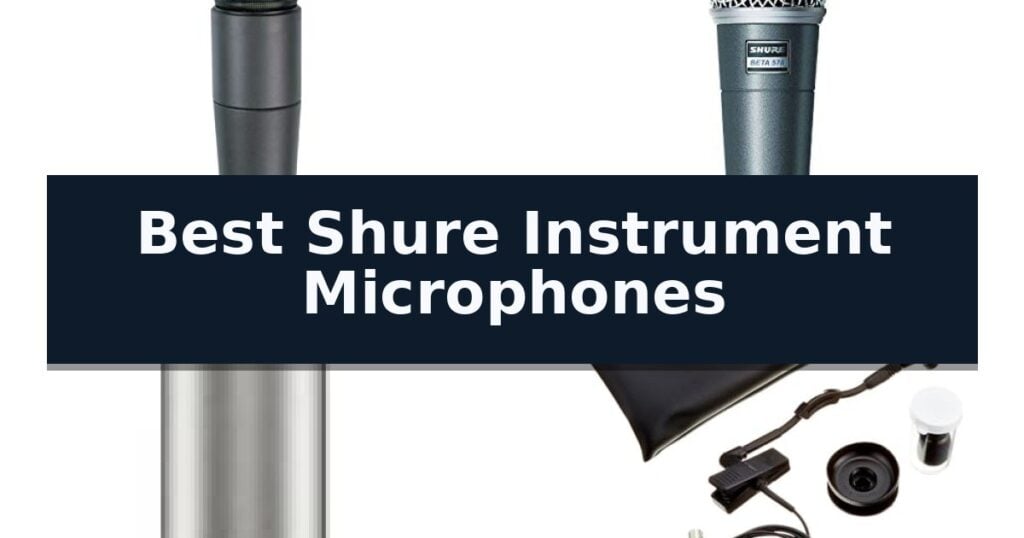
7 Best Shure Instrument Microphones in 2026 Reviews
Quick Comparison
| Product | Best For | Key Strength | Score |
|---|---|---|---|
| Shure SM57 Instrument Microphone | Best Overall | Contoured frequency response enhances instrument attack and clarity. | 4.9 |
| Shure Beta 57A Instrument Microphone | High-output supercardioid precision | High-output neodymium magnet for superior signal-to-noise ratio. | 4.9 |
| Shure SM81 Instrument Microphone | Flat response for acoustic accuracy | Flat frequency response for accurate sound reproduction | 4.8 |
| Shure Beta 98H/C Instrument Microphone | Compact clip-on for brass percussion | High gain-before-feedback design for loud stage environments | 4.6 |
| Shure Beta 91A Instrument Microphone | Low-profile kick drum specialist | Half-cardioid polar pattern provides excellent rejection of off-axis sound. | 4.4 |
| Shure PGA81 Instrument Microphone | Sensitive capture for acoustic sources | Flat-response cartridge for accurate acoustic reproduction. | 4.8 |
| Shure PGA57 Instrument Microphone | Reliable choice for loud cabinets | Tailored cartridge design optimized for clear instrument reproduction. | 4.4 |
How We Chose
To determine the best Shure instrument microphones, we evaluate each model based on its intended recording or live application. We analyze technical specifications such as polar patterns and frequency response to assess how effectively a microphone isolates a sound source, ensuring that the selected tools provide reliable, professional-grade audio capture across diverse musical environments.
- Transducer type (dynamic vs. condenser)
- Polar pattern suitability for the intended sound source
- Maximum sound pressure level (SPL) handling
- Frequency response characteristics for specific instruments
- Build quality and mounting versatility
1 Shure SM57 Instrument Microphone — Industry standard for stage instruments
Achieving professional audio quality in both live and studio environments requires gear that can handle high sound pressure levels while maintaining sonic detail. The Shure SM57 Pro XLR Dynamic Instrument Microphone is engineered with a contoured frequency response and a refined presence boost, specifically designed to enhance the attack and clarity of instruments like snare drums, brass, and guitar amplifiers.
This microphone is widely recognized as a studio and stage staple due to its consistent performance across diverse recording setups. Its precise cardioid pickup pattern is a critical design choice, as it effectively isolates the intended sound source while minimizing background noise and bleed, ensuring a clean capture even in complex, multi-instrument environments.
Built for demanding professional use, the Shure SM57 Pro XLR Dynamic Instrument Microphone features legendary rugged construction that withstands frequent transport and the rigors of daily studio sessions. Its ability to handle high sound pressure levels without distortion makes it a versatile tool for close-miking cabinets and percussion, providing reliable results for various acoustic and amplified sources.
While the microphone is highly adaptable, users should note that it requires an XLR connection to integrate into a standard audio interface or mixing console. With its compact dimensions of 6.19 inches in length and a weight of 0.625 pounds, it remains easy to position in tight spaces, such as between drum hardware or in front of crowded guitar cabinets.
Best for: Musicians and engineers who require a reliable, high-SPL capable microphone for close-miking instruments like drums, percussion, and guitar amplifiers.
Skip if: Users seeking a large-diaphragm condenser microphone for capturing delicate room ambiance or high-frequency detail in vocal performances.
- Contoured frequency response enhances instrument attack and clarity.
- Precise cardioid pattern reduces unwanted background bleed.
- Rugged construction designed for high sound pressure levels and transport.
- Versatile application across drums, brass, and guitar cabinets.
- Requires XLR connectivity and external interface for operation.
- Dynamic design may lack the sensitivity of condenser microphones for subtle acoustic details.
2 Shure Beta 57A Instrument Microphone — High-output supercardioid precision
Capturing the nuance of live performance requires a microphone that balances sensitivity with robust rejection. The Shure Beta 57A Supercardioid Dynamic Instrument Microphone utilizes a high-output neodymium magnet to achieve a superior signal-to-noise ratio, ensuring that delicate instrument transients are preserved without unwanted background interference.
Engineered for versatility, this microphone features a tailored frequency response that delivers studio-quality sound across a wide range of sources, including drums, guitars, and horns. Its uniform supercardioid pattern is particularly effective in demanding live environments, providing high gain-before-feedback while maintaining excellent rejection of off-axis sound.
Durability is central to its design, highlighted by a hardened steel mesh grille that resists wear and abuse during frequent transport and setup. The integrated advanced pneumatic shock mount system further protects the signal by minimizing the transmission of mechanical noise and vibrations, ensuring clean audio capture even when mounted on busy stages.
The package includes essential accessories for immediate deployment, such as the A25D stand adapter, a 5/8” to 3/8” thread adapter, and a storage bag. Because it is minimally affected by varying load impedance, the microphone offers consistent performance across different mixing consoles and preamps, making it a reliable tool for professional sound reinforcement.
Best for: Professional musicians and sound engineers requiring high-gain, feedback-resistant audio capture for drums, guitars, and brass instruments in live settings.
Skip if: Users seeking a large-diaphragm condenser microphone for studio-only vocal recording or those who require a flat, uncolored frequency response for critical acoustic measurement.
- High-output neodymium magnet for superior signal-to-noise ratio.
- Advanced pneumatic shock mount reduces mechanical noise.
- Hardened steel mesh grille provides rugged durability.
- Uniform supercardioid pattern ensures excellent off-axis rejection.
- Supercardioid polar pattern requires precise microphone placement to avoid dead spots.
3 Shure SM81 Instrument Microphone — Flat response for acoustic accuracy
Achieving precise audio capture requires a tool designed for transparency, and the Shure SM81-LC Cardioid Condenser Instrument Microphone is engineered specifically for this purpose. Featuring a flat frequency response curve from 20 Hz to 20 kHz, it provides accurate reproduction of sound sources, making it a staple for recording acoustic guitars, pianos, and cymbals.
This condenser microphone utilizes a cardioid polar pattern that remains uniform with frequency and symmetric about its axis. This design ensures maximum rejection of off-axis sounds, minimizing unwanted coloration in complex recording environments. Its rugged steel construction allows for reliable operation across a wide range of temperature and humidity conditions, ensuring the unit remains stable during demanding sessions.
Performance is supported by low self-noise and a high output clipping level, which helps maintain signal integrity. The microphone includes a selectable low-frequency response with flat, 6 dB/octave, or 18 dB/octave rolloff options to manage proximity effect or rumble. Additionally, a lockable 0 dB/10 dB attenuator switch provides flexibility when capturing high-SPL sound sources.
The Shure SM81-LC requires phantom power, performing optimally with a 48 Vdc supply, though it remains functional with supplies as low as 11 Vdc. It features low RF susceptibility to maintain a clean signal path. Each unit comes with a swivel adapter, attenuator-switch lock, foam windscreen, and a dedicated storage case for protection during transport.
Best for: Professional and home studio recording applications requiring a flat, transparent frequency response for acoustic instruments.
Skip if: Users who do not have access to an audio interface or mixer capable of providing phantom power.
- Flat frequency response for accurate sound reproduction
- Rugged steel construction for long-term durability
- Selectable low-frequency rolloff and lockable attenuator
- Uniform cardioid polar pattern for excellent off-axis rejection
- Requires phantom power to operate
- Sensitivity decreases if phantom power supply is below 48 Vdc
4 Shure Beta 98H/C Instrument Microphone — Compact clip-on for brass percussion
The Shure Wireless BETA 98H/C Microphone is a specialized miniature instrument microphone designed to handle the high sound pressure levels (SPL) generated by brass, woodwind, and percussion instruments. Featuring a flexible gooseneck and a secure clip-on design, it allows for precise positioning on the rim of a drum or the bell of an instrument, effectively reducing stage clutter compared to traditional stand-mounted setups.
Engineered with transformerless preamplifier circuitry, this microphone improves linearity across its entire frequency range, ensuring a clean and accurate signal. Its cardioid polar pattern is specifically tailored to provide high gain-before-feedback, which is essential for maintaining clarity in loud stage environments. The microphone's wide dynamic range ensures it can capture the nuances of an instrument without distortion, even when exposed to extreme volume.
This model is equipped with a TA4F 4-pin mini XLR connector, making it compatible with various Shure wireless bodypack transmitters (sold separately). The interchangeable microphone cartridges offer flexibility, allowing users to swap in different polar patterns if the acoustic requirements of a performance change. Its compact, lightweight construction is built to withstand the rigors of frequent use while remaining unobtrusive during a performance.
While the Shure Wireless BETA 98H/C Microphone excels in high-SPL applications, users should note that it requires a compatible wireless bodypack transmitter to function as a wireless unit. It is a dedicated tool for those who prioritize isolation and mobility on stage, offering a professional-grade solution for instrumentalists who need consistent, studio-quality performance in live settings.
Best for: Professional brass, woodwind, and percussion players who require a secure, low-profile microphone for high-volume live stage performances.
Skip if: Users who do not own a compatible Shure wireless bodypack transmitter or those who prefer a traditional wired XLR microphone setup for studio recording.
- High gain-before-feedback design for loud stage environments
- Transformerless preamplifier for improved frequency linearity
- Compact, clip-on gooseneck design reduces stage clutter
- High maximum SPL handling for brass and percussion
- Wireless bodypack transmitter sold separately
- Requires specific TA4F connection for wireless operation
5 Shure Beta 91A Instrument Microphone — Low-profile kick drum specialist
The Shure Beta 91A Instrument Microphone is specifically engineered for high-pressure sound environments, utilizing a half-cardioid polar pattern to capture kick drums with precision while maximizing gain-before-feedback. By focusing its sensitivity on the source while rejecting off-axis sound, this microphone provides a clean, isolated signal that is essential for complex live stage mixes where bleed from other instruments can compromise clarity.
Designed for seamless integration, the microphone features an integrated preamplifier and an XLR connector built directly into its low-profile housing. This configuration eliminates the need for external mounting hardware or bulky cables, allowing the unit to sit securely inside the drum shell. This streamlined approach significantly reduces stage clutter and simplifies the setup process for sound engineers and drummers alike.
Versatility is provided through a two-position contour switch, which allows users to tailor the frequency response to specific musical requirements. The flat response setting delivers a natural, transparent reproduction of the drum, while the low-mid scoop setting is designed to emphasize a punchy low-end response with enhanced high-frequency attack, making it an adaptable tool for various genres and tuning preferences.
Built for durability and ease of storage, the Shure Beta 91A Instrument Microphone arrives with a dedicated zipper pouch to protect the unit during transport. Its compact dimensions of 10.25 by 3.5 by 5 inches ensure it fits easily within most standard kick drum configurations, providing a reliable, high-SPL solution that maintains consistent performance without requiring additional accessories.
Best for: Professional drummers and sound engineers seeking a low-profile, high-SPL microphone for kick drum applications that minimizes stage clutter.
Skip if: Users who require a traditional stand-mounted microphone or those looking for a multi-purpose vocal microphone will find this specialized kick drum tool less versatile for their needs.
- Half-cardioid polar pattern provides excellent rejection of off-axis sound.
- Low-profile design with integrated preamp eliminates the need for external mounting hardware.
- Two-position contour switch allows for quick adjustments between natural sound and scooped low-mid punch.
- Wide dynamic range engineered specifically for high SPL environments.
- Specialized form factor limits the microphone primarily to kick drum or low-frequency instrument use.
6 Shure PGA81 Instrument Microphone — Sensitive capture for acoustic sources
Capturing the nuanced resonance of acoustic instruments requires a precise approach to sound reproduction, and the Shure PGA81 Instrument Microphone is engineered specifically for this task. Featuring a flat-response microphone cartridge design, this condenser mic provides clear, accurate audio reproduction, making it a reliable tool for sensitive environments where capturing the natural character of an instrument is the priority.
The Shure PGA81 Instrument Microphone utilizes a cardioid polar pattern, which focuses on the intended sound source while effectively rejecting unwanted noise from the sides and rear. This directional capability is essential for isolating acoustic guitars, pianos, or orchestral instruments in busy or live settings, ensuring that the final output remains clean and defined.
Built with an updated industrial design, the microphone features a durable black metallic finish and grille that provides an unobtrusive visual presence on stage or in the studio. Its compact dimensions of 10" W x 3.5" L x 5" H and included stand adapter allow for versatile placement, ensuring it can be easily positioned to suit various instrument configurations.
This model is available in two configurations, including an option with a 15-foot XLR-XLR cable, providing immediate connectivity for most standard audio setups. With a 2-year limited warranty, the unit is designed for consistent use, offering a balanced solution for those seeking a dedicated condenser microphone for acoustic sound reinforcement.
Best for: Musicians and sound engineers who need a precise, flat-response condenser microphone for capturing acoustic instruments in live or studio settings.
Skip if: Users who require a dynamic microphone for high-SPL applications like loud guitar cabinets or drum kits, or those who need a multi-pattern microphone for room recording.
- Flat-response cartridge for accurate acoustic reproduction.
- Cardioid polar pattern minimizes off-axis noise interference.
- Durable black metallic finish for a professional, low-profile aesthetic.
- Includes stand adapter for flexible mounting options.
- Requires phantom power to operate as a condenser microphone.
- Fixed cardioid pattern limits versatility compared to multi-pattern microphones.
7 Shure PGA57 Instrument Microphone — Reliable choice for loud cabinets
Capturing the raw energy of a loud guitar cabinet requires a microphone built to handle high sound pressure levels without compromising clarity. The Shure PGA57 Dynamic Microphone is engineered specifically for this purpose, utilizing a tailored microphone cartridge design that ensures precise reproduction of instruments while maintaining a focused sound profile.
At the heart of its performance is a cardioid polar pattern, which is essential for isolating the intended audio source. By effectively rejecting unwanted noise from the sides and rear, this microphone allows for cleaner recordings in environments where bleed from other instruments or ambient room noise might otherwise interfere with the signal.
The physical construction reflects a focus on professional utility and longevity. Featuring an updated industrial design with a durable black metallic finish and a reinforced grille, the microphone is built to withstand the rigors of frequent use while maintaining an unobtrusive visual presence on stage or in the studio. It includes a stand adapter for secure mounting, ensuring consistent placement during performances.
This model offers flexibility for various setups, as it is available with or without a 15-foot XLR-to-XLR cable. With its standard 3-pin XLR connector, it integrates seamlessly into most professional audio environments, providing a reliable and straightforward solution for capturing drums, percussion, and amplified instruments.
Best for: Musicians and engineers seeking a reliable, cardioid-pattern microphone for capturing loud instrument cabinets and percussion.
Skip if: Users requiring a condenser microphone for high-frequency detail or those needing a multi-pattern microphone for versatile room recording.
- Tailored cartridge design optimized for clear instrument reproduction.
- Cardioid polar pattern effectively rejects off-axis noise.
- Durable industrial design with a robust black metallic finish.
- Includes a stand adapter for stable positioning.
- Fixed cardioid pattern limits use for ambient or stereo recording applications.
Best Shure Instrument Microphones Buying Guide
Dynamic vs. Condenser Transducers
Dynamic microphones are the workhorses of the stage and studio. They are rugged, handle high sound pressure levels without distortion, and generally do not require external power, making them ideal for loud sources like guitar amplifiers and drums.
Condenser microphones, by contrast, use a lightweight diaphragm to capture high-frequency detail and transient response with greater precision. These are typically preferred for acoustic instruments, pianos, and cymbals where capturing subtle nuances is more important than handling extreme volume.
Understanding Polar Patterns
The polar pattern determines how a microphone picks up sound from different directions. Cardioid patterns are the most common, focusing on the front while rejecting sound from the rear, which helps isolate instruments in a busy mix.
Supercardioid patterns offer a tighter focus and even greater rejection of off-axis noise, which is particularly useful in live performance environments where bleed from other instruments or stage monitors can be problematic.
Handling High Sound Pressure Levels
Instruments like kick drums, brass sections, and overdriven guitar cabinets produce intense sound pressure levels that can overwhelm sensitive equipment. Choosing a microphone rated for high SPL ensures the signal remains clean and free of clipping.
Specialized kick drum microphones often feature internal shock mounts and tailored frequency curves to handle these high-energy environments while maintaining a punchy, clear sound that cuts through the mix.
Mounting and Placement Versatility
The physical form factor of a microphone dictates how easily it can be placed in tight spaces. Compact, clip-on microphones are essential for brass and percussion where traditional stands would be cumbersome or intrusive.
For studio setups, the ability to mount a microphone on a standard stand or use a specialized swivel adapter allows for precise positioning. Always check the included accessories to ensure the microphone can be integrated into your existing setup without additional purchases.
Frequency Response and Sound Character
Every microphone has a unique frequency response that colors the sound. Some models are designed to be flat, providing an accurate, transparent reproduction of the source, which is ideal for acoustic instruments.
Other microphones feature a presence boost or a scooped mid-range to help specific instruments stand out. Understanding whether you need a neutral capture or a pre-shaped sound will help you select the right tool for your specific recording goals.
Frequently Asked Questions
Do I need phantom power for all Shure instrument microphones?
No, only condenser microphones require phantom power (typically 48V). Dynamic microphones, such as the SM57, do not require any external power to operate.
Can I use a vocal microphone for instruments?
While some microphones are marketed for vocals, many are versatile enough for instruments. However, dedicated instrument mics are often built to handle higher SPLs and have form factors optimized for tight instrument placement.
What is the difference between the SM57 and the Beta 57A?
The SM57 features a standard cardioid pattern, while the Beta 57A uses a supercardioid pattern and a neodymium magnet for higher output and better rejection of off-axis sound.
Are condenser microphones too fragile for live use?
While condenser microphones are more sensitive than dynamic models, many Shure condenser mics are built with rugged steel construction suitable for professional live environments.
What is the best microphone for a kick drum?
Specialized microphones like the Beta 91A are designed specifically for kick drums, featuring a low-profile design and a frequency response tailored to capture low-end punch and high-frequency attack.
Conclusion: Our Top Pick
Our top pick is Shure SM57 Instrument Microphone. Selecting the right Shure instrument microphone depends on the specific sound source and the environment in which you are recording. By prioritizing the transducer type and polar pattern, you can ensure that your equipment complements the unique characteristics of your instruments.
Whether you need the rugged versatility of the SM57 for daily studio work or the specialized precision of a condenser mic for acoustic accuracy, Shure offers a range of professional solutions. Evaluate your primary use case to choose the model that best supports your audio production needs.