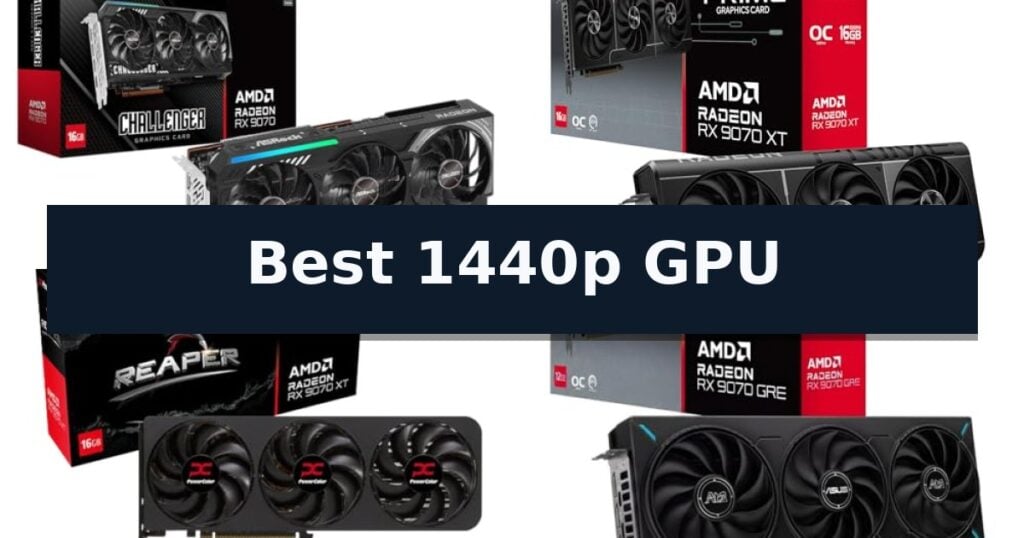
ASRock Radeon RX 9070 Challenger earns our recommendation for the Best 1440p GPU because its 16GB GDDR6 memory and RDNA 4 architecture provide the necessary bandwidth for high-resolution textures and modern ray tracing workloads.
For those prioritizing sustained thermal performance, the ASUS Prime Radeon RX 9070 XT offers specialized axial-tech fans and a dual-BIOS design to manage heat during intense gaming sessions. Meanwhile, the PowerColor Reaper Radeon RX 9070 XT provides a more compact footprint, making it a practical choice for users working within tighter chassis constraints.
Selecting the right card requires balancing your monitor's refresh rate against the GPU's memory buffer and power requirements. While higher boost clocks can improve frame rates, ensuring your power supply unit meets the manufacturer's recommended wattage is essential for system stability.
For those building a new rig, finding the Best 1440p CPU and GPU Combo is essential to avoid bottlenecks. If you are on a tighter budget, our guide on the Best 1440p Budget GPU highlights cost-effective alternatives.
10 Best 1440p GPU in 2026 Reviews
Quick Comparison
| Product | Best For | Key Strength | Score |
|---|---|---|---|
| ASRock Radeon RX 9070 Challenger | Best Overall | 16GB GDDR6 memory provides significant bandwidth for high-resolution textures. | 4.9 |
| ASUS Prime Radeon RX 9070 XT | Reliable cooling for sustained frame rates | Dual BIOS switch for easy toggling between performance and quiet modes | 4.6 |
| PowerColor Reaper Radeon RX 9070 XT | Compact footprint for smaller builds | Compact 289 mm length ideal for smaller PC builds. | 4.7 |
| ASUS ATS Radeon RX 9070 GRE | Balanced performance for high-refresh gaming | Axial-tech fan design increases downward air pressure for improved cooling efficiency. | 4.7 |
| XFX Swift Radeon RX 9060 XT | Triple-fan cooling for quiet operation | 16 GB GDDR6 memory for high-resolution texture handling | 4.8 |
| ASUS Dual Radeon RX 9060 XT | Silent gaming with 0dB technology | 0dB technology enables silent operation during light gaming. | 4.9 |
| ASRock Radeon RX 7700 XT Challenger | Efficient thermal management for gaming | AMD RDNA 3 architecture with dedicated RT+AI accelerators | 4.3 |
| ASUS Prime GeForce RTX 5070 | Small-form-factor enthusiast power | SFF-Ready design optimized for compact build compatibility. | 4.3 |
| PNY GeForce RTX 5060 Ti | Blackwell architecture for modern AI | 16GB GDDR7 memory provides significant bandwidth for high-resolution textures and AI models. | 4.5 |
| ASUS Prime GeForce RTX 5060 Ti | Dual-BIOS flexibility for custom tuning | 2.5-slot design improves compatibility with smaller PC cases. | 4.9 |
How We Chose
Evaluating graphics cards for 1440p gaming requires a focus on sustained performance and hardware compatibility. As an experienced reviewer, I prioritize memory capacity and thermal efficiency to ensure the GPU can handle demanding titles without throttling. These criteria help distinguish cards that offer reliable, high-refresh-rate experiences from those that may struggle under heavy, long-term loads.
- Memory capacity and bandwidth for high-resolution texture loading
- Boost and game clock speeds for frame rate consistency
- Thermal management systems including fan design and heat dissipation
- Physical dimensions and chassis compatibility
- Power delivery requirements and PSU compatibility
1 ASRock Radeon RX 9070 Challenger — High-bandwidth 16GB for 1440p textures
Equipped with the latest AMD RDNA 4 architecture, the ASRock Radeon RX 9070 Challenger is built to handle the demands of high-fidelity gaming at 1440p and 4K resolutions. This card utilizes 56 compute units and 3584 stream processors, supported by 3rd generation ray tracing and 2nd generation AI accelerators to manage complex graphical workloads efficiently.
The card features a factory-overclocked boost clock reaching up to 2520 MHz, ensuring high-framerate performance straight out of the box. With 16GB of GDDR6 memory on a 256-bit bus, it provides the necessary bandwidth for high-resolution textures and intensive ray-tracing scenarios, making it a capable choice for modern gaming environments.
Designed for thermal management, the unit employs a triple-fan cooling system that includes a 0dB silent mode for quiet operation during lighter tasks. The card is a 2.5-slot design measuring 290x123x51mm, which requires users to verify chassis clearance before installation. It also features an integrated LED indicator for status monitoring.
Power delivery is handled via two 8-pin connectors, with a recommended 700W power supply to ensure system stability. This PCIe 5.0 compatible card offers a robust balance of memory capacity and processing power for users looking to upgrade their visual experience.
Best for: Gamers seeking a high-bandwidth 16GB GPU capable of handling demanding 1440p and 4K textures.
Skip if: Users with compact PC chassis that cannot accommodate a 2.5-slot, 290mm long graphics card.
- 16GB GDDR6 memory provides significant bandwidth for high-resolution textures.
- Factory overclocked boost clock up to 2520 MHz for enhanced performance.
- Triple-fan cooling system with 0dB silent mode for effective thermal management.
- Advanced AMD RDNA 4 architecture with dedicated ray tracing and AI accelerators.
- Requires a 700W power supply and specific chassis clearance due to its 2.5-slot size.
2 ASUS Prime Radeon RX 9070 XT — Reliable cooling for sustained frame rates
Maintaining high frame rates at 1440p resolution requires a graphics card that balances thermal efficiency with raw processing power. The ASUS Prime Radeon RX 9070 XT addresses this through a specialized 2.5-slot design that optimizes build compatibility without sacrificing cooling capacity, making it a versatile choice for various desktop configurations.
At the heart of its cooling system, the card utilizes Axial-tech fans engineered with a smaller hub and a barrier ring to increase downward air pressure. This is complemented by a phase-change GPU thermal pad, which is designed to improve heat transfer and lower operating temperatures. For users who prioritize a quiet environment, the 0dB technology allows for silent operation during light gaming sessions.
Performance customization is managed via the GPU Tweak III software, which provides granular control over thermal settings and monitoring. The card features a Dual BIOS switch, allowing users to toggle between Quiet and Performance profiles depending on their immediate needs. With an OC mode capable of reaching a 3030 MHz boost clock, it offers significant headroom for demanding titles.
Built for longevity and precision, the unit is constructed using an Auto-Extreme manufacturing process and features dual-ball fan bearings that are rated to last up to twice as long as conventional sleeve bearing designs. These features collectively ensure that the ASUS Prime Radeon RX 9070 XT remains a reliable component for sustained high-resolution gaming.
Best for: Gamers seeking a reliable, cool-running GPU for 1440p performance with flexible thermal and noise profiles.
Skip if: Users with extremely compact small-form-factor cases that cannot accommodate a 12.3-inch length or a 2.5-slot thickness.
- Dual BIOS switch for easy toggling between performance and quiet modes
- Axial-tech fans with barrier rings for improved airflow
- Phase-change thermal pad for efficient heat dissipation
- Auto-Extreme manufacturing for enhanced build precision
- 12.3-inch length may limit compatibility in smaller PC chassis
3 PowerColor Reaper Radeon RX 9070 XT — Compact footprint for smaller builds
When space is at a premium, the PowerColor Reaper Radeon RX 9070 XT offers a streamlined solution for high-resolution gaming. Measuring just 289 mm in length, this card is engineered to fit into smaller chassis configurations where traditional, bulkier GPUs might struggle to find clearance. By prioritizing a compact 289 x 111 x 41 mm footprint, this model provides a practical path for enthusiasts building high-performance systems within confined physical constraints without sacrificing essential connectivity.
Under the hood, this model is equipped with 16GB of GDDR6 memory, providing the capacity required for modern graphical demands at 1440p. This memory overhead is critical for handling high-resolution textures and complex assets in contemporary titles. Connectivity is handled by a versatile array of ports, including one HDMI 2.1 and three DisplayPort 2.1 outputs, ensuring compatibility with a wide range of current high-refresh-rate monitors.
Power delivery is managed via two 8-pin PCI Express power connectors, and the manufacturer specifies a minimum system power requirement of 750W. This ensures the card receives stable current during intensive graphical tasks. Users should verify their power supply unit meets this threshold before installation to ensure system stability. The reliance on dual 8-pin connectors necessitates careful cable management, particularly in the smaller cases this card is designed to inhabit.
This GPU remains a focused choice for those who need to balance raw graphical output with the physical limitations of their PC case. While it demands a robust power supply, its ability to deliver 1440p gaming performance in a reduced-length form factor makes it a specialized tool for space-conscious builders.
Best for: Gamers who require a high-performance 1440p GPU that fits into compact or space-constrained PC cases.
Skip if: Users with small-form-factor power supplies under 750W or those who prefer massive, triple-fan cooling solutions that prioritize aesthetics over space-saving dimensions.
- Compact 289 mm length ideal for smaller PC builds.
- 16GB GDDR6 memory provides ample overhead for 1440p gaming.
- Versatile connectivity with three DisplayPort 2.1 and one HDMI 2.1 port.
- 750W minimum power requirement may necessitate a PSU upgrade for some users.
- Two 8-pin power connectors require specific cable management in tight spaces.
4 ASUS ATS Radeon RX 9070 GRE — Balanced performance for high-refresh gaming
Achieving consistent frame rates at 1440p resolution requires a card that balances thermal efficiency with raw processing power. The ASUS ATS Radeon RX 9070 GRE addresses this through a specialized 2.5-slot design that optimizes internal airflow without requiring an oversized chassis footprint, making it a practical choice for standard mid-tower builds.
At the heart of its cooling system are Axial-tech fans engineered with a smaller hub and a barrier ring. This configuration is designed to increase downward air pressure, forcing more cool air through the heatsink. To maintain long-term reliability, the fans utilize dual-ball fan bearings, which are rated to last up to twice as long as conventional sleeve bearing designs, while 0dB technology allows the fans to remain idle during light workloads for silent operation.
Performance tuning is handled via GPU Tweak III software, which provides granular control over the card's boost clocks, reaching up to 2880 MHz in OC mode. The unit also features a phase-change GPU thermal pad to facilitate efficient heat transfer, alongside a Dual BIOS switch that allows users to toggle between Quiet and Performance profiles depending on their immediate thermal or acoustic preferences.
Built using an Auto-Extreme manufacturing process, the card emphasizes precision and consistency in its construction. Its inclusion of PCIe 5.0 support and HDMI/DP 2.1 connectivity ensures that it remains compatible with modern display standards and high-bandwidth interfaces, providing a robust foundation for high-refresh gaming setups.
Best for: Gamers seeking a balance of high-refresh 1440p performance and a compact 2.5-slot cooling solution for standard PC cases.
Skip if: Users requiring specialized small-form-factor builds that cannot accommodate a 12-inch long graphics card.
- Axial-tech fan design increases downward air pressure for improved cooling efficiency.
- Dual-ball fan bearings offer enhanced longevity compared to standard sleeve designs.
- Dual BIOS switch allows for quick toggling between performance and acoustic profiles.
- 2.5-slot thickness provides a balance between thermal performance and build compatibility.
- 12-inch length may limit compatibility with smaller micro-ATX or ITX cases.
5 XFX Swift Radeon RX 9060 XT — Triple-fan cooling for quiet operation
Maintaining high frame rates at higher resolutions requires a GPU capable of handling demanding graphical loads without sacrificing thermal efficiency. The XFX Swift AMD Radeon RX 9060 XT addresses this with its integrated XFX SWFT Triple Fan Cooling Solution, which is specifically engineered to manage heat output during extended gaming sessions. By utilizing three fans, the card increases airflow across the heatsink, allowing the hardware to maintain stability even when pushing high-resolution textures in modern titles.
Built around the AMD RX 9060 XT chipset, this card provides 16 GB of GDDR6 memory. This substantial memory capacity is a significant advantage for users who frequently engage in complex rendering tasks or play games that require loading large, high-fidelity texture assets into the frame buffer. The architecture supports a Boost Clock Up to 3320 MHz, providing the high-frequency throughput necessary to sustain consistent performance during intensive gameplay scenarios.
The physical design of the card measures approximately 11.4 inches in length. This footprint necessitates a chassis with adequate internal clearance to accommodate the triple-fan configuration, making it essential for users to verify their case dimensions before installation. For connectivity, the card features one HDMI port and two DisplayPort outputs, facilitating multi-monitor setups that are common in high-end desktop environments.
This graphics card serves as a robust option for users prioritizing cooling performance and memory overhead for 1440p gaming. With a 3 Year Manufacturer warranty, it provides long-term support for those looking to integrate a reliable graphics solution into their desktop PC builds. While the large size requires careful planning, the combination of high-speed memory and active thermal management makes it a capable choice for demanding visual workloads.
Best for: Gamers seeking a high-memory, triple-fan cooling solution for consistent 1440p performance.
Skip if: Users with compact PC cases that cannot accommodate an 11.4-inch triple-fan graphics card.
- 16 GB GDDR6 memory for high-resolution texture handling
- XFX SWFT Triple Fan design for improved thermal management
- High Boost Clock Up to 3320 MHz for demanding applications
- Includes 3 Year Manufacturer warranty
- Large physical footprint may not fit in smaller PC cases
6 ASUS Dual Radeon RX 9060 XT — Silent gaming with 0dB technology
Selecting a graphics card for 1440p gaming requires balancing thermal efficiency with raw clock speed to maintain consistent frame rates. The ASUS Dual Radeon RX 9060 XT addresses this by utilizing a specialized 2.5-slot design, which optimizes the balance between chassis compatibility and cooling surface area.
At the heart of its performance is the Axial-tech fan array. These fans feature a smaller hub to accommodate longer blades, further supported by a barrier ring that increases downward air pressure to keep the GPU cool during intensive sessions. For those who prioritize a quiet environment, the integrated 0dB technology allows the fans to remain idle during light workloads, ensuring silent operation when high performance is not required.
Customization is a key aspect of this model, provided through a Dual BIOS switch. This allows users to toggle between Quiet and Performance profiles depending on their specific needs. The card also features Dual ball fan bearings, which are engineered to last up to twice as long as traditional sleeve bearing designs, contributing to long-term reliability.
Technical flexibility is further enhanced by the GPU Tweak III software, which enables users to engage an OC mode for a boost clock of up to 3250 MHz. With support for PCIe 5.0, HDMI 2.1b, and DisplayPort 2.1a, this card is equipped to handle modern display standards, making it a versatile choice for high-resolution gaming setups.
Best for: Gamers seeking a balance of silent operation and high-clock performance in a compact, 2.5-slot form factor.
Skip if: Users requiring a multi-fan flagship design for extreme overclocking or those with very small form factor cases that cannot accommodate a 2.5-slot thickness.
- 0dB technology enables silent operation during light gaming.
- Dual BIOS switch allows for easy toggling between performance and quiet profiles.
- Axial-tech fans improve downward air pressure for better cooling.
- Dual ball fan bearings provide increased longevity compared to sleeve designs.
- 2.5-slot thickness may limit compatibility in ultra-compact PC builds.
7 ASRock Radeon RX 7700 XT Challenger — Efficient thermal management for gaming
Achieving smooth frame rates at high resolutions requires a graphics card capable of balancing raw compute power with efficient thermal management. The ASRock Radeon RX 7700 XT Challenger addresses this demand by utilizing the AMD RDNA 3 architecture, which integrates 54 Compute Units and dedicated RT+AI Accelerators to handle modern gaming workloads.
Performance is driven by a Boost Clock up to 2584 MHz, ensuring responsiveness in demanding titles. To minimize latency, the card features 12GB of GDDR6 memory on a 192-bit bus, complemented by 48MB of AMD Infinity Cache. This configuration is specifically tuned to maintain stability and speed when rendering complex scenes at 1440p.
The hardware design focuses on sustained operation through a Dual Fan cooling system equipped with Striped Ring Fans and Ultra-fit Heatpipe technology. For quieter environments, the 0dB Silent Cooling feature keeps the fans inactive during light tasks or idle states. The unit is reinforced by a stylish metal backplate, which provides structural rigidity while assisting in heat dissipation.
Connectivity is handled by three DisplayPort 2.1 ports and one HDMI 2.1 port, supporting high-refresh-rate monitors. Because this card requires dual 8-pin power connectors and specific chassis clearance, users must verify their power supply and case dimensions before installation to ensure a proper fit.
Best for: Gamers seeking a dedicated 1440p performance solution with efficient thermal management in a dual-fan form factor.
Skip if: Users with compact ITX cases or limited power supply capacity should choose a more power-efficient or smaller-profile card.
- AMD RDNA 3 architecture with dedicated RT+AI accelerators
- 0dB Silent Cooling for quiet operation during light workloads
- Durable metal backplate for structural support and heat dissipation
- Modern DisplayPort 2.1 connectivity for high-refresh-rate monitors
- Requires dual 8-pin power connectors and sufficient chassis space
- Not compatible with all pre-built systems due to power and size constraints
8 ASUS Prime GeForce RTX 5070 — Small-form-factor enthusiast power
The ASUS Prime GeForce RTX 5070 is engineered for enthusiasts who prioritize space efficiency without sacrificing graphical capability. By utilizing a 2.5-slot design, this card offers a balance between robust cooling performance and the physical constraints required for small-form-factor (SFF) builds, making it a versatile choice for compact desktop configurations.
At the heart of its performance is the NVIDIA Blackwell architecture, which supports DLSS 4 for advanced rendering. The cooling system features Axial-tech fans designed with a smaller hub to accommodate longer blades, paired with a barrier ring that effectively increases downward air pressure. This airflow management is complemented by a phase-change GPU thermal pad, which facilitates efficient heat transfer to maintain reliability during intensive gaming sessions.
Connectivity is future-proofed with PCIe 5.0 support and HDMI/DP 2.1 outputs, ensuring compatibility with modern high-bandwidth displays. The card also includes Dual BIOS functionality, allowing users to toggle between performance profiles. Backed by a 3-year warranty, this unit is built to provide consistent operation in constrained chassis environments.
While the ASUS Prime GeForce RTX 5070 excels in SFF compatibility, its 12GB of GDDR7 memory is specifically optimized for high-fidelity 1440p gaming. The card's dimensions—measuring 12 inches in length and 5 inches in width—are designed to fit within standard SFF-Ready enclosures, though users should verify their specific case clearance before installation.
Best for: Enthusiasts building high-performance, small-form-factor PCs who require a compact yet powerful GPU for 1440p gaming.
Skip if: Users with full-tower cases who prioritize maximum multi-fan cooling arrays or those requiring higher VRAM capacities for professional-grade 4K rendering workloads.
- SFF-Ready design optimized for compact build compatibility.
- Axial-tech fans with barrier rings for increased air pressure.
- Phase-change thermal pad for improved heat transfer.
- PCIe 5.0 and DLSS 4 support for modern architecture.
- 12GB GDDR7 memory may be a limiting factor for extreme 4K resolution tasks.
- 2.5-slot thickness requires specific case clearance in ultra-compact builds.
9 PNY GeForce RTX 5060 Ti — Blackwell architecture for modern AI
Modern gaming and creative workflows demand hardware that balances raw processing power with physical space constraints. The PNY NVIDIA GeForce RTX™ 5060 Ti 16GB OC Dual-Fan Graphics Card addresses this by integrating the advanced NVIDIA Blackwell architecture into a compact, dual-slot form factor, making it a versatile choice for high-resolution setups.
Equipped with 16GB of GDDR7 memory and a 448 GB/s bandwidth, this card is engineered to handle high-fidelity textures at 1440p resolution and complex AI-driven tasks. The inclusion of 5th-Gen Tensor Cores and 4th-Gen Ray Tracing Cores provides the necessary overhead for demanding visual rendering and neural shader optimization.
Thermal management is handled by a dual-fan cooling system paired with a dense heatsink and a vented metal backplate. This design promotes efficient heat dissipation while reinforcing the card's structural integrity to prevent sagging. The SFF-Ready build ensures compatibility with smaller chassis without sacrificing the thermal headroom required to maintain high boost clocks.
Users can utilize the VelocityX Software to manage performance metrics, including custom fan curves and core clock adjustments. With support for up to five saved profiles, the interface allows for quick transitions between different workloads, whether for gaming or intensive creative production.
Best for: Gamers and creators requiring a compact, SFF-ready GPU with high memory capacity for 1440p gaming and AI applications.
Skip if: Users who require a full-length, triple-fan cooling solution or have specific needs for connectivity beyond the provided HDMI/DP 2.1 ports.
- 16GB GDDR7 memory provides significant bandwidth for high-resolution textures and AI models.
- Compact dual-fan design is SFF-ready and suitable for space-constrained builds.
- Vented metal backplate offers passive cooling and structural reinforcement.
- VelocityX Software allows for detailed performance tuning and profile management.
- Dual-fan cooling may not provide the same thermal dissipation as larger, triple-fan alternatives in extreme overclocking scenarios.
10 ASUS Prime GeForce RTX 5060 Ti — Dual-BIOS flexibility for custom tuning
The ASUS Prime GeForce RTX 5060 Ti is engineered for users prioritizing build compatibility and thermal efficiency, featuring a compact 2.5-slot design that fits into a wider range of chassis configurations. This card leverages the NVIDIA Blackwell architecture to deliver significant processing power, highlighted by an AI performance rating of 758 AI TOPS.
Cooling is managed by Axial-tech fans, which utilize a smaller fan hub to accommodate longer blades and a barrier ring designed to increase downward air pressure. For longevity, the unit incorporates dual-ball fan bearings that are rated to last up to twice as long as standard sleeve bearings, while 0dB technology allows for silent operation during light workloads.
Customization is a core component of this model, offering a Dual BIOS switch that lets users toggle between Quiet and Performance profiles to balance acoustics and clock speeds. The card is built using the Auto-Extreme manufacturing process, which automates production for increased precision, and it includes a reinforced metal backplate to provide structural rigidity and protection.
Users can further refine their experience using GPU Tweak III software, which provides tools for performance tuning, thermal monitoring, and system management. With PCIe 5.0 support and HDMI/DP 2.1 connectivity, this graphics card is designed to handle modern display standards and high-bandwidth data transfers.
Best for: Enthusiasts seeking a compact, SFF-ready GPU that balances thermal performance with customizable BIOS profiles.
Skip if: Users requiring maximum multi-monitor connectivity or extreme overclocking headroom may find the 2.5-slot form factor and standard power delivery insufficient compared to larger, triple-fan flagship models.
- 2.5-slot design improves compatibility with smaller PC cases.
- Dual BIOS switch allows for easy toggling between performance and quiet modes.
- Axial-tech fans with dual-ball bearings enhance cooling efficiency and durability.
- Auto-Extreme manufacturing ensures high build precision.
- Limited slot thickness may restrict cooling capacity compared to larger 3-slot designs.
- SFF-focused form factor might not appeal to users with large tower cases seeking maximum thermal dissipation.
Best 1440p GPU Buying Guide
VRAM and Texture Performance
Modern 1440p gaming relies heavily on video memory to manage high-resolution assets and complex lighting effects. A 16GB frame buffer is increasingly standard, providing enough headroom to avoid stuttering in titles that demand massive texture streaming.
When choosing a card, consider that lower VRAM configurations may require you to reduce texture settings to maintain smooth performance. Prioritizing a card with at least 12GB to 16GB ensures your system remains capable as game requirements evolve.
Thermal Management and Cooling
Graphics cards generate significant heat during extended gaming sessions, which can lead to clock speed throttling if not properly managed. Triple-fan designs generally offer more surface area for heat dissipation, though they require more space inside your case.
Look for features like axial-tech fans or phase-change thermal pads, which are designed to maintain lower operating temperatures. These additions help the card sustain its maximum boost clock for longer periods, preventing performance dips during critical gameplay moments.
Chassis Clearance and Compatibility
Before purchasing, verify the physical dimensions of the GPU against your computer case's maximum clearance. Many high-performance cards feature 2.5-slot or 3-slot designs that can obstruct other motherboard components or simply fail to fit in compact builds.
Always check the length and width specifications provided by the manufacturer. If you are using a small-form-factor case, prioritize models specifically labeled for compact compatibility to avoid installation issues.
Power Supply Requirements
High-end GPUs require stable power delivery to function correctly, often necessitating specific wattage ratings for your power supply unit. Using a PSU that falls below the manufacturer's recommendation can lead to system crashes or unexpected shutdowns under load.
Check the number and type of power connectors required by the card, such as dual 8-pin inputs. Ensure your existing power supply has the necessary cables and sufficient overhead to handle transient power spikes during demanding gaming sequences.
Clock Speeds and Overclocking
Factory-overclocked cards come with higher boost clocks out of the box, providing a slight performance advantage over reference models. These cards are tuned for higher speeds, which can translate to more consistent frame rates in competitive titles.
While factory tuning is convenient, consider whether the cooling solution is robust enough to support those higher speeds. A card with a dual-BIOS switch can also offer flexibility, allowing you to toggle between a quiet profile and a performance-focused mode.
Frequently Asked Questions
Does 1440p gaming require 16GB of VRAM?
While 12GB is often sufficient for many current titles at 1440p, 16GB provides better future-proofing for games with high-resolution textures and advanced ray tracing.
How do I know if a GPU will fit in my case?
Compare the length, width, and slot-thickness dimensions of the GPU against your case manufacturer's specifications for maximum GPU clearance.
What happens if my PSU is below the recommended wattage?
Insufficient power can cause system instability, random reboots, or failure to boot entirely when the GPU draws peak power during intensive gaming.
Are triple-fan cards always better than dual-fan cards?
Triple-fan cards typically offer better thermal headroom, but dual-fan cards are often more compatible with smaller cases and can still provide excellent cooling if designed well.
What is the benefit of a dual-BIOS switch?
A dual-BIOS switch allows you to choose between different performance profiles, such as a 'Quiet' mode for low-noise operation or a 'Performance' mode for maximum clock speeds.
Conclusion: Our Top Pick
Choosing the right 1440p GPU involves balancing your specific case constraints with the need for reliable thermal performance and sufficient memory. By focusing on cards that match your power supply capabilities and physical space, you ensure a stable and responsive gaming experience.
Whether you prioritize the high-bandwidth capacity of the ASRock Radeon RX 9070 Challenger or the compact flexibility of other models, matching your hardware to your resolution goals is the key to long-term satisfaction.