Novation 61SL MkIII MIDI Controller is our top choice for the Best Semi-Weighted 61-Key MIDI Controller, offering a highly playable, sprung-action keybed designed for the needs of experienced players. For those prioritizing expressive performance features like polyphonic aftertouch, the Korg Keystage 61 serves as a strong alternative, while the M-Audio Oxygen Pro 61 provides a robust, tactile-focused solution for users who rely heavily on faders and knobs for virtual instrument control.
Selecting a controller in this category requires balancing the physical feel of the keys against the depth of software integration. Semi-weighted action occupies a middle ground, providing enough resistance for expressive piano-style playing while remaining light enough for rapid synth-lead lines and drum programming.
Beyond the keys, the connectivity options determine how well the controller fits into your existing setup. Whether you are routing MIDI through a computer or managing external hardware synthesizers, the ability to synchronize clocks and map parameters directly to your DAW is essential for a seamless production workflow.
For those seeking more advanced studio setups, our guide on Best Professional MIDI Controllers explores high-end options that offer even greater hardware integration.
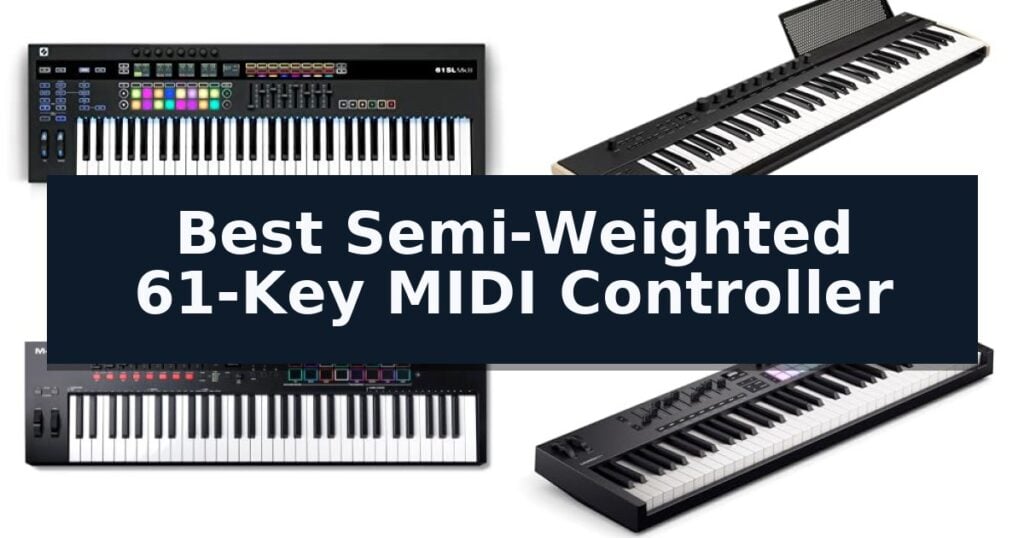
9 Best Semi-Weighted 61-Key MIDI Controller in 2026 Reviews
Quick Comparison
| Product | Best For | Key Strength | Score |
|---|---|---|---|
| Novation 61SL MkIII MIDI Controller | Best Overall | Advanced hardware integration with CV/Gate and MIDI connectivity. | 4.9 |
| Korg Keystage 61 MIDI Controller | Polyphonic Aftertouch for Expressive Play | Polyphonic Aftertouch and MPE compatibility for superior expressive control. | 4.7 |
| M-Audio Oxygen Pro 61 MIDI Controller | Tactile Control for Virtual Instruments | Semi-weighted keys with aftertouch for expressive performance. | 4.5 |
| Novation Launchkey 61 MK4 MIDI Controller | Deep DAW Integration for Producers | Polyphonic aftertouch on FSR pads for advanced expression | 4.4 |
| Nektar Impact GXP61 MIDI Controller | Premium Feel with Aftertouch | Semi-weighted keybed with aftertouch for expressive performance. | 4.4 |
| M-Audio Keystation 61 MK3 MIDI Controller | Simple Plug-and-Play Workflow | 61 full-size semi-weighted keys provide a natural, expressive feel. | 4.6 |
| Arturia KeyLab Essential 61 mk3 | Versatile Software-Focused Control | Extensive tactile controls including 9 faders and 9 encoders for deep parameter mapping. | 4.3 |
| Novation FLkey 2 61 MIDI Controller | Dedicated Workflow for FL Studio | Deep FL Studio integration for seamless control over mixing and sequencing. | 4.7 |
| Midiplus X6 Pro MIDI Controller | Built-in Sounds for Standalone Use | Built-in 128 GM standard sounds for standalone performance | 4.8 |
How We Chose
Selecting the right semi-weighted 61-key MIDI controller involves evaluating how the hardware bridges the gap between your physical performance and digital production environment. We focus on keybed mechanics, the efficiency of DAW communication, and the versatility of onboard control surfaces to ensure each model provides a reliable, high-performance foundation for your studio.
- Keybed responsiveness and physical resistance profile
- Depth of native DAW integration and parameter mapping
- Hardware connectivity options including MIDI I/O and CV/Gate
- Availability of performance tools like arpeggiators and scale modes
- Tactile control surface layout and build quality
1 Novation 61SL MkIII MIDI Controller — Advanced Hardware and CV Integration
The Novation 61SL MkIII MIDI Controller distinguishes itself through a comprehensive internal eight-track polyphonic pattern-based sequencer, allowing users to manage both MIDI hardware and CV/Gate synthesizers without needing a computer. This integration capability is supported by a robust set of physical connections, including MIDI I/O, CV/Gate outputs, and an analog clock out, ensuring all equipment stays synchronized.
Designed with the experienced player in mind, the unit features a high-quality synth-style semi-weighted keybed with a specifically tuned sprung action. The interface is built for deep software interaction, utilizing five color LCD screens that provide real-time parameter feedback, which is particularly effective for users working within Ableton Live or other major DAWs like Logic, Reason, Cubase, and Pro Tools.
The controller acts as a central hub for complex setups, offering a routable clock that manages timing for both in-the-box and external hardware. Its build emphasizes hardware control, enabling users to map and manipulate parameters directly from the keyboard, reducing the need to navigate software menus during performance or production sessions.
Measuring 38.62 inches in width and weighing 14.42 pounds, the device provides a stable platform for studio environments. While it offers extensive connectivity for legacy and modern gear, users should ensure their workspace can accommodate its physical footprint and that their specific hardware supports the provided CV/Gate and MIDI connectivity standards.
Best for: Producers and live performers who require a central hardware hub to bridge MIDI, CV/Gate, and DAW-based workflows.
Skip if: Users who prefer a lightweight, compact controller for travel or those who do not utilize external hardware synthesizers or modular gear.
- Advanced hardware integration with CV/Gate and MIDI connectivity.
- Internal 8-track sequencer for standalone pattern creation.
- High-quality semi-weighted keybed tuned for expressive performance.
- Deep DAW integration with visual feedback via five LCD screens.
- Substantial physical footprint may require significant desk space.
- Complexity of features may exceed the needs of simple MIDI input users.
2 Korg Keystage 61 MIDI Controller — Polyphonic Aftertouch for Expressive Play
Achieving nuanced control over virtual instruments requires more than just keys; it demands a tactile interface that responds to the player's touch. The Korg Keystage 61 MIDI Controller distinguishes itself by incorporating a 61-key semi-weighted keybed that supports both Polyphonic and Channel Aftertouch, alongside MPE compatibility for high-level expressive performance.
Beyond its keybed, the unit is engineered for a streamlined studio and stage workflow. It features parameter-dedicated OLED screens that provide immediate visual feedback, reducing the need to look at a computer monitor during a session. The inclusion of a built-in audio interface with direct stereo output further simplifies live setups, allowing for a more compact and efficient performance rig.
Integration is a core focus of this controller, utilizing MIDI 2.0 Property Exchange for seamless communication with compatible software. It offers native integration with Ableton Live, ensuring that transport controls and device parameters are ready for use immediately upon connection. The hardware is reinforced with durable wood side panels, balancing a professional aesthetic with the physical requirements of transport and live use.
The package is rounded out by a comprehensive software bundle, including Korg Gadget Producer Bundle, wavestate native LE, and Ableton Live 11 Lite. By combining advanced touch sensitivity with deep software integration, the Korg Keystage 61 MIDI Controller serves as a versatile hub for producers who prioritize expressive control and efficient hardware-to-software communication.
Best for: Producers and live performers who require MPE compatibility and polyphonic aftertouch for highly expressive synthesizer and virtual instrument control.
Skip if: Users who prefer a fully weighted, hammer-action keybed for authentic piano-style resistance will find the semi-weighted action of this controller less suitable for their needs.
- Polyphonic Aftertouch and MPE compatibility for superior expressive control.
- OLED screens provide clear, parameter-specific visual feedback.
- Built-in audio interface simplifies live performance connectivity.
- MIDI 2.0 Property Exchange ensures advanced, seamless integration with modern software.
- Semi-weighted keybed may not satisfy players seeking a traditional weighted piano feel.
3 M-Audio Oxygen Pro 61 MIDI Controller — Tactile Control for Virtual Instruments
The M-AUDIO Oxygen Pro 61 MIDI Controller provides a comprehensive tactile interface for music production, centered around 61 velocity-sensitive, semi-weighted keys that include aftertouch and assignable zones. This configuration allows for expressive control over virtual instruments and synthesizers, making it a functional centerpiece for studio setups.
Beyond the keybed, the unit features 16 RGB backlit, velocity-sensitive drum pads equipped with Note Repeat, which are designed for beat production and clip launching. These pads are complemented by a suite of assignable hardware controls, including 8 knobs and buttons, plus 9 faders, providing direct manipulation of DAW parameters and effect plugins.
Integration is a primary focus, highlighted by Native Kontrol Standard (NKS) support. This partnership with Native Instruments enables users to browse and manage presets directly from the keyboard. The controller also includes a choice of three curated Komplete 15 Select bundles—Beats, Band, or Electronic—to expand sound libraries immediately upon setup.
Built for versatility, the controller measures 40.48 inches in height and weighs 10.58 pounds. It is designed to serve as a central hub for digital audio workstations, offering a balance between deep software integration and physical, hands-on control for both studio recording and live performance environments.
Best for: Producers and keyboardists who require deep DAW integration and tactile control over virtual instruments.
Skip if: Users who prefer a compact, portable controller with fewer physical faders and knobs will find the size and feature set excessive.
- Semi-weighted keys with aftertouch for expressive performance.
- Native Kontrol Standard (NKS) integration for streamlined preset management.
- Extensive tactile control via 9 faders, 8 knobs, and 16 drum pads.
- Bundled software including curated Komplete 15 Select options.
- Larger physical footprint compared to minimalist MIDI controllers.
- Weight of 10.58 pounds may limit portability for some users.
4 Novation Launchkey 61 MK4 MIDI Controller — Deep DAW Integration for Producers
The Novation Launchkey 61 MK4 MIDI Controller prioritizes tactile control by pairing a premium semi-weighted keybed with 16 FSR-based drum pads that feature polyphonic aftertouch. This design choice allows for nuanced expression, enabling users to trigger chords, launch clips, or perform complex step sequencing directly from the hardware interface.
Engineered for deep DAW integration, the controller provides native support for major software including Ableton Live, Logic, Cubase, and FL Studio. The inclusion of nine faders and dedicated pitch and mod wheels ensures that essential mixing and modulation tasks remain accessible without constant mouse interaction. An integrated OLED display provides real-time feedback, streamlining navigation through settings and parameters.
Beyond its core performance capabilities, the unit includes creative tools such as Scale Mode and arpeggiators to assist in composition. The hardware is also NKS-ready, facilitating a streamlined workflow when using Native Instruments software. Connectivity is handled via USB-C, ensuring modern compatibility with current studio setups.
The package includes a comprehensive software bundle featuring Ableton Live Lite, Cubase LE, and various sound libraries from GForce, Klevgrand, and Orchestral Tools. With a 3-year warranty and a robust build measuring 35.2 inches in length, this controller serves as a centralized hub for production environments requiring a balance of playability and software control.
Best for: Producers and keyboardists who require deep DAW integration and expressive, polyphonic aftertouch-enabled pads for complex performance and sequencing.
Skip if: Users who prioritize a fully weighted hammer-action keybed for authentic piano simulation will find the semi-weighted action insufficient for their needs.
- Polyphonic aftertouch on FSR pads for advanced expression
- Seamless DAW integration with major software platforms
- NKS-ready for optimized control of Native Instruments software
- Comprehensive software bundle included for immediate production
- Semi-weighted keybed may not satisfy players seeking a traditional weighted piano feel
5 Nektar Impact GXP61 MIDI Controller — Premium Feel with Aftertouch
The Nektar Impact GXP61 MIDI Controller distinguishes itself through a focus on expressive performance, featuring 61 premium quality semi-weighted, velocity-sensitive keys. This controller is designed for musicians who require a tactile, responsive interface, incorporating aftertouch for added modulation control alongside dedicated pitch bend and modulation wheels.
Beyond its core keyboard action, the unit provides extensive hardware control options, including octave and transpose buttons, as well as dedicated sustain and expression pedal sockets. Connectivity is handled via a standard MIDI 5-pin output, ensuring compatibility with a wide range of external hardware and software setups. The controller is fully compatible with both Mac and PC environments.
Workflow efficiency is a primary design goal, evidenced by integrated Nektar DAW support for major software applications. The inclusion of Nektarine PlugIn Control allows for detailed management of virtual instruments and effects directly from the keyboard. To assist with immediate production, the package includes Cubase LE DAW, the Retrologue 2 VSTi, and a comprehensive sound content package.
Measuring 38 inches in width and weighing approximately 11 pounds, the Nektar Impact GXP61 MIDI Controller offers a stable footprint for studio environments. Its semi-weighted keybed strikes a balance between the light feel of synth-action keys and the resistance found in weighted piano actions, making it a versatile choice for various performance styles.
Best for: Musicians and producers seeking a tactile, semi-weighted keybed with aftertouch and deep DAW integration for studio production.
Skip if: Users requiring a compact, portable controller for mobile setups or those who prefer a lightweight, synth-action keybed.
- Semi-weighted keybed with aftertouch for expressive performance.
- Integrated Nektar DAW support and Nektarine PlugIn Control.
- Includes Cubase LE and Retrologue 2 software bundle.
- Dedicated MIDI 5-pin output for hardware connectivity.
- Larger footprint may not suit cramped desk spaces.
- Heavier build compared to ultra-portable MIDI controllers.
6 M-Audio Keystation 61 MK3 MIDI Controller — Simple Plug-and-Play Workflow
Achieving expressive control over virtual instruments requires a reliable interface that balances tactile feedback with desk space. The M-AUDIO Keystation 61 MK3 USB MIDI Controller is designed to bridge this gap by offering 61 full-size, velocity-sensitive semi-weighted keys that provide a natural resistance, allowing for nuanced performance across various musical styles.
Beyond the keybed, this controller functions as a central hub for studio workflows. It features dedicated transport and directional buttons for seamless software integration, alongside ergonomically positioned pitch and modulation wheels. These controls, combined with an octave up/down range, ensure that players have immediate access to the parameters necessary for dynamic compositions.
Connectivity is straightforward with a plug-and-play USB interface that requires no additional drivers or external power supplies for Mac or PC users. For those working in mobile environments, the unit maintains compatibility with iOS devices when paired with an Apple to USB Camera Adapter. Its compact footprint makes it an efficient addition to any studio or stage setup.
The package includes a comprehensive software suite, featuring Ableton Live Lite and MPC Beats, alongside virtual instruments like Velvet and Mini Grand. To assist in skill development, the controller also provides access to free online lessons from Skoove and Melodics, supporting both beginners and experienced players in refining their technique.
Best for: Producers and keyboardists who need a compact, semi-weighted 61-key controller with essential transport controls for a streamlined studio workflow.
Skip if: Users who require advanced features like built-in arpeggiators, motorized faders, or fully weighted hammer-action keys will find this model too basic for their needs.
- 61 full-size semi-weighted keys provide a natural, expressive feel.
- Plug-and-play USB connectivity eliminates the need for drivers or external power.
- Comprehensive software bundle includes DAWs and virtual instruments for immediate production.
- Integrated transport and directional controls simplify software navigation.
- Lacks advanced performance features such as built-in sequencers or drum pads.
- No dedicated MIDI DIN output for hardware-only setups.
7 Arturia KeyLab Essential 61 mk3 — Versatile Software-Focused Control
Integrating a MIDI controller into a studio setup requires a balance of tactile control and software integration. The Arturia KeyLab Essential 61 mk3 addresses this by combining a 61-key hybrid-feel keybed with an extensive array of assignable hardware, including 9 encoders, 9 faders, and 8 multi-purpose performance pads.
Designed for seamless music production, this controller features a DAW Command Center that supports custom scripts and MCU/HUI protocols. This allows users to manage transport functions like play, record, and metronome toggling directly from the hardware, reducing the need to reach for a mouse during creative sessions.
The unit includes a vivid display with contextual buttons for swift preset browsing and parameter adjustments. To support immediate creative output, it ships with a comprehensive software package, including Analog Lab V, Ableton Live Lite, UVI Model D, and NI’s The Gentleman, providing a wide range of vintage and modern sounds out of the box.
Durability and sustainability are central to its construction, utilizing a minimum of 40% recycled plastic in its chassis. The Arturia KeyLab Essential 61 mk3 is built for longevity and includes a 2-year warranty, ensuring a reliable hub for studio workflows while maintaining an eco-conscious design profile.
Best for: Producers seeking a deep-integration controller with extensive tactile faders and encoders for hands-on DAW control.
Skip if: Users who require fully weighted hammer-action keys for authentic piano-style playing feel.
- Extensive tactile controls including 9 faders and 9 encoders for deep parameter mapping.
- Deep DAW integration via custom scripts and MCU/HUI support.
- Comprehensive software bundle included for immediate production capability.
- Eco-friendly construction using at least 40% recycled plastic.
- Semi-weighted keybed may not satisfy users looking for a traditional piano-weighted feel.
8 Novation FLkey 2 61 MIDI Controller — Dedicated Workflow for FL Studio
The Novation FLkey 2 61 MIDI Controller is engineered specifically for FL Studio workflows, offering deep integration that allows producers to control instruments, sequences, and mix parameters directly from the hardware. With its 61 semi-weighted keys, this controller provides a tactile, responsive surface for sketching melodies and basslines, while the pitch and modulation wheels add essential expressive control to any performance.
Beyond its keyboard, the unit features 16 velocity-sensitive pads designed for precise finger drumming and step sequencing within the Channel Rack. The hardware layout includes eight dedicated knobs and nine precision faders, providing immediate access to mixer levels, filters, and effects without needing to reach for a mouse. An integrated OLED display keeps track of settings, ensuring that navigation remains intuitive during complex sessions.
For those looking to streamline their composition process, the controller includes built-in Scale and Chord modes, alongside a powerful arpeggiator. These tools allow users to generate complex chord progressions and patterns without relying on external software packs. The device connects via USB-C and includes a 5-pin MIDI out port for expanded connectivity with external hardware.
The package includes a comprehensive software bundle, featuring six months of FL Studio Producer Edition, Novation Play, and various partner instruments and effects. Measuring 35.24 inches in width and weighing approximately 10.6 pounds, the Novation FLkey 2 61 MIDI Controller is built to serve as a central hub for studio production, backed by a 3-year warranty.
Best for: Producers who use FL Studio as their primary DAW and require a dedicated, tactile interface for sequencing, mixing, and performance.
Skip if: Users who primarily work in DAWs other than FL Studio may find the dedicated integration features less beneficial compared to a universal MIDI controller.
- Deep FL Studio integration for seamless control over mixing and sequencing.
- 61 semi-weighted keys provide a balanced feel for both melody and bassline creation.
- Comprehensive hardware controls including 16 pads, 8 knobs, and 9 faders.
- Built-in creative modes like Scale, Chord, and Arpeggiator for rapid composition.
- Workflow is optimized for FL Studio, which may limit utility in other software environments.
9 Midiplus X6 Pro MIDI Controller — Built-in Sounds for Standalone Use
The Midiplus X6 Pro USB MIDI Keyboard Controller distinguishes itself from standard controllers by incorporating 128 high-quality GM standard sounds, allowing for standalone use without a constant connection to a computer. This 61-key instrument provides a versatile foundation for both studio production and live performance scenarios.
Equipped with 61 full-size semi-weighted velocity keys, the controller offers a tactile response suitable for expressive playing. The inclusion of 9 editable knob controllers with backlighting provides immediate visual feedback and hands-on control over parameters, while the 8 groups of adjustable velocity curves allow players to tailor the keyboard sensitivity to their specific playing style.
Measuring 35 inches in length and weighing 11 pounds, the unit maintains a manageable footprint for most desk setups. Its dual functionality as both a MIDI interface and a sound module makes it a practical choice for musicians who require a portable, all-in-one solution for composition and practice.
While the semi-weighted action provides a middle ground between synth-action and fully weighted piano keys, users should verify their specific requirements for keybed feel. The integration of built-in sounds simplifies the workflow for those who want to play immediately upon power-up, though it remains a fully capable controller for DAW-based environments.
Best for: Musicians who need a portable 61-key controller that functions as both a MIDI interface and a standalone sound module.
Skip if: Users who require a fully weighted, hammer-action keybed for authentic acoustic piano simulation will find the semi-weighted action insufficient.
- Built-in 128 GM standard sounds for standalone performance
- 9 editable, backlit knobs for real-time parameter control
- 8 selectable velocity curves to customize touch sensitivity
- 61 full-size semi-weighted keys providing a balanced playing feel
- Semi-weighted action may not satisfy players seeking a heavy, acoustic-style piano touch
Best Semi-Weighted 61-Key MIDI Controller Buying Guide
Keybed Feel and Performance
The primary distinction in this category is the quality of the semi-weighted action. A well-tuned keybed provides enough mechanical resistance to allow for nuanced dynamic control, which is critical for playing virtual pianos and orchestral libraries effectively.
Experienced players should look for consistent spring tension across the entire key range. While synth-style actions are often lighter, a high-quality semi-weighted bed should feel substantial enough to prevent accidental triggering while remaining fast enough for complex arpeggios.
DAW Integration and Workflow
Modern MIDI controllers are designed to minimize the time spent using a mouse. Look for models that offer deep, native integration with your specific DAW, as this allows for automatic mapping of transport controls, mixer faders, and device parameters.
Visual feedback is equally important for maintaining a fast workflow. Controllers that feature OLED or LCD screens allow you to monitor parameter changes and preset names directly on the hardware, keeping your focus on the music rather than the computer monitor.
Hardware Connectivity and Sequencing
If your studio includes hardware synthesizers or modular gear, connectivity becomes a deciding factor. Controllers with dedicated 5-pin MIDI outputs, CV/Gate outputs, and analog clock synchronization allow you to control external instruments without needing a computer interface.
Internal sequencers provide an additional layer of creative freedom. By using the controller's built-in pattern-based sequencing, you can build complex arrangements and trigger external gear independently, turning the keyboard into the central hub of your entire hardware ecosystem.
Tactile Control Surfaces
The inclusion of faders, knobs, and pads significantly impacts how you interact with virtual instruments. Faders are particularly useful for real-time automation of volume or filter sweeps, while assignable knobs allow for precise control over plugin parameters.
Velocity-sensitive pads are essential for finger drumming and clip launching. When evaluating these, consider the responsiveness and the presence of features like note repeat or polyphonic aftertouch, which can add significant depth to your beat-making process.
Build Quality and Longevity
A MIDI controller is a long-term investment that should withstand daily use. Look for robust chassis construction and high-quality components, particularly for the pitch and modulation wheels, which are among the most frequently used parts of the interface.
Consider the environmental impact and materials used in manufacturing. Some modern controllers utilize recycled plastics and eco-friendly packaging, which can be a factor for environmentally conscious producers without compromising the structural integrity of the device.
Frequently Asked Questions
What is the difference between synth-action and semi-weighted keys?
Synth-action keys are typically unweighted and very light, designed for fast playing. Semi-weighted keys add a small amount of resistance and mass, providing a more piano-like feel that is better for dynamic control.
Do I need a MIDI controller with CV/Gate outputs?
You only need CV/Gate outputs if you intend to control analog synthesizers or modular Eurorack gear. If you work exclusively 'in the box' with software plugins, standard USB-MIDI connectivity is sufficient.
Can I use these controllers with any DAW?
Yes, all MIDI controllers are compatible with any DAW that accepts standard MIDI input. However, some models offer deeper, pre-mapped integration for specific software like Ableton Live or FL Studio, which simplifies the setup process.
What is polyphonic aftertouch?
Polyphonic aftertouch allows you to send unique pressure data for each individual key you are holding down. This enables expressive control over specific notes in a chord, which is not possible with standard channel aftertouch.
Are these controllers powered by USB?
Most modern 61-key MIDI controllers are USB-bus powered, meaning they draw power directly from your computer. Some larger units may require an external power supply if you are using them in standalone mode without a computer.
Conclusion: Our Top Pick
Our top pick is Novation 61SL MkIII MIDI Controller. Choosing the right semi-weighted 61-key MIDI controller depends on whether you prioritize deep hardware sequencing, expressive performance features, or streamlined DAW control. By focusing on the keybed feel and the specific connectivity needs of your studio, you can select a tool that enhances your creative process.
Evaluate your current setup to determine if you need advanced features like CV/Gate integration or if a simpler, software-focused controller will better serve your production style. Investing in a unit that matches your workflow ensures that your controller remains a central, reliable part of your music-making for years to come.